What Is a DC-DC Converter in an Electric Car?
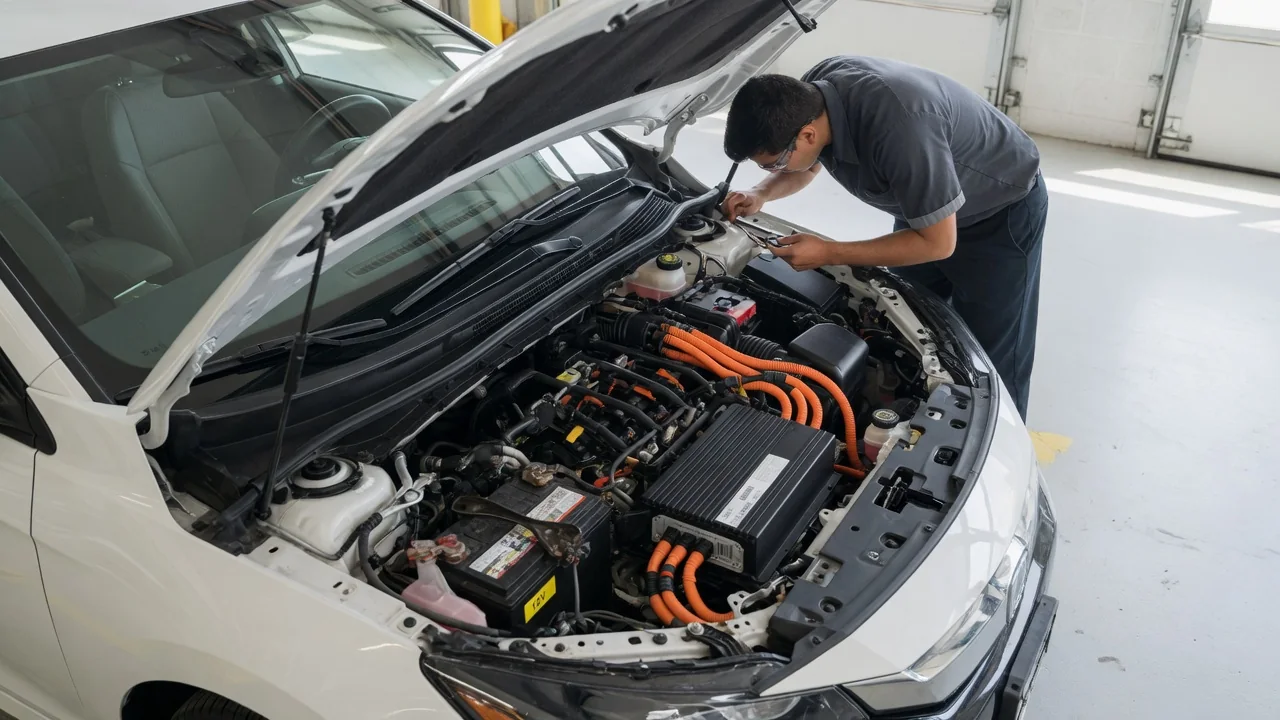
Anyone asking what is a DC-DC converter in an electric car is really asking how one battery pack can run both a powerful drive motor and a set of ordinary headlights. The converter is the electronic bridge between those two worlds. It takes high-voltage direct current from the traction battery and steps it down to the low voltage that the vehicle's accessories and control modules need.
Energy path
Energy in an electric car starts at the traction battery, which stores direct current at several hundred volts on most designs. That level suits the inverter and drive motor, but it would destroy a radio, a window switch, or a body control module. The DC-DC converter sits on a branch of the high-voltage circuit, draws a small share of pack energy, and delivers it at a much lower voltage to the conventional electrical system that runs through the rest of the vehicle.
Inside the unit, power transistors switch the incoming current on and off very rapidly, a transformer lowers the voltage while keeping the two circuits electrically isolated, and rectifier and filter stages smooth the output back into steady direct current. Because this process produces heat, many converters share a liquid cooling loop with other power electronics. Packaging differs widely: some manufacturers build it as a standalone box, while others combine it with the onboard charger or power distribution hardware in a single housing.
12-volt support
In a gasoline car, a belt-driven alternator keeps the low-voltage battery charged and supplies the accessories while the engine runs. An electric car has no engine to spin an alternator, so the DC-DC converter does that job instead. Whenever the vehicle is switched on, it feeds the lights, wipers, infotainment, power steering assistance, door locks, and the many computers that manage the car, while also topping up the small auxiliary battery.
That auxiliary battery still matters because it wakes the car up. The contactors that connect the traction pack are closed by low-voltage controls, so a healthy high-voltage pack cannot help if the small battery is flat. Once the contactors close, the converter takes over the load. Auxiliary battery chemistry varies by manufacturer, with some using traditional lead-acid units and others lithium-based ones, and a few vehicles use a higher low-voltage standard than the familiar twelve volts.
Failure clues
When a converter stops delivering enough output, the symptoms often resemble a failing alternator in a conventional car. A low-voltage battery warning may appear, interior or exterior lights may dim, screens can reset, and the vehicle may eventually refuse to enter its ready-to-drive state. An auxiliary battery that keeps going flat despite regular driving is another hint, because the converter should be replenishing it whenever the car is active.
These signs are not conclusive on their own. An aged auxiliary battery, a corroded ground connection, a blown fuse, a coolant flow problem, or a software fault can produce very similar behavior. Stored fault codes help narrow the search, but a code describes a condition a module detected rather than proving a specific part has failed. Many of these codes are manufacturer-specific, so their meaning should be confirmed against information for the exact vehicle before drawing conclusions.
Everyday Use and Observations
In normal driving the converter is invisible. It makes no sound a driver would notice, has no dashboard gauge of its own on most cars, and adjusts its output automatically as loads change. Turning on the heated seats, rear defroster, and headlights together simply makes it work harder. The energy involved comes from the traction battery, so heavy accessory use trims driving range slightly, though the effect is small compared with propulsion or cabin heating.
Some behaviors become noticeable once an owner knows what to look for. Many electric cars periodically wake the converter while parked or charging to keep the auxiliary battery topped up, which can explain faint clicks or coolant pump noise from a stationary vehicle. Others only maintain the small battery when switched on or plugged in. Because these strategies differ between manufacturers and can change with software updates, the owner's manual is the best guide to what counts as normal.
Limits and Next Steps
A DC-DC converter has a finite output rating, sized for the factory electrical load with some margin. Adding high-draw aftermarket equipment such as large audio amplifiers, auxiliary lighting, or power inverters can exceed what the system was designed to supply and may drain the auxiliary battery faster than it can be replenished. It also cannot rescue a deeply discharged or worn-out auxiliary battery indefinitely, since that battery must still hold enough charge to start the car's systems.
If low-voltage problems appear, checking the auxiliary battery's condition is a sensible and safe first step, as it is the most accessible component involved. Anything beyond that belongs with a technician trained on high-voltage systems, because the converter connects directly to circuits carrying dangerous energy, typically identified by orange cabling. Proper diagnosis involves scan-tool data, measured output under load, and vehicle-specific service information rather than guesswork or part swapping.