What Is a CVT Variator? Pulleys, Belt or Chain, and Control Explained
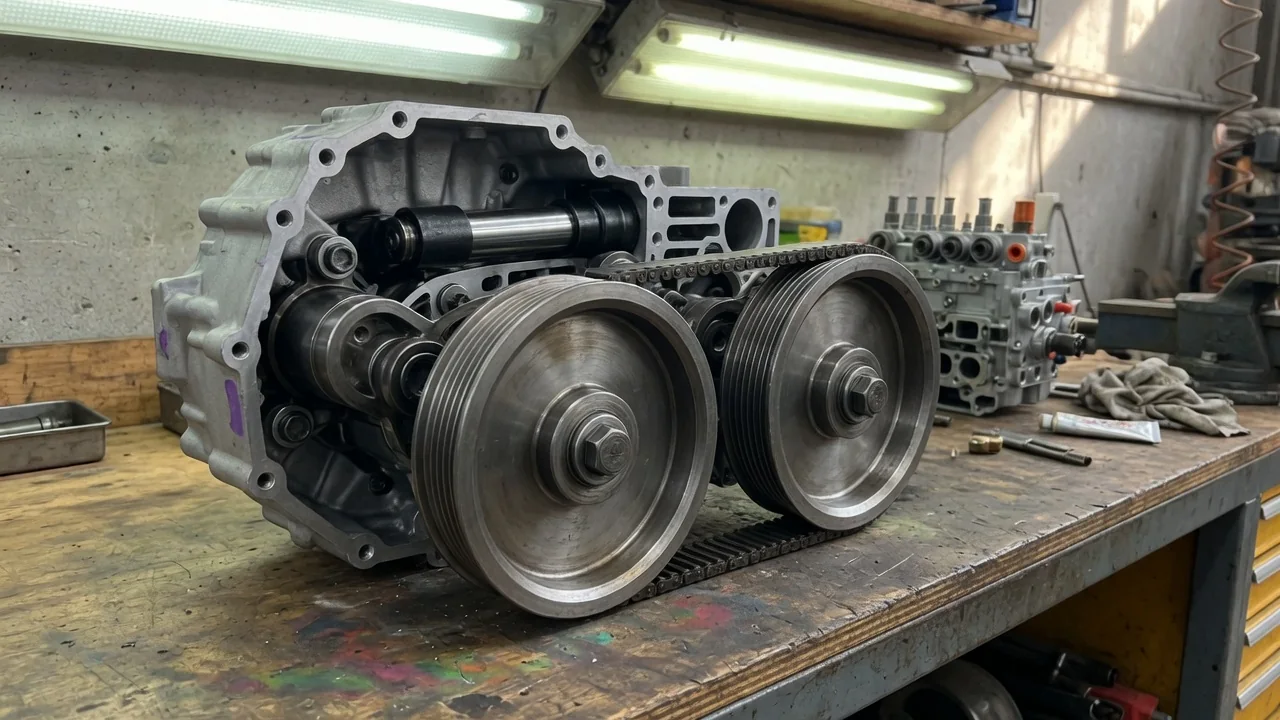
A continuously variable transmission does not use a fixed set of gears to change ratios. Instead, it relies on a variator, the assembly that changes the drive ratio smoothly between its lowest and highest limits. In most automotive CVTs, the variator is a pair of adjustable pulleys linked by a steel belt or chain and managed by a hydraulic system and a control unit. Understanding these three parts explains how a CVT behaves and why it needs specific care.
Variable pulley diameter
Each pulley in a CVT pulley variator consists of two cone-shaped halves, called sheaves, that face each other to form a V-shaped groove. One sheave is fixed to its shaft, and the other can slide along it. When the movable sheave moves toward the fixed one, the groove narrows and the belt is pushed outward to a larger working radius. When the movable sheave moves away, the groove widens and the belt drops closer to the shaft, running at a smaller radius. The pulley does not physically grow or shrink. What changes is the effective diameter at which the belt or chain runs.
The variator uses two of these assemblies. The primary, or drive, pulley receives power from the engine, usually through a launch device such as a torque converter or clutch. The secondary, or driven, pulley sends power toward the final drive and the wheels. Because the belt has a fixed length, the two pulleys work in opposition: as the effective diameter of one increases, the other decreases. A small drive diameter paired with a large driven diameter gives a low ratio for pulling away and climbing. The reverse arrangement gives a tall, overdrive-like ratio for relaxed cruising at lower engine speed.
Since the movable sheaves can sit at any position between their mechanical stops, the ratio can take any value inside that range instead of jumping between fixed steps. That is the core meaning of continuously variable. The range itself is finite and set by the pulley geometry, so a CVT still has a defined lowest and highest ratio, just with no gaps in between.
Belt or chain
The element that links the two pulleys must carry engine torque while being gripped only by the sheave faces. In most passenger-car CVTs this is either a steel push belt or a steel chain, not the rubber belts used on scooters, snowmobiles and other light vehicles. Both metal designs run in a lubricated environment and transmit power through friction between their contact flanks and the sheave surfaces, with the transmission fluid playing an important role in that contact.
A steel push belt is made of many thin steel elements, sometimes called blocks or segments, held in line by sets of thin, flexible steel bands. The bands keep the elements together, while the elements carry the load by pressing against each other as they travel from the drive pulley to the driven pulley. This is why such a belt is often described as one that pushes rather than pulls. A chain-type variator instead uses linked plates joined by pins or rocker pieces. The ends of those pins contact the sheaves, and the chain transmits force in tension, more like a conventional chain drive.
Each design involves trade-offs in noise, packaging, torque capacity and manufacturing, and the choice belongs to the transmission designer. For an owner, the shared principle matters more: the belt or chain must be clamped firmly enough to prevent slip, because slip across the sheave faces wears both the belt or chain and the pulley surfaces. That makes clamping force and fluid condition central to variator durability.
Control
The movable sheaves are positioned by hydraulic pressure. Each movable sheave is backed by a piston chamber, and the valve body directs pressurized fluid from the transmission oil pump into these chambers. In many designs the secondary pulley also uses a spring to help maintain clamping. Two jobs happen at the same time: setting the ratio by moving the sheaves, and setting the clamping force that keeps the belt or chain from slipping. Too little force risks slip, while too much wastes energy and adds load on components.
A transmission control unit decides what the hydraulics should do. It typically uses inputs such as accelerator position, vehicle speed, engine speed and the rotational speeds of both pulleys, then commands solenoids in the valve body to adjust pressures. Comparing pulley speeds lets the controller calculate the actual ratio and correct it toward its target. Because the ratio is not tied to fixed gears, software can hold engine speed near a chosen point while road speed changes, or let it rise smoothly when the driver asks for strong acceleration.
Control strategy is where vehicle behavior differs most. Some calibrations keep engine speed fairly steady during acceleration, while others imitate stepped shifts, often called simulated or virtual gears, to feel more familiar. Manual modes, where fitted, select preset ratio points. These behaviors come from programming, not from a different variator principle, so they vary by manufacturer and model. Reverse and launch are handled elsewhere in the transmission, typically by a planetary gearset with clutches and a torque converter or launch clutch, because the variator itself does not reverse rotation or disconnect the engine from the wheels at a stop.
Practical implications and limits
For drivers, the most noticeable effect is the absence of distinct shift points. Engine speed can stay level while the car gains speed, which some people describe as a disconnected or rubber-band feeling, especially under heavy throttle. That sensation is normal operating behavior rather than a sign of trouble. Keeping the engine near efficient speeds more of the time is one of the design goals of a CVT, though real fuel economy depends on the whole vehicle and its calibration.
Because the variator depends on friction and precise hydraulic pressure, fluid matters more than in many other transmissions. CVTs generally require a fluid formulated for their specific friction characteristics, and the owner's manual or service information specifies the correct type and service interval. An incorrect fluid, a low level or contaminated fluid can affect clamping and accelerate wear. Symptoms that may point to a variator or control problem include whining, shudder, delayed response, engine speed flaring without matching acceleration, or warning lights. The same symptoms can also come from other systems, so proper diagnosis is needed before conclusions are drawn.
The variator also has load limits set by its torque capacity and clamping design. Towing capacity, if any, and guidance on sustained heavy loads come from the specific vehicle's documentation, not from general rules. Repair approaches differ as well: some manufacturers support component-level service, while others treat the transmission as a replaceable assembly. When in doubt, the vehicle's service information is the reference for what is permitted, what is normal and what needs attention.