What Is a CVT in a Car?
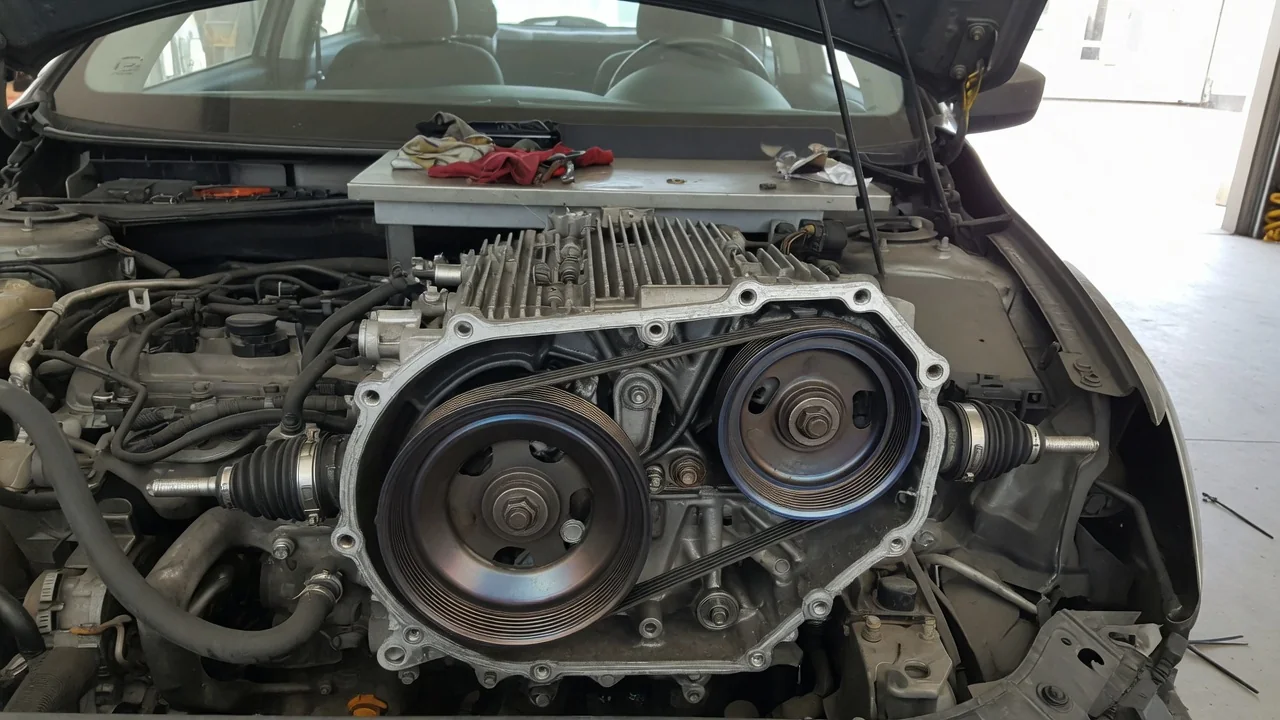
If you have ever wondered what is a CVT in a car, the short answer is that it is a continuously variable transmission: an automatic gearbox that does not step through a fixed set of gears. Instead, it slides smoothly through an unbroken range of ratios, keeping the engine in a useful speed range while the vehicle accelerates, cruises or climbs.
Pulleys or alternatives
The most common design uses two cone-faced pulleys connected by a steel belt or chain. One pulley is driven by the engine and the other sends power toward the wheels. Each pulley is made of two halves that can move closer together or farther apart, which changes the diameter the belt rides on. When the drive pulley runs small and the driven pulley runs large, the car has a low ratio for pulling away. Reverse those diameters and the ratio becomes tall for relaxed highway cruising.
Not every continuously variable transmission relies on a belt. Many hybrids use an electronically controlled arrangement in which a planetary gearset blends power from the engine and electric motors, producing a seamless ratio change with no belt at all. Some designs add a conventional launch gear for pulling away from a stop before handing over to the belt, and a few have used rollers and discs instead of pulleys. Which layout a particular vehicle uses depends on the manufacturer and model, so the owner's manual is the reliable reference.
Engine response
Because the ratio can change without interruption, the engine no longer has to rise and fall in speed with each gear change. Press the accelerator firmly and the transmission moves toward a lower ratio, letting the engine climb to a speed where it makes strong power and then hold there while road speed catches up. Under light throttle, the opposite happens: the ratio lengthens and the engine settles to a low, quiet speed. The control unit is constantly balancing demand from the pedal against efficiency.
This behavior explains the sensation some drivers describe as a rubber-band effect, where engine sound rises quickly and the car's speed follows a moment later. The tachometer may hover at one reading during hard acceleration rather than sweeping up and dropping back. To make this feel more familiar, many manufacturers program simulated shift points that mimic stepped gears under heavy throttle, and some offer paddle shifters or a manual mode with preset ratios. How pronounced these traits are varies considerably between brands, engines and model years.
Service context
A belt or chain CVT depends heavily on its fluid. The fluid does more than lubricate; it provides the hydraulic pressure that clamps the pulleys and it has friction properties that allow the belt to grip the pulley faces without slipping. For that reason, these transmissions generally call for a dedicated fluid specified by the manufacturer, and ordinary automatic transmission fluid is not an assumed substitute. Change intervals and the correct fluid type differ by vehicle, so the maintenance schedule for the specific model is what matters.
When a warning light appears and a scan tool retrieves a transmission-related fault code, that code is a starting point for diagnosis rather than proof that a component has failed. Codes pointing to ratio errors or pressure concerns can stem from fluid condition, sensors, wiring, software or internal wear, and many are manufacturer-specific, meaning their exact meaning has to be confirmed against information for that vehicle. A technician with the right data and equipment can check fluid level and condition, look for software updates and test the system before any parts are replaced.
Everyday Use and Observations
In daily driving, a healthy CVT is mostly notable for what is missing. There are no shift shocks in stop-and-go traffic, no hunting between gears on a gentle grade, and no pause while the transmission decides to downshift for a pass. Acceleration feels like one continuous surge. At a steady highway speed, the engine often turns slowly because the transmission can choose a very tall ratio, which is one reason this design is popular in fuel-economy-focused compact cars, crossovers and hybrids.
Drivers can also learn what is normal for their own car by paying attention. A steady engine drone during a long uphill merge is typical, as is a faint whine from some belt-driven units. Changes from that baseline deserve notice: a shudder when pulling away, a sudden flare in engine speed without matching acceleration, hesitation, new noises or a reduced-power mode. Selector positions vary too, with some vehicles offering a low range or an engine-braking setting for descents, so the labels on the shifter are worth reading against the manual.
Limits and Next Steps
A CVT has limits like any transmission. The belt and pulleys transmit power through friction under high clamping force, so heat is the main enemy. Sustained heavy loads, steep climbs with a full cabin, or towing beyond what the manufacturer permits can raise fluid temperature, and some vehicles will reduce power to protect themselves. Towing ratings, where towing is approved at all, are specific to each model. Drivers who prefer crisp, distinct gear changes may also simply find the driving character less engaging.
For anyone shopping for or already owning a CVT-equipped vehicle, the practical next steps are straightforward. Confirm which type of transmission the car actually has, since a hybrid's electronic unit and a belt-driven unit have different needs. Read the maintenance schedule for fluid service guidance, and ask for service records when buying used. During a test drive, check for smooth takeoff and consistent response. If a warning light or unusual behavior shows up, have the vehicle inspected promptly rather than continuing to drive on a developing problem.