What Is a CV Axle and What Does It Do?
What is the direct answer to my question?
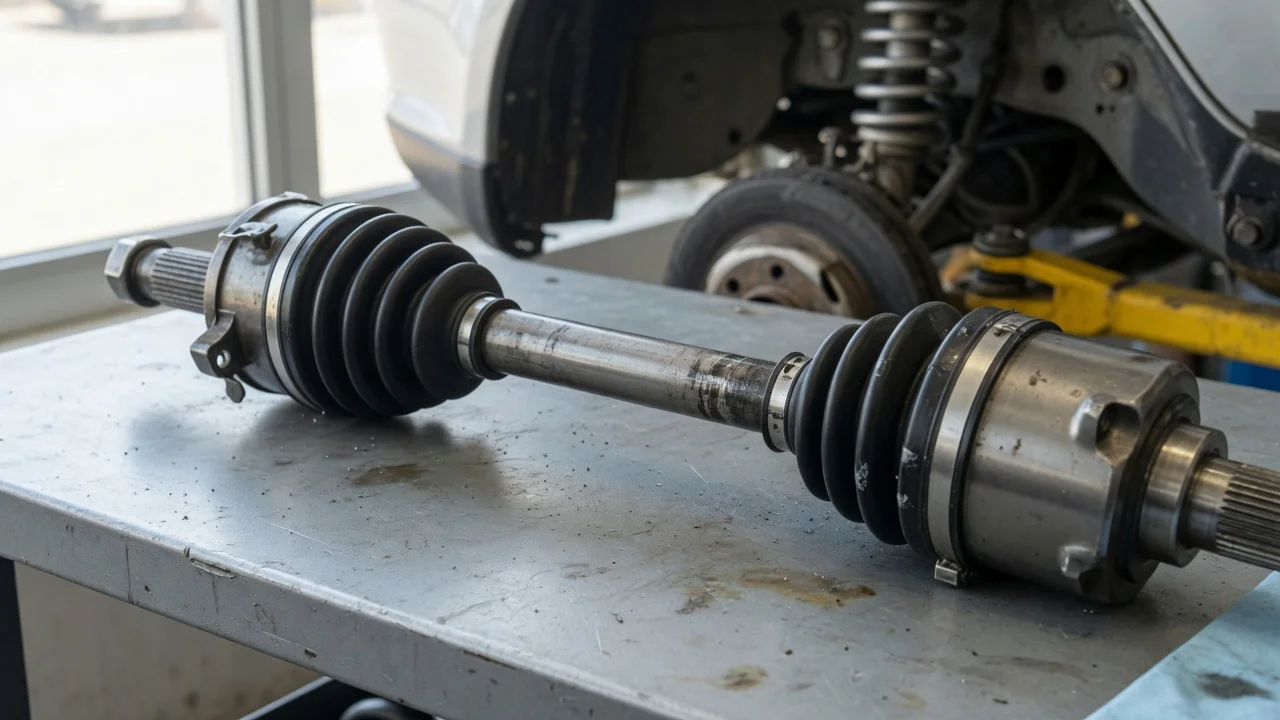
A CV axle is an axle shaft with constant velocity joints at one or both ends. It connects the transaxle or differential to the wheel hub and transmits engine torque to the drive wheels while allowing the shaft to keep turning smoothly as the suspension moves up and down and the front wheels steer. The abbreviation CV stands for constant velocity, which describes how the outboard joint maintains a steady rotational speed even when the joint is operating at an angle. On many passenger vehicles, especially front-wheel-drive cars, the term CV axle is used interchangeably with driveshaft or half shaft, but the constant velocity joint is the feature that distinguishes this assembly from a simple solid axle shaft.
What does it do, and how does it work?
The CV axle closes the gap between two points that are not rigidly aligned: the transmission or transaxle, which is mounted to the vehicle body or subframe, and the wheel hub, which moves with the suspension and steering. The engine creates rotational power that passes through the transmission to the transaxle or differential. The inboard end of the CV axle receives that rotation, carries it along the axle shaft, and delivers it to the wheel hub through the outboard CV joint.
Because the wheel hub moves through its suspension travel and, on a steered axle, changes angle with the steering wheel, the connection cannot be a fixed straight shaft. Each CV joint contains bearings, a cage, and a set of grooves or races that permit rotational force to be transmitted smoothly through a range of angles. The inboard joint usually accommodates suspension travel and small axial changes in shaft length, while the outboard joint handles the larger angles created by steering.
Main parts of a CV axle assembly
A replacement CV axle is often sold as a complete assembly so the installer does not have to rebuild the joints. The main components are:
Outboard CV joint: the joint at the wheel side, designed to handle steering angle while transmitting torque. Inboard CV joint: the joint at the transmission or transaxle side, designed to allow suspension movement and small length changes. Axle shaft: the solid or tubular shaft between the two joints that carries rotational force. Protective boots: flexible rubber or thermoplastic covers at each joint that retain grease and keep out dirt, water, and debris. Splines: grooved ends that engage the wheel hub and the transaxle or differential. Retaining components: clips or rings that help hold the axle in position at each connection.
Where CV axles are used
CV axles are most commonly associated with front-wheel-drive vehicles, where the same axle must deliver power and allow steering. They are also used on the front axle of all-wheel-drive vehicles, on independent rear suspensions in rear-wheel-drive and all-wheel-drive configurations, and on some four-wheel-drive vehicles with independent front suspension. The exact number and layout of CV axles depend on the vehicle. A front-wheel-drive car typically has two front CV axles, one on each side. An all-wheel-drive vehicle may have CV axles at all four corners or at the corners served by independent suspension, depending on the drivetrain design.
Symptoms of a failing CV axle
The protective boot is one of the most common failure points on a CV axle. When a boot cracks, splits, or loses its clamp, grease can escape and road debris can enter the joint. Once the joint loses lubrication or becomes contaminated, wear accelerates and the joint may eventually fail.
Common signs of a CV axle problem include:
Clicking or popping noise during sharp turns, often pointing to a worn outboard CV joint. Vibration or shudder during acceleration, which may indicate a worn inboard joint or damaged shaft. Grease splattered around the wheel, suspension, or inner fender from a torn boot. A torn or cracked boot discovered during inspection, even if the joint has not yet become noisy. Clunking during gear engagement or when transitioning between acceleration and deceleration.
A torn boot that is caught early may allow the joint to be cleaned, repacked with grease, and protected with a new boot. If the joint has already become noisy or loose, the more reliable repair is usually to replace the complete CV axle assembly.
Distinguishing a CV axle problem from similar symptoms
Noise during turns can also be produced by a worn wheel bearing, a damaged tire, or a suspension component. One useful check is to compare the behavior in left turns versus right turns. A failing outboard CV joint often clicks more when turning toward the side opposite the damaged axle because that turn increases the joint angle and loads the worn surfaces. A wheel bearing noise, by contrast, often changes when the vehicle weight shifts from side to side rather than following the steering angle in the same way.
The safest way to confirm the source is a physical inspection. Raise the vehicle safely, check both boots for tears or grease loss, feel for play at the joints, and compare the left and right axle shafts for looseness or damage. Diagnostic trouble codes alone are not proof that a CV axle needs replacement, because many modern vehicles do not monitor the CV joint directly. A code related to the drivetrain, wheel speed sensor, or traction control should be diagnosed with the applicable test criteria and operating conditions, not treated as automatic authorization to replace an axle.
Replacement choices and practical notes
A replacement CV axle should be selected for the exact vehicle model, model year, engine, driven wheels, and transmission configuration. Vehicles with different transmissions or axle lengths may use different shafts even when the body style looks the same. When a complete axle assembly is installed, the mating surfaces at the wheel hub and transaxle or differential should be clean, the seals should be inspected for damage, and the retaining hardware should be installed according to the vehicle manufacturer's specification. If there is uncertainty about the correct shaft length, joint type, or compatibility, the specific vehicle configuration should be verified before purchase or installation.