What Is a Coolant Bypass Circuit?
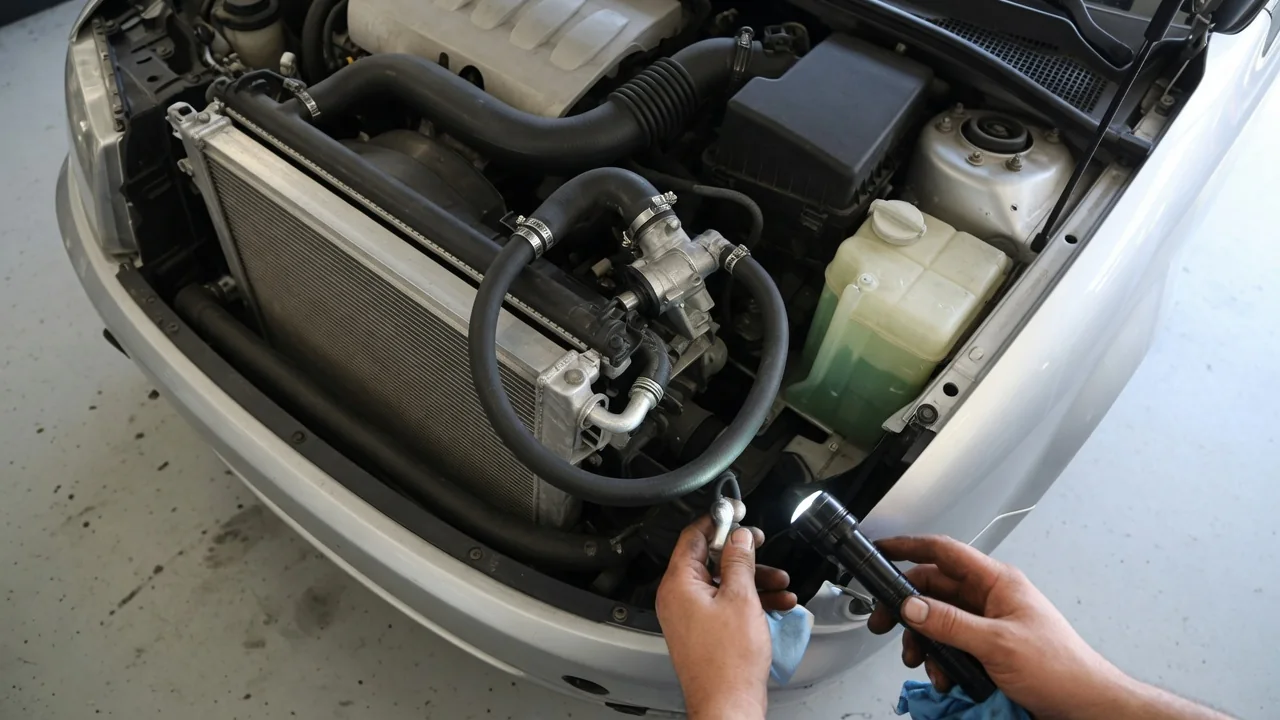
A coolant bypass circuit is a short return path. It lets the water pump keep coolant moving through the engine while the thermostat is still closed and the radiator is shut out of the loop. It is one of the less visible parts of the cooling system, yet it shapes how evenly the engine warms up, how the thermostat responds, and how soon the cabin heater produces warm air. Here is how an engine coolant bypass works in general terms.
Warmup flow: circulating coolant with the radiator closed off
When a cold engine starts, the thermostat stays closed so the engine can reach operating temperature quickly. If coolant could only flow through the radiator, a closed thermostat would stop circulation entirely. The water pump would then be pushing against a blocked outlet. The bypass circuit solves this with a small passage or hose that connects the engine's coolant outlet area, usually near the thermostat housing, back to the pump inlet. Coolant leaving the cylinder head can then return directly to the pump without going to the radiator.
This short loop matters for several reasons. Moving coolant carries heat away from the hottest areas around the combustion chambers and exhaust ports and spreads it through the block and head. As a result, the metal warms more evenly instead of forming local hot spots. Continuous circulation also helps the coolant around the thermostat and temperature sensor reflect actual engine temperature. Without flow, a pocket of stagnant coolant near the sensor or thermostat could lag behind conditions elsewhere in the engine, which would delay the thermostat's response.
The bypass also protects the pump. A pump spinning against a closed path churns the same small volume of coolant, which raises local temperature and encourages cavitation, where vapor bubbles form and collapse on the impeller. Keeping a path open reduces that risk. Because the bypass routes coolant away from the radiator, it removes little heat. Its job during warmup is circulation and temperature equalization, not cooling.
The thermostat's role in opening and closing the bypass
The thermostat and the bypass work as a pair. As coolant temperature rises, the wax element in the thermostat expands and pushes the main valve open, admitting coolant to the radiator. From that point, coolant has two possible return routes to the pump: the long route through the radiator and the short route through the bypass. How the system divides flow between them depends on the design.
In some engines the bypass is a fixed, restricted passage that stays open at all times. Some coolant keeps bypassing the radiator even when the engine is fully warm, but the restriction ensures most flow goes through the radiator once the thermostat opens. In other engines the thermostat has a second valve, often a small disc on the opposite end of the element, which closes the bypass port as the main valve opens. This arrangement is sometimes called a bypass-type or dual-valve thermostat. When the engine is cold, it sends nearly all coolant through the bypass. As temperature rises, it progressively diverts that coolant to the radiator.
Thermostat placement also affects behavior. Some systems put the thermostat on the engine outlet, where it controls coolant leaving the head. Others put it on the inlet side. There it blends cold coolant returning from the radiator with warm coolant from the bypass before the mix enters the pump. Inlet-side layouts can smooth temperature swings because the thermostat senses the blended coolant. In that layout, bypass flow keeps warm coolant reaching the element so it can regulate accurately. Some engines replace or supplement the conventional thermostat with electronically controlled valves, but the basic idea is the same: a short internal loop versus a radiator loop.
Cabin heat and the bypass circuit
The cabin heater depends on hot engine coolant flowing through a heater core, a small radiator behind the dashboard. In many vehicles the heater core receives coolant regardless of thermostat position. It draws coolant from a point on the engine ahead of the thermostat and returns it toward the pump inlet. In that sense the heater circuit acts as a second bypass, another path that lets coolant circulate without passing through the main radiator. Some designs rely on the heater loop to help with warmup circulation. Others combine a dedicated bypass passage with a separate heater loop.
Because coolant reaches the heater core during warmup, the cabin can start receiving heat as the coolant warms, without waiting for the thermostat to open. How quickly that happens depends on how much heat the engine produces at idle or light load, the outside temperature, and how flow is split between the heater core and other paths. Systems also differ in how they control cabin temperature. Some use a valve that regulates coolant flow to the heater core. Many others keep coolant flowing and use a blend door to mix heated and unheated air. Some vehicles also add an electric auxiliary pump to keep coolant moving through the heater when engine-driven flow is low or the engine is stopped.
The heater's draw also affects warmup. Running the heater at full output removes heat from the coolant that would otherwise help the engine reach temperature. On a cold day, the engine may therefore warm more slowly with the heater on high. This is normal behavior, not a fault.
Practical implications and limits
For owners, the bypass circuit matters mostly when diagnosing temperature or heating complaints. A bypass hose can become blocked, collapsed or kinked, and a bypass passage can clog with sediment or degraded coolant. Either problem can cause uneven warmup, erratic temperature gauge readings, a thermostat that seems to open late, or overheating under some conditions. A leaking bypass hose or fitting loses coolant like any other cooling system leak. Bypass hoses are often short and tucked under intake components, so they can be hard to inspect and are sometimes overlooked during routine hose replacement.
Thermostat selection is another practical point. An engine designed for a dual-valve thermostat needs the correct part. A thermostat without the bypass valve, or with the wrong configuration, can change flow distribution and affect warmup or temperature control. Removing the thermostat entirely is not a reliable fix for overheating. It changes how coolant splits between the radiator and bypass paths and can keep the engine from reaching or holding its intended temperature. Air trapped after service can also interrupt flow in small passages such as the bypass or heater circuit, which is why many manufacturers specify a bleeding procedure.
A general explanation has limits. Bypass layouts, thermostat types, heater plumbing and the use of electric pumps or valves vary widely between engines. The exact route coolant takes, and the symptoms of a fault, therefore depend on the specific vehicle. For diagnosis or parts selection, the service information for that engine is the authoritative reference, including coolant type, hose routing and refill procedure.