What Is a Control Arm?
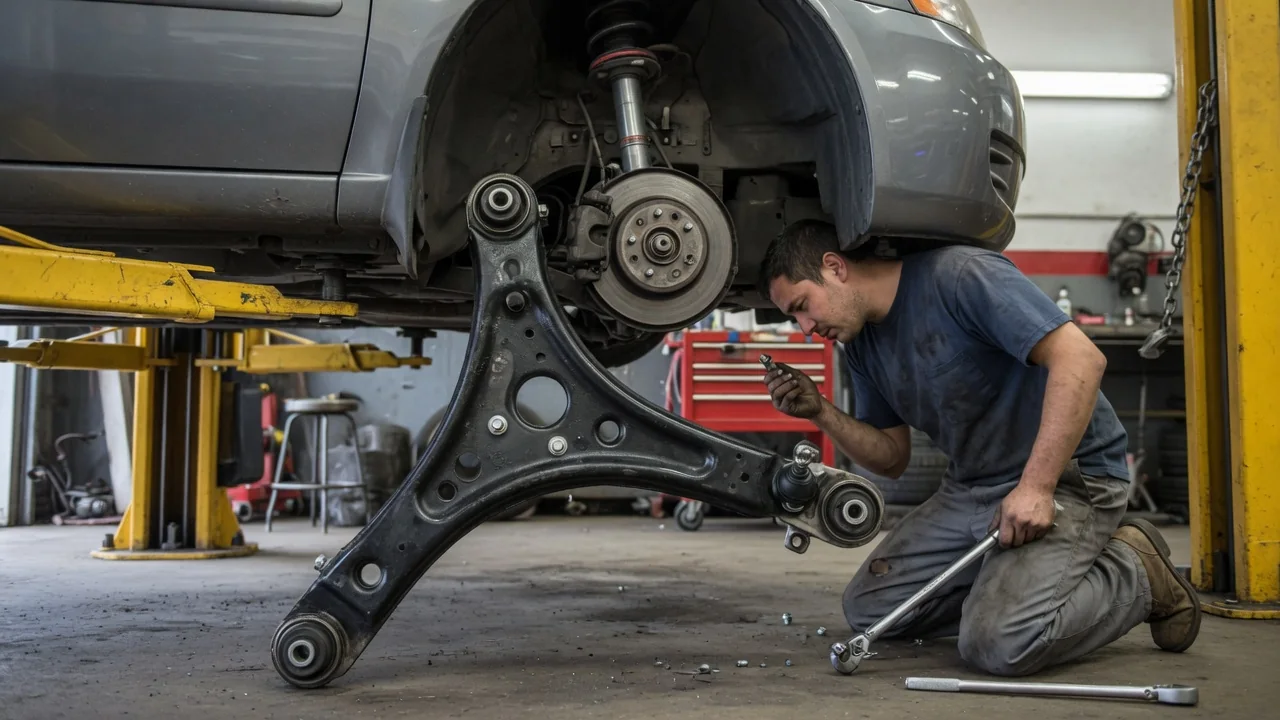
Anyone asking what is a control arm is really asking how a wheel stays in the right place while the suspension moves. A control arm is a hinged link between the vehicle's frame or subframe and the wheel assembly. It lets the wheel rise and fall over bumps while holding its position front to back and side to side.
Arm and bushings
The arm itself is a rigid link, usually stamped steel, cast iron, or forged or cast aluminum. Its inner end attaches to the frame or subframe, and its outer end carries the steering knuckle or wheel hub. Many arms are shaped like a triangle, often called an A-arm or wishbone, with two inner mounting points spread apart. That wide base resists braking and acceleration forces that would otherwise push the wheel forward or backward. Other designs use a single straight link paired with a separate rod to do the same job.
Bushings sit at the inner pivots. Most are rubber bonded between metal sleeves, though some vehicles use fluid-filled or firmer synthetic versions. The rubber twists slightly as the arm swings, so the pivot needs no lubrication, and it absorbs road vibration before it reaches the cabin. Bushing stiffness is a deliberate compromise: softer rubber quiets the ride, while stiffer material holds alignment more precisely under load. With the wheel turned or the vehicle raised, the bushings are often visible where the arm meets the subframe, although layout differs widely between models.
Ball joint
At the outer end of many control arms sits a ball joint, a ball-and-socket connection much like a human hip. A hardened steel ball stud rotates and tilts inside a lubricated housing, sealed by a flexible rubber boot. This lets the knuckle do two things at once: pivot left and right for steering, and change angle as the arm swings through suspension travel. A plain hinge could not allow both motions, which is why the ball joint appears wherever a steered wheel meets an arm.
How the joint is loaded depends on the suspension design. In a strut front suspension, there is typically one lower arm and one lower ball joint per side, with the strut locating the top of the knuckle. Double wishbone and many truck layouts use upper and lower arms, each with its own joint, and one of them usually carries the vehicle's weight through the spring. Some ball joints bolt or press into the arm and can be serviced separately, while others are built in, so the whole arm is replaced together.
Inspection symptoms
Because the arm locates the wheel, wear in its joints lets the wheel move in ways it should not. A common sign is a clunk or knock over bumps, or when shifting between braking and accelerating, as a worn bushing allows the arm to shift in its mount. Steering may feel vague or wander on the highway, and the vehicle may pull during braking. Vibration through the steering wheel and tires worn unevenly on one edge can also point to a wheel that no longer holds its alignment.
A visual check can add evidence. Bushing rubber that is cracked, torn, separated from its sleeve, or leaking fluid suggests deterioration, and a split ball joint boot lets grease out and grit in. The arm itself rarely wears out, but a hard curb or pothole strike can bend it, and corrosion can weaken steel arms in regions that salt their roads. These symptoms overlap with worn tie rod ends, sway bar links, struts, and wheel bearings, so noises alone do not identify the faulty part.
Everyday Use and Observations
In normal driving the control arms are working constantly without being noticed. Over a speed bump, both arms swing upward on their bushings and then return. In a corner, the outside arm takes side load from the tire while the body leans, and under hard braking the arms resist the wheels being pushed rearward. The geometry of the arms also controls how camber changes as the suspension compresses, which influences how much of the tire tread stays flat on the road during cornering.
Drivers can pick up changes by paying attention to patterns. A noise that appears only over sharp bumps at low speed, or a steering wheel that sits slightly off center after a pothole strike, is worth noting along with when it happens. Tire wear is a slow but honest record: a healthy suspension tends to wear the tread evenly across its width. Vehicles differ in how much they reveal, since a softly sprung sedan can mask looseness that a firm sports car or a loaded pickup makes obvious quickly.
Limits and Next Steps
Observation from the driver's seat has limits. Play in a ball joint or bushing is often small, and some joints only show looseness when the suspension is loaded or unloaded in a particular way that depends on the design. A proper assessment involves raising the vehicle safely and checking movement against the manufacturer's specifications, which vary by model. Suspension springs store considerable energy, and separating these components without the correct equipment and procedure can cause serious injury, so this work is best left to a qualified technician.
A sensible next step when symptoms appear is a professional suspension inspection rather than replacing parts on a guess. If a joint is confirmed loose, it should not be put off, because a ball joint that separates can let the wheel collapse outward and take away steering control. After any control arm, bushing, or ball joint replacement, a wheel alignment is normally needed, since the new parts change where the wheel sits. The vehicle's service information determines which components are available separately and how they are tightened.