What Is a Constant-Velocity Joint? Angle, Torque Transfer and Wear Explained
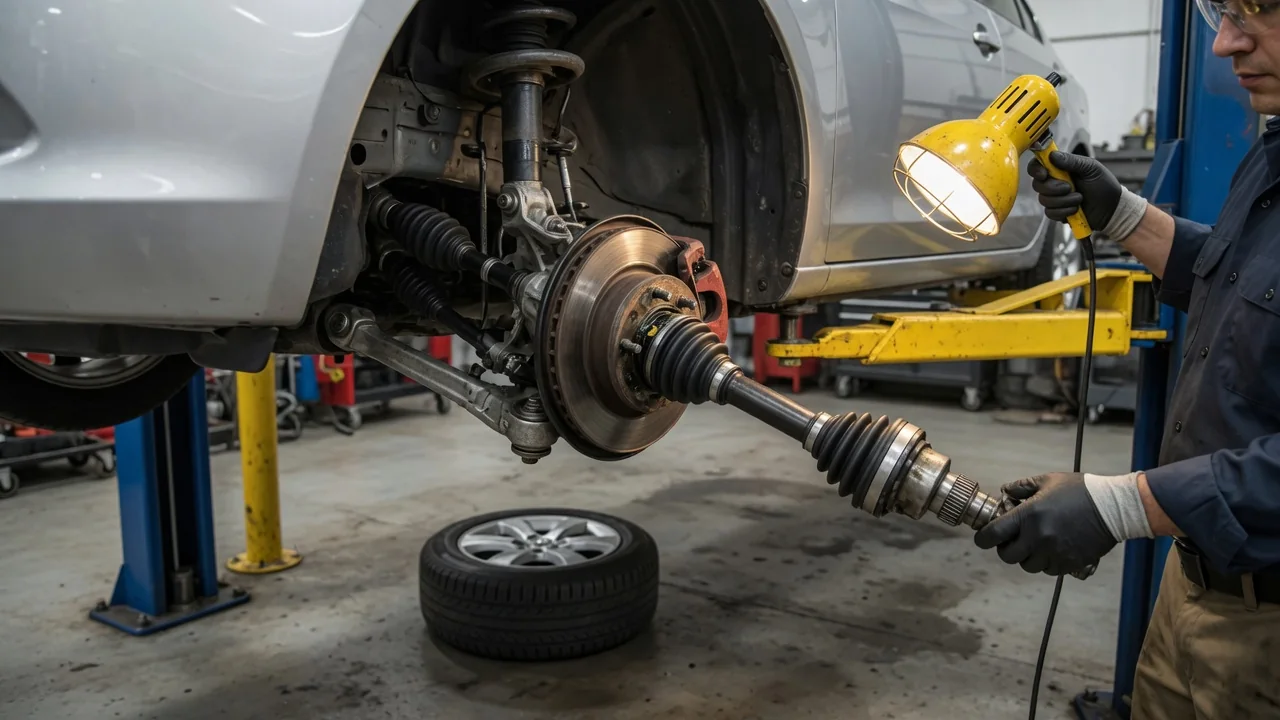
A constant-velocity joint, usually called a CV joint, is a drivetrain coupling that lets a spinning shaft deliver power through an angle without making the output speed rise and fall during each revolution. Most front-wheel-drive cars have CV joints at both ends of each drive axle, and so do many vehicles with independent rear or all-wheel-drive suspension. The CV joint's function in a car comes down to three things: the angles it handles, how it carries torque, and how it wears.
Joint Angle and Why Constant Velocity Matters
A drive axle links the transmission or differential to a wheel hub, and the two ends rarely stay in line. The wheel moves up and down as the suspension works, and on a front-drive car it also steers left and right. The axle therefore has to turn power through an angle that changes constantly. A simple universal joint, the cross-shaped Cardan type used on many driveshafts, can do this, but not smoothly. When a Cardan joint runs at an angle, its output shaft speeds up and slows down twice per revolution even though the input turns at a steady speed. The larger the angle, the larger the fluctuation. Driveshafts often use two Cardan joints arranged so their fluctuations cancel out. That arrangement is impractical at a steered wheel, where the angle is large and keeps changing.
A CV joint avoids this problem through its geometry. Its rolling elements are held in the plane that bisects the angle between the input and output shafts. Because the driving and driven sides meet symmetrically, both shafts turn at the same speed at every point in the rotation. Joints are also specialized by position. The outer joint, at the wheel, is typically a fixed ball-type design, often called a Rzeppa joint, built to handle the large angles that steering requires. The inner joint, at the transmission, is usually a plunging type, either a tripod or a ball-type design such as a double-offset joint. It works at smaller angles but lets the axle change effective length as the suspension compresses and extends. The exact angle and plunge capacity depend on the joint design and the vehicle.
Torque Transfer Through the Joint
In a ball-type CV joint, an inner race is splined to the axle shaft and sits inside an outer housing, which on outer joints usually forms the stub shaft that goes into the wheel hub. Both parts have matching curved grooves, and a steel ball rides in each pair of grooves. A cage with windows keeps the balls aligned in the bisecting plane. When the axle turns, torque passes from the inner race grooves through the balls into the outer housing grooves. The load is shared among all the balls, commonly six, though other counts exist. This sharing is how a compact joint can carry the substantial forces involved in driving a wheel.
A tripod joint transfers torque differently. A three-armed spider is splined to the shaft, and each arm carries a roller, usually on needle bearings. The rollers run in three tracks inside a housing often called a tulip. Torque passes from the spider arms through the rollers to the track walls. Because the rollers can also slide along the tracks, the joint allows the in-and-out movement that suspension travel requires.
The torque reaching a CV joint is not simply engine torque. The transmission and final drive gearing multiply it, so the joints carry their highest loads in low gears, during hard launches, and when pulling heavy loads. Angle matters here too. As operating angle increases, internal friction and contact stresses generally rise, so a joint carrying high torque at a sharp angle works harder than the same joint running nearly straight.
Wear: How CV Joints Deteriorate
A CV joint is lubricated by grease sealed inside a flexible boot, a ribbed cover clamped to the axle shaft at one end and the joint housing at the other. The boot flexes with every steering input and suspension movement. While it stays intact, the joint is protected and can last a long time. The most common path to failure is a damaged boot. Rubber and plastic boots can crack with age, heat, and cold, tear from road debris or careless service work, or leak at a loose clamp. Once the boot is open, rotation slings grease out while water, sand, and grit get in. The resulting abrasive paste wears the balls, grooves, cage windows, or tripod rollers, and moisture adds corrosion and pitting.
As internal clearances grow, the joint develops free play, and symptoms follow. A worn outer joint classically makes a rhythmic clicking or popping noise when turning under power, such as accelerating out of a tight corner or a parking space. A worn inner joint more often shows up as vibration or shudder under acceleration, or as a clunk when the load reverses, such as shifting between drive and reverse or lifting off the throttle. A torn boot often leaves visible grease on the inside of the wheel, the suspension, or nearby brake parts. If wear is left unaddressed, a joint can eventually fail completely, cutting drive to that wheel.
Practical Implications and Limits
For owners, the most useful habit is checking the boots whenever the car is lifted, such as during tire rotations or oil changes. A boot replaced early, with the joint cleaned and repacked with the correct grease, can preserve a healthy joint. Once the joint has started clicking or knocking, the internal surfaces are usually already worn, and a new boot alone will not fix the noise. At that point many repairs replace the complete axle assembly rather than rebuilding an individual joint, because the labor is similar and complete axles are widely available. The best choice depends on the vehicle, part quality, and cost.
Driving habits and modifications also play a role. Hard acceleration with the wheels at full lock combines high torque with maximum angle, the most demanding condition for an outer joint. Lift kits and lowering springs change the resting angles of both joints and can move a plunging joint closer to the ends of its travel. Whether that shortens joint life depends on the specific vehicle and how far the geometry has changed.
This overview has limits. Clicks, vibration, and clunks can also come from wheel bearings, tires, engine or transmission mounts, suspension bushings, or brakes, so a noise alone does not confirm a CV joint fault. A proper inspection should look for boot damage, play, and the conditions under which the symptom appears. Joint type, grease specification, axle nut torque, and replacement procedures all vary between vehicles. The service manual for the specific make and model is the reference for those details.