What Is a Coilover Suspension Unit? Spring, Damper, Adjustment and Service
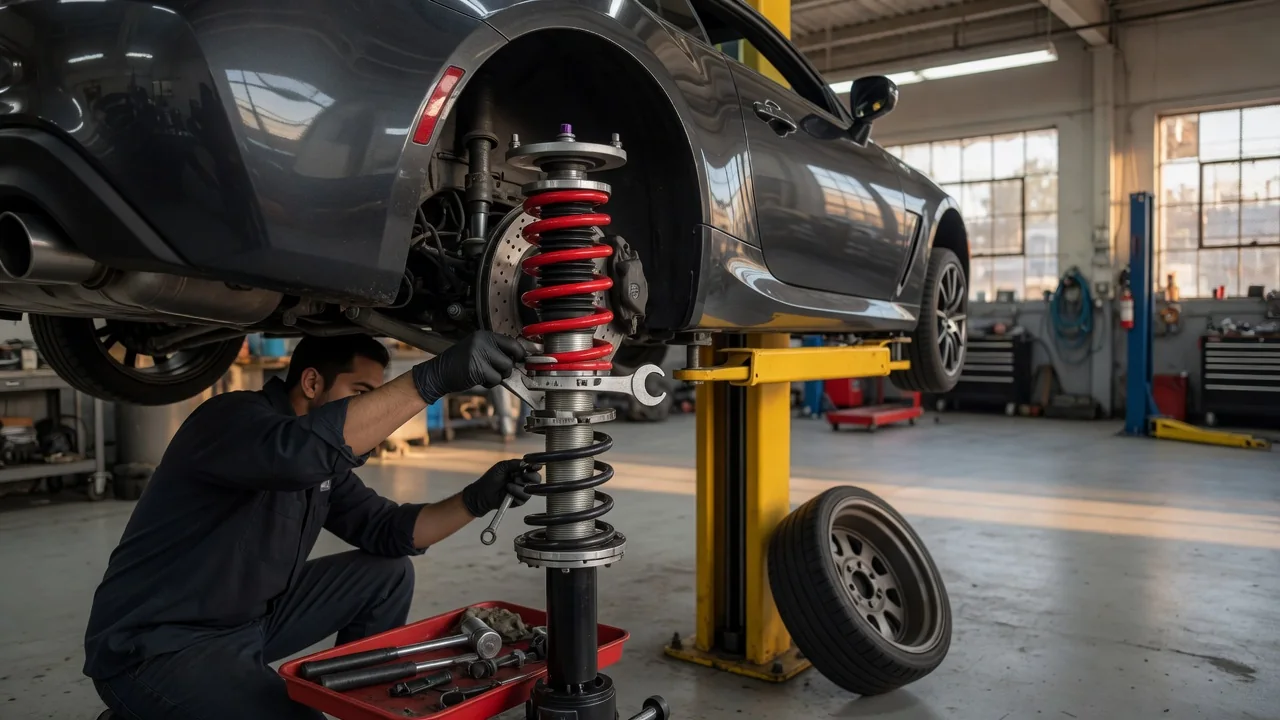
A coilover suspension unit combines a coil spring and a shock absorber, more precisely called a damper, into one assembly, with the spring mounted around the damper body. That is the plain car coilover meaning: coil over shock. Many factory suspensions already use this layout, and aftermarket coilovers usually add threaded ride-height and damping adjustment. To understand a coilover in practical terms, it helps to look at how its two main parts share the work, what can be adjusted, and how the unit is maintained.
Spring and damper
The spring supports the weight of the vehicle and stores energy when the wheel moves upward over a bump. Its rate describes how much force is needed to compress it by a given distance, so a higher-rate spring resists compression more strongly. In a coilover, the lower end of the spring rests on a spring seat, often called a perch, attached to the damper body, and the upper end bears against a seat at the top mount. Because both ends locate on the same assembly, spring and damper work along one axis, and the whole unit can be removed and installed as a single piece.
A spring on its own would keep oscillating after every bump. The damper controls that motion by forcing hydraulic fluid through valves and small passages as its piston moves, converting motion energy into heat. Compression, or bump, damping resists the wheel moving up, while rebound damping resists the spring pushing the wheel back down and the body back up. Two common internal layouts exist. A twin-tube damper has an inner working tube and an outer reserve tube, while a monotube damper uses a single pressure tube in which a floating piston separates the oil from a pressurized gas charge.
The coilover is part of the suspension geometry, not the whole of it. Where it mounts relative to the control arms determines its motion ratio, meaning the unit usually travels a different distance than the wheel. The effective rate felt at the wheel therefore depends on both the spring rate and that installation geometry, roughly with the square of the motion ratio. In a MacPherson strut design the coilover is also a structural member that helps locate the wheel, while in double-wishbone and many multilink designs the arms locate the wheel and the coilover mainly supports load and controls motion.
Adjustment
Most aftermarket coilovers use a threaded damper body or sleeve so ride height can be changed without swapping parts. On a simple threaded-sleeve design, a lower spring perch screws up or down and is held by a lock collar. Lowering the perch lowers the car, but the damper's own length stays the same, so the static position moves closer to the end of its stroke and bump travel before the bump stop can shrink. Designs with full-length or body-length adjustment instead thread the lower mount into the damper body, changing the overall unit length while leaving spring preload and available stroke unchanged.
Spring preload is the amount the spring is compressed before the vehicle's weight is applied. On a linear spring, changing preload does not change the spring rate; on a perch-adjustable unit it mainly shifts ride height and the amount of droop travel. Changing the rate requires a different spring. Some coilovers add a short helper or tender spring that keeps the main spring seated when the suspension is fully extended, such as when a wheel lifts off the ground or the car is raised on a lift.
Damping adjustment is usually made with a knob or wheel on the damper shaft or on a remote reservoir. Single-adjustable units change one setting, often affecting rebound alone or rebound and compression together depending on the valving design. Double-adjustable and more complex units separate compression from rebound, and some divide compression into low-speed and high-speed circuits. Clicks or positions are relative steps defined by each manufacturer, not standardized units, so the supplier's baseline settings are the reference point. Strut-type applications may also use adjustable top mounts, sometimes called camber plates, and any ride-height change generally calls for a wheel alignment.
Service
Routine inspection focuses on a few clear signs. An oil film or wetness on the damper body suggests a leaking seal, and a damper that has lost fluid or gas charge lets the body bounce or float after bumps. Torn dust boots, damaged bump stops, cracked or broken springs, and springs that are not fully seated in their perches should be corrected. Knocking over bumps or binding while steering on strut applications can point to worn top mounts, bearings or bushings. Uneven ride height from side to side may indicate a sagging spring, a loose collar or a settled adjustment.
Threaded bodies need particular care because dirt, road salt and corrosion can seize the collars, making later adjustment difficult or impossible. Keeping the threads clean and protected according to the manufacturer's guidance helps preserve adjustability. Many aftermarket coilovers can be rebuilt with new seals, fresh oil and, where applicable, a gas recharge, usually by the manufacturer or a specialist with the correct equipment. Factory-style units are more often replaced as complete assemblies or by fitting a new damper while reusing compatible components.
Disassembly carries real hazards. A preloaded spring stores significant energy and must be compressed with a suitable spring compressor before the top nut is removed, and gas-charged dampers are under internal pressure and should not be opened without proper tools and procedures. Dampers are normally replaced in pairs on the same axle to keep behavior balanced, and fasteners should be tightened to the values given in the vehicle's service manual.
Practical implications and limits
In everyday driving, a coilover's behavior comes from the combination of spring rate, damping and geometry rather than from any single setting. Lowering a car with threaded collars may improve appearance or reduce body roll, but it can also reduce suspension travel and ground clearance, increase the chance of hitting bump stops, and change camber, toe and steering behavior as the arms operate at different angles. Stiffer springs or firmer damping can make the body feel more controlled on smooth surfaces while reducing comfort and tire contact on rough roads. Adjustability helps only when changes are made one at a time and evaluated carefully.
A coilover also cannot compensate for worn bushings, ball joints, tires or misalignment elsewhere in the suspension. Whether a particular vehicle uses coilovers from the factory, and which replacement units fit, depends on its specific suspension design, so the vehicle's service manual and the part supplier's fitment data are the proper references. Some vehicles use ride-height sensors, headlamp leveling or electronically controlled dampers, and changing the suspension may require compatible components or recalibration following the manufacturer's procedure. Local inspection rules on ride height and suspension modifications vary as well.