What Is a Coachbuilt Car? Bodycraft, Chassis, and Production Explained
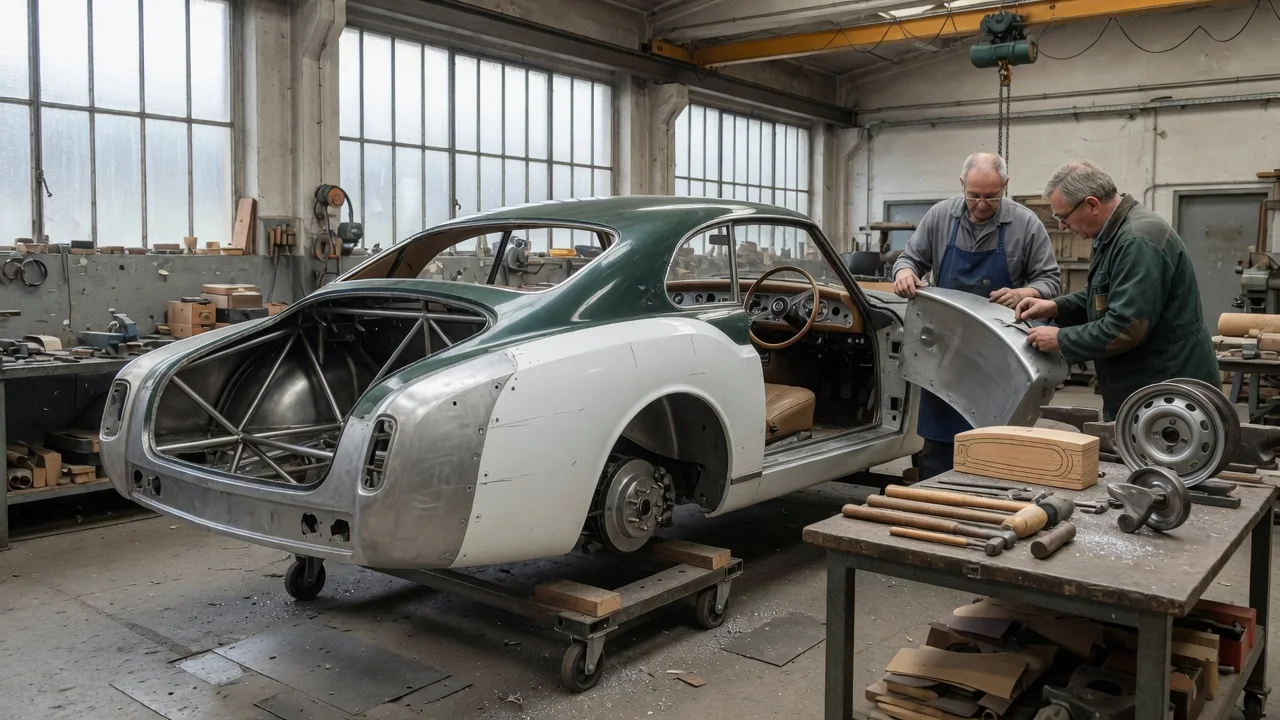
A coachbuilt car is a vehicle whose body was designed and built by a specialist body maker, usually in small numbers or as a one-off, rather than stamped out on a factory assembly line. The term comes from the craft of building horse-drawn coaches. To understand the coachbuilt car definition fully, it helps to look at three things: how the body was made, what it was mounted on, and how production was organized.
Bodycraft
Bodycraft, often called coachwork, is the heart of what makes a car coachbuilt. Traditional coachbuilders carried their carriage-building skills into the automotive era, so early car bodies were often built much like coaches: a wooden frame, commonly made from hardwood, formed the skeleton, and metal panels were attached over it. Craftspeople shaped those panels by hand, using hammers, shaping tools, and machines such as the English wheel to create smooth compound curves. Aluminum and steel were both used, with the choice depending on the builder, the period, and the intended use of the car.
Because each body was shaped largely by hand, coachbuilders frequently worked from full-size wooden forms, sometimes called bucks, that captured the intended shape. Panels were checked against these forms and adjusted until they fit. This process allowed a high degree of individuality. A customer could request a particular roofline, door arrangement, window shape, interior layout, or trim material, and the body maker could design around those wishes. Paint, upholstery, and interior woodwork were often treated as part of the same commission rather than as separate options chosen from a fixed list.
The result was a body that reflected both the builder's design language and the buyer's preferences. That combination of hand skill and personalization is why enthusiasts treat coachbuilt bodies as distinct from mass-produced ones, even when the underlying mechanical components came from a large manufacturer.
Chassis
Coachbuilding as a widespread practice depended on a particular kind of vehicle structure: body-on-frame construction. In this layout, a separate chassis frame carries the engine, transmission, suspension, steering, and wheels. The body sits on top of the frame and does not need to carry the main structural loads of the vehicle. This separation is what made it practical for one company to build the running gear and another to build the body.
Historically, some manufacturers sold what is known as a rolling chassis: a complete, drivable mechanical platform without a finished body. A buyer could purchase that chassis and send it to a coachbuilder of their choice, or the manufacturer might arrange the work itself. The coachbuilder then designed a body to fit the chassis dimensions, mounting points, and mechanical layout. Because the frame handled the structural duties, the body maker had considerable freedom over shape and style.
The broad shift toward unibody, or monocoque, construction changed this relationship. In a unibody vehicle, the body shell itself is the main structure, so altering it significantly affects strength, crash behavior, and how the suspension and drivetrain are supported. That makes independent body building far more complex, which is a major reason traditional coachbuilding became less common. Modern coachbuilt projects still exist, but they typically involve substantial engineering work to reshape or replace body structures on an existing platform while preserving its integrity.
Production
Production is the third element that separates coachbuilt cars from ordinary ones. Mass manufacturing relies on expensive tooling, such as large stamping dies, that is only economical when spread across many identical bodies. Coachbuilding works the other way around: it avoids heavy tooling and relies on skilled labor, which makes very small runs and single commissions possible but keeps each unit time-consuming to produce.
Coachbuilt output generally falls into a few patterns. A true one-off is a single body built for a single customer. A short series involves a design produced in limited numbers, where each example may still differ in details because of hand fabrication and individual specifications. Some manufacturers have also offered factory-arranged coachwork, in which an outside or in-house specialist built bodies to an approved design. Enthusiasts sometimes debate where the line falls between these categories, so the term is applied with some flexibility.
It also helps to separate coachbuilding from related ideas. A custom-painted or retrimmed production car is personalized but not coachbuilt, because its body still came from the factory line. Likewise, a limited-edition model is not automatically coachbuilt; the defining factor is whether the body itself was designed and constructed by specialist body makers using low-volume methods.
Practical implications and limits
For owners and prospective buyers, a coachbuilt body brings specific practical considerations. Replacement panels are rarely available off the shelf, so damage repair often means fabricating parts by hand or adapting existing pieces. Body work therefore tends to require specialists familiar with traditional metal shaping and, on older examples, wooden body framing that can deteriorate with moisture and age. The mechanical components, by contrast, may share parts with the donor chassis or platform, which can make engine and drivetrain service more straightforward than body repairs.
Documentation matters more than usual. Because coachbuilt bodies vary, identifying what a particular car originally looked like and confirming that its body is authentic generally depends on build records, chassis and body numbers, photographs, and ownership history. Later rebodying, where an old chassis receives a newer body, is a known practice in the collector world, so the description of a car should be checked against whatever records exist rather than taken at face value.
There are limits to what the label tells you. Coachbuilt does not by itself guarantee better quality, performance, or value; outcomes depend on the builder, the condition of the car, and how it has been maintained or restored. Behavior on the road also depends on the specific chassis, body weight, and materials used, so general statements about coachbuilt cars cannot predict how any individual example drives. When evaluating one, treat the term as a description of how the body was made, then assess the actual vehicle on its own merits.