What Is a Closed Deck Engine Block? Cylinder Support, Cooling and Design Trade-offs
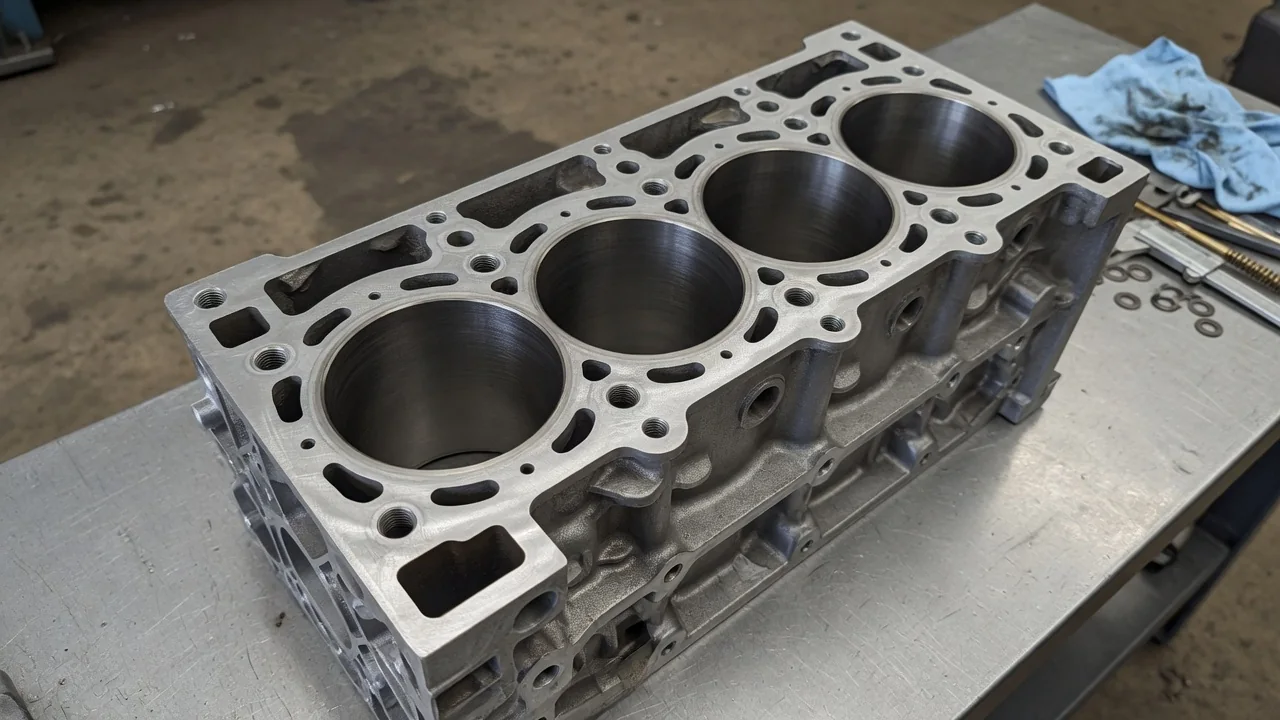
A closed deck engine block is a cylinder block in which the top surface, or deck, is largely solid material joining the cylinder bores to the outer walls of the block. Coolant reaches the cylinder head only through a set of smaller openings, not through an open channel around each cylinder. This layout explains why closed deck blocks are associated with rigidity, how they change coolant flow, and why engine designers do not use them everywhere.
Cylinder support
In a liquid-cooled engine, each cylinder is surrounded by a water jacket, a cavity that holds circulating coolant. The deck is the flat, machined surface at the top of the block where the head gasket and cylinder head are clamped down. In an open deck block, the water jacket is open at the top, so the upper part of each cylinder stands like a tube surrounded by coolant. It is attached to the rest of the block mainly lower down and, in many designs, where neighboring cylinders share a wall. In a closed deck block, the deck surface bridges the gap between the cylinder walls and the outer block wall around most of each bore. Only relatively small holes remain to let coolant pass upward.
The main structural benefit is support at the top of the bore. That is where combustion pressure acts first and where the head gasket must hold a seal. A cylinder that is tied to the block at its top as well as further down is less free to move or distort when it is loaded by pressure and heat. A continuous deck also gives the head gasket a stiffer, more uniform surface to clamp against, which helps keep the seal consistent around each cylinder. For this reason, closed deck construction is often discussed in connection with high cylinder pressures, such as those created by turbocharging, supercharging, or high compression. A third category, usually called semi-closed deck, sits in between. It uses bridges or ribs that link the cylinders to the outer wall at intervals rather than a fully continuous top surface, adding some support while keeping more of the jacket open.
Cooling passages
Whatever the deck design, coolant generally flows from the water jacket in the block, up through openings in the deck, through matching holes in the head gasket, and into the passages of the cylinder head. In a closed deck block, those openings are a defined set of holes rather than a channel that runs around the cylinders. Their size, number, and position shape how coolant moves from block to head. The head gasket holes can further restrict or direct that flow, so the gasket is part of the cooling design, not just a seal. This arrangement lets engineers steer more coolant toward areas that need it, but it also means the cooling result depends heavily on how the passages were laid out.
The trade-off is around the upper cylinder, which is one of the hottest parts of the block. In an open deck design, coolant can contact the cylinder wall all the way to the top of the jacket. In a closed deck design, solid material occupies that top zone, so the uppermost part of the bore is cooled partly by conduction through the metal rather than by coolant flowing directly against it. Air or steam that collects high in the jacket also has fewer paths to escape, which makes well-placed passages and correct coolant filling procedures more important. None of this makes a closed deck block inherently prone to overheating, but it is one of the factors designers must manage.
Design context
Manufacturing method plays a large role in deck choice. A closed deck water jacket is an enclosed cavity, so it typically requires a core, often made of sand, to form the internal space during casting. An open deck jacket can be formed from above by a reusable metal die that is then pulled straight out. That makes open deck designs well suited to high-pressure die casting of aluminum, a process valued for speed, consistency, and lower weight in high-volume production. As a result, many modern aluminum passenger car blocks use open deck or semi-closed deck construction, often paired with cast-in iron liners or coated bores to give the cylinder walls the strength and wear surface they need.
Closed deck construction tends to appear where rigidity and gasket sealing take priority over casting cost, such as some heavily loaded diesel and performance-oriented engines, and it is common among traditionally cast iron blocks. The choice is never made in isolation. Bore spacing, wall thickness, liner design, head bolt layout, gasket technology, and the intended power level all interact with the deck type. Engineers can achieve adequate cylinder support with an open deck through thicker walls and stronger gaskets, and they can achieve good cooling in a closed deck through careful passage design. The deck style is one tool among many rather than a single deciding feature.
Practical implications and limits
For an owner, the deck type is rarely listed in everyday specifications, and it usually becomes visible only with the cylinder head removed. Service information for the specific engine is the reliable way to learn how a block is built. It is also important not to treat the term closed deck as a guarantee of durability. A block's real-world strength depends on its materials, casting quality, maintenance history, and how the engine is operated. A closed deck engine that runs low on coolant, uses the wrong fuel, or is tuned beyond its design limits can still suffer head gasket or cylinder damage.
Routine care matters for both designs. Using the coolant type the manufacturer specifies, replacing it on schedule, and bleeding air correctly after service help keep coolant moving through the defined passages between block and head. When an engine is rebuilt, deck flatness and surface finish must meet the manufacturer's limits, and the correct head gasket must be used, because swapping to a gasket with different coolant holes can change how coolant reaches the head.
Aftermarket deck reinforcement inserts and similar modifications exist for open deck blocks used at higher power levels. They can add support at the top of the bores, but they also alter coolant flow and the space around the cylinders. Any such change is best treated as part of an overall engine build with professional machining and planning, not as a stand-alone upgrade that makes a stock engine safe for more boost or power.