What Is a Charging Station's Uptime Status?
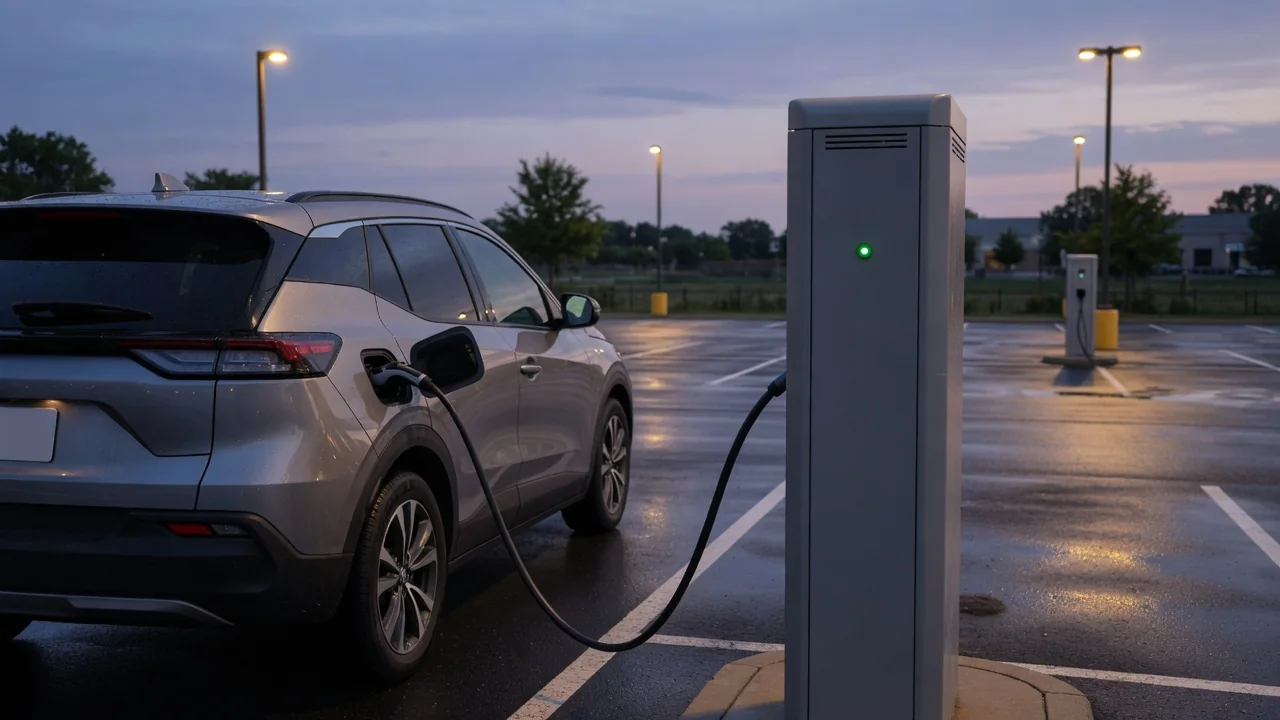
A charging station's uptime status tells you whether a charger is expected to work right now and how reliably it has stayed operational over time. On maps and apps it usually appears as a simple label such as available, in use, or out of service. That label is useful, but it is a report from a networked system, not a direct view of the hardware. Knowing where it comes from, how fresh it is, and what to do when it is wrong makes charging stops far less stressful.
Availability signal
Most public fast chargers and many Level 2 units are networked. A controller inside the charger communicates with the operator's back-end software, typically over a cellular or wired internet connection. Many networks use an open communication protocol such as OCPP for this link, although proprietary systems also exist. Through that connection the charger reports events such as a connector being plugged in, a session starting or stopping, and detected faults. The back end translates those reports into the simple labels drivers see: available, in use or occupied, reserved, out of service, offline, or unknown. Exact wording varies between operators and apps.
Uptime and current status are related but different. Current status is a snapshot of what the system believes right now. Uptime is a measure over a period, usually expressed as the share of time a charger or individual port was able to provide charging. Operators do not all calculate it the same way: some count each connector separately, others a whole station, and some exclude planned maintenance, utility outages, or damage caused by third parties. A charger may also count as up simply because it is powered and communicating. For these reasons, uptime figures from different networks are not always directly comparable.
Status is also reported at different levels of detail. A site with several dispensers may be shown as available even though only one connector of the type your vehicle uses is working. Non-networked chargers often have no live signal at all, so their entry in an EV charger status listing may depend entirely on reports from other drivers.
Data delay
No status label is truly real time. A charger typically sends a message when its state changes, plus a periodic heartbeat to confirm it is still connected. If the cellular link drops or the controller freezes, the back end may continue to display the last known state until a timeout passes and the unit is marked offline. During that window, a broken charger can still look available. The reverse also happens: after a repair, a station may keep appearing out of service until the network refreshes its record.
Self-diagnosis has limits too. A charger can detect many electrical and internal faults, but it may not recognize a damaged cable, an unreadable screen, a failed payment terminal, or a communication problem that only appears with certain vehicles. In those cases the hardware reports itself as ready while drivers cannot start a session, and the listing stays wrong until someone reports it or the operator investigates.
Each step between the charger and your screen can add delay. Third-party maps, in-vehicle navigation systems, and roaming platforms often receive operator data through feeds refreshed at intervals rather than instantly, and status categories may be translated imperfectly between systems. Crowdsourced check-ins carry their own timestamps and lose value as they age. Where an app shows a last-updated time or recent driver comments, those details say more about reliability than the label alone. The operator's own app is usually closest to the source, though it shares the same connectivity limits.
Backup plan
Because the signal can be stale or incomplete, the safest approach is to avoid arriving at a single charger with no margin. Before a trip, identify at least one alternative within comfortable range of the primary stop, preferably at a different site and, where practical, on a different network so that one outage does not affect both. Plan to arrive with a reserve state of charge rather than the minimum the vehicle's estimate allows. Route planners that consider charger status can help, but their output is an estimate built on the same data described above.
If a charger fails on arrival, start with the simple steps. Try another dispenser or connector, follow any on-screen instructions, and attempt to start the session another way, such as through the app, an RFID card, or a payment terminal if one is available. Many chargers display a support phone number, and operators can sometimes check the unit remotely or restart it. Reporting the fault through the operator's app or a crowdsourced map also helps correct the listing for the next driver.
When fast charging is unavailable, a slower option may still bridge the gap. Level 2 charging at a nearby business, hotel, or parking structure can add enough range to reach the next fast charger, provided access hours and parking rules allow it. If the vehicle came with a portable charging cable, knowing where it is stored and how the owner's manual says to use it adds one more fallback.
Practical implications and limits
An available status says nothing about how fast a session will be. Some sites share power between dispensers, and output may be reduced by heat, grid limits, or the station's own settings. The vehicle also controls the charging rate based on battery temperature, state of charge, and its own design, so the same charger can perform differently for different cars. For vehicle-specific charging behavior, the owner's manual and manufacturer guidance are the reliable references, not the station listing.
Many obstacles never appear in the electronic signal at all. A space may be blocked by a parked vehicle that is not charging, a garage may be closed after certain hours, or part of a site may be fenced off for construction. Drivers' comments and photos are often the only way to learn about these conditions in advance.
Historical uptime is most useful for choosing stations you plan to use repeatedly, such as on a regular commute or a familiar highway route, because it reflects how consistently a site has been maintained. It cannot guarantee any particular visit. The most realistic way to read a charging station's uptime status is as a probability informed by recent data: a good reason to prefer one site over another, combined with a backup plan in case conditions on the ground do not match the screen.