What Is a Charging Cable Current Rating? Amps, Heat and Compatibility
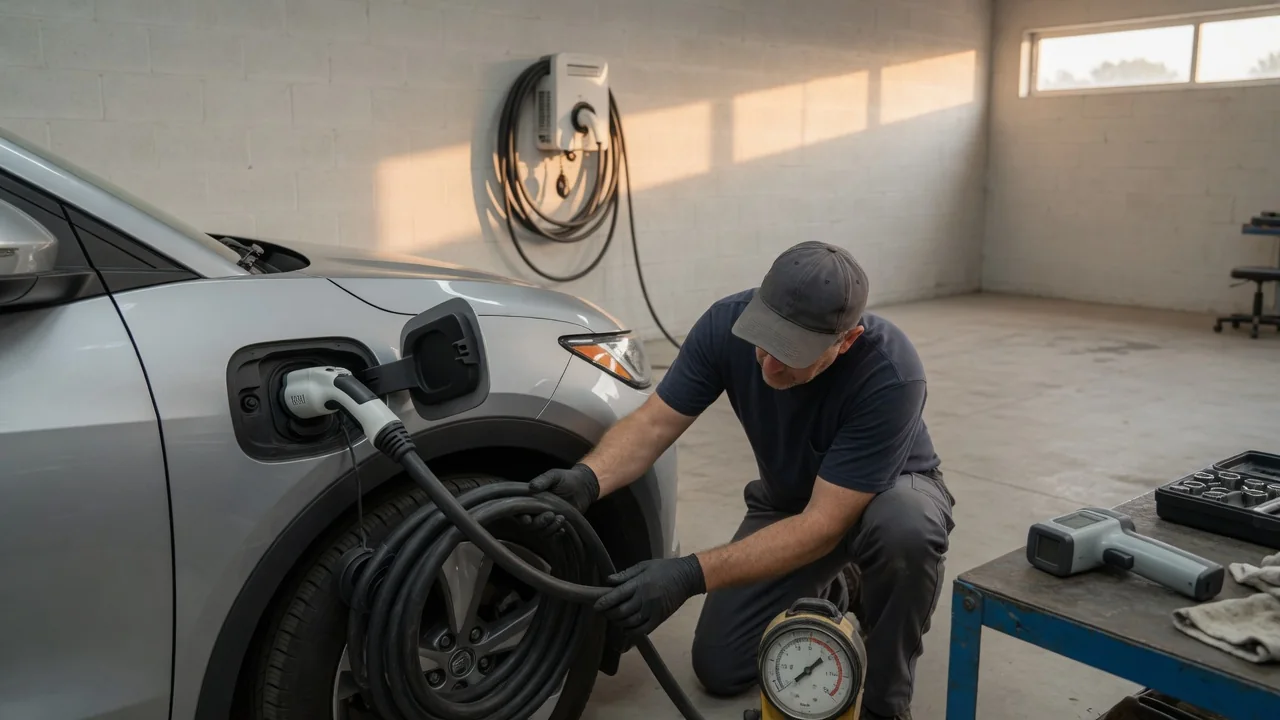
A charging cable current rating is the maximum continuous current, measured in amperes, that a cable assembly is designed to carry safely under its specified conditions. If you are looking up an EV charging cable amp rating, the short answer is that the number describes a safety and temperature limit, not a promised charging speed. That limit depends on how large the conductors are, how much heat the cable can handle, and how well the cable matches the station and vehicle on either end.
Conductor Size: The Physical Basis of the Rating
Every conductor resists the flow of electricity to some degree. In a charging cable the current-carrying conductors are typically copper, and their resistance depends mainly on the material and the cross-sectional area. A thicker conductor offers more paths for current to flow, so its resistance per unit of length is lower. Conductor size is usually expressed as a wire gauge, such as AWG in North America, or as a cross-sectional area in square millimeters in many other markets. Lower resistance means less electrical energy is turned into heat for a given current, which is why a cable intended to carry more amps needs conductors with a larger cross-section. The current rating printed on a cable or its label is, at its root, a statement that the conductors were sized for that load.
Several other details shape what the rating means. Total resistance grows with cable length, so a longer cable loses more energy overall and produces more voltage drop, even if each section heats up at the same rate. The rating also applies per current-carrying conductor. A single-phase cable carries current on the line and return conductors, while a three-phase cable, used in some regions, carries current on each phase conductor. Because charging power depends on voltage and the number of phases as well as current, an amp rating alone does not tell you how many kilowatts a cable supports. Charging cables also contain small signaling conductors used for communication between the station and the vehicle; those wires are not part of the power rating and are sized for very low currents.
Heat: Why the Rating Is Really a Temperature Limit
When current passes through resistance, it produces heat, and that heat rises with the square of the current. In practical terms, doubling the current through the same conductor roughly quadruples the heat it generates. The heat has to escape through the insulation and outer jacket into the surrounding air. A cable current rating is chosen so that, during continuous operation, the conductors and insulation stay within the temperature limits of their materials. This is especially important for EV charging because sessions often last for hours at a steady load, unlike many household appliances that draw high current only briefly.
Real conditions influence how hot a cable actually gets. High ambient temperatures, direct sunlight, a cable left tightly coiled, or a cable covered by other objects all reduce its ability to shed heat. Connectors are a common hot spot as well. The contact pins in a plug have their own resistance, and wear, dirt, corrosion or a loose fit can increase it. A cable can have properly sized conductors and still overheat at a degraded connector. For this reason, many charging systems use temperature sensing in the connector or station and reduce or stop the current if temperatures climb too high, although whether a particular plug includes sensing depends on its design. At the very high currents used in some DC fast charging, designers may use liquid-cooled cables to manage heat rather than relying only on larger, heavier conductors.
Equipment Compatibility: The Lowest Rating Wins
Charging works as a chain: the supply circuit, the charging station (often called EVSE), the cable, the vehicle inlet, and the onboard charger for AC charging or the battery system for DC charging. The current that actually flows is limited by the weakest link in that chain. In AC charging, the station communicates the maximum current it can provide to the vehicle through a control pilot signal. The vehicle then draws up to that amount or up to the limit of its own onboard charger, whichever is lower. A cable with a high current rating does not override either of those limits.
How the cable fits into this conversation depends on its design. A tethered cable is permanently attached to the station, so the manufacturer pairs it with the station's output. Detachable cables are handled differently under some standards. In systems following IEC 61851 with Type 2 connectors, for example, a detachable cable identifies its own current capacity to the station through a resistor in the proximity circuit, and the station then limits what it offers accordingly. Connector shapes and signaling conventions vary by standard and region. An adapter that joins two systems must respect the ratings of both sides, and it cannot raise the capacity of the cable, the station or the vehicle it connects.
Practical Implications and Limits
For everyday use, the practical goal is a cable rated at least for the current your station can deliver and your vehicle can accept. Going higher does no harm, but it will not make charging faster than the station or onboard charger allows, and higher-rated cables tend to be heavier, stiffer and more expensive. Using a lower-rated cable on a more capable station usually means slower charging when the system recognizes the cable's limit, rather than an immediate fault. The exact limits that matter for your setup are vehicle-specific and equipment-specific, so the owner's manual and the station's documentation are the right places to confirm them, along with the rating marked on the cable or its label.
The rating also has boundaries worth understanding. It assumes an undamaged cable used within its stated conditions, so it says nothing about a crushed jacket, water intrusion, bent pins or worn contacts. Signs that deserve attention include a plug that feels unusually warm, discoloration, a deformed or melted housing, or charging that repeatedly slows down or stops without an obvious reason. Household extension cords and improvised adapters that were not designed for continuous EV loads sidestep the assumptions behind the rating, and equipment makers commonly advise against them. In short, a charging cable current rating tells you how much current the cable can safely carry; it does not guarantee compatibility with every system or predict a specific charging time.