What Is a Car Wash Lubricant? How Wash Lubrication Protects Paint
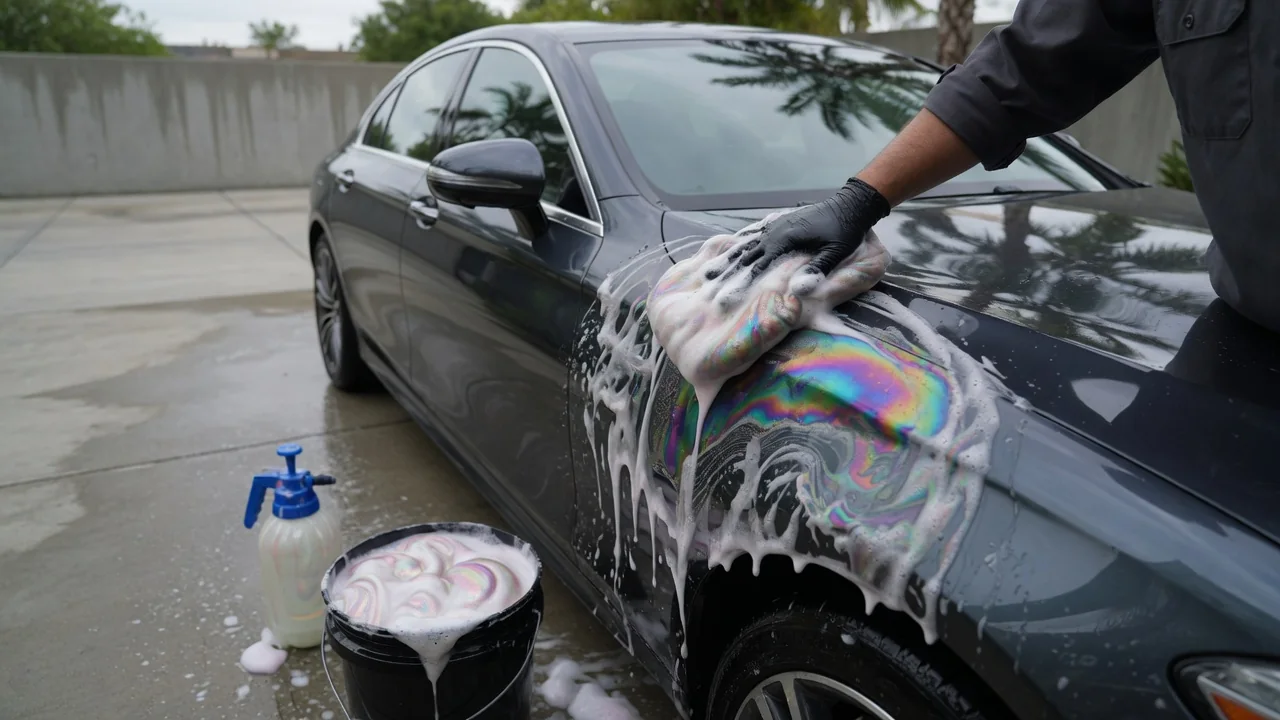
A car wash lubricant is the slick, friction-reducing part of a wash solution that lets a mitt or sponge glide across paint instead of dragging on it. In most car shampoos, lubrication comes from surfactants and added polymers working together in water. Understanding car wash lubrication explains why dedicated shampoos behave differently from household soaps, why dilution matters, and why lubrication alone cannot prevent scratches. The sections below cover how lubricants reduce drag, how they help carry grit, and how technique completes the job.
Reduce drag: how wash lubrication lowers friction
Every time a wash mitt moves across a panel, it creates friction against the clear coat. Plain water offers some lubrication, but it beads, runs off quickly and leaves thin spots where fibers press directly against the surface. A car wash lubricant changes that contact. Surfactants lower the surface tension of water so the solution spreads into a more continuous film, and lubricity additives, often water-soluble polymers or similar slip agents, make that film feel slick. The result is a cushioning layer between the wash media and the paint. With less friction, the mitt needs less force to move, so each stroke is gentler and more controlled.
Reducing drag matters because clear coat is relatively soft compared with many of the mineral particles found in road dirt. Fine scratches and swirl marks are commonly linked to particles dragged under pressure across the finish. Lower friction does not make the surface harder, but it reduces how firmly a trapped particle is pushed into the paint as the mitt moves. This is the main reason dedicated car shampoos emphasize slickness, while general-purpose cleaners are usually formulated for cleaning power and may not prioritize lubricity or finish safety.
Carry grit: suspending dirt away from the finish
Lubrication works alongside a second job: lifting and holding dirt. Surfactant molecules have one end attracted to water and another attracted to oils and grime. They surround soil particles and road film, loosen them from the surface and help keep them suspended in the solution rather than resting on the paint. Some products describe this as encapsulation. Whatever the term, the goal is the same: dirt surrounded by a slick, wet layer is more likely to slide away with the mitt and rinse water instead of being ground into the clear coat.
A good wash solution therefore helps carry grit in two places. On the panel, it lets loosened particles move with the flow of water instead of anchoring them in place. In the mitt, a saturated, well-lubricated fiber pile gives particles room to be drawn away from the contact surface, where they can later be released in a rinse bucket. This is also why foam pre-soaks and pre-rinses are popular: they begin loosening and suspending dirt before any contact wash starts, so less abrasive material is present when the mitt first touches the paint.
Technique: getting the most from car wash lubrication
Lubricant chemistry only performs as well as the method used with it. Start with a thorough rinse to remove as much loose dirt as possible, working from the top of the vehicle down. If a foam or pre-wash product is used, let it dwell according to its label and rinse it off before the contact wash, without allowing it to dry on the surface. Mix the shampoo at the dilution the manufacturer recommends; too little product can reduce slickness, while far more than recommended is not necessarily better and can leave residue that is harder to rinse.
During the contact wash, keep the mitt fully loaded with solution and let it glide with light pressure rather than scrubbing. Many detailers use a two-bucket approach, with one bucket of wash solution and one of plain rinse water, sometimes fitted with grit guards, so the mitt is rinsed before it returns to the clean solution. Washing one section at a time, starting with the cleaner upper panels and leaving lower panels and wheels for last or for separate tools, limits how much heavy grit reaches cleaner paint. Straight-line passes are often preferred because any marks that do occur tend to be less noticeable than circular swirls.
Keep the surface wet throughout. Working in shade on a cool panel slows evaporation, which helps the lubricating film stay in place and reduces water spotting. Rinse each section before the solution dries, and dry the vehicle with a clean, soft towel or filtered air, since drying is another contact step where light pressure still matters.
Practical implications and limits
Lubrication lowers risk; it does not eliminate it. Heavy mud, sand, salt crust or caked-on road grime can overwhelm any wash solution, so those conditions call for more pre-rinsing and pre-soaking before touching the paint. Bonded contaminants such as industrial fallout, tar or tree sap are not removed by lubrication and usually need dedicated products or decontamination steps. A slick shampoo also cannot correct existing swirls; it only helps avoid adding new ones.
Product type changes how much depends on lubrication. Rinseless and waterless washes rely heavily on polymer lubricants because there is little or no rinsing to carry dirt away, which is why they are generally suited to light dust rather than heavy soiling. Some shampoos also contain waxes, sealant polymers or gloss agents that can change how water behaves on the finish. Owners of vehicles with ceramic coatings, paint protection film, wraps or matte paint should follow the care guidance from the product manufacturer or installer, since compatibility depends on the specific finish rather than on lubrication in general.
Finally, how a solution feels in the bucket is only a rough guide. Water hardness, temperature, how dirty the vehicle is and the condition of the wash mitt all affect real results. Worn or contaminated mitts and towels can scratch even with a well-lubricated solution, so keeping wash media clean and replacing it when it degrades is as important as choosing the shampoo itself.