What Is a Car's Power Distribution Box? Battery Feed, Fuses, Relays and Diagnosis
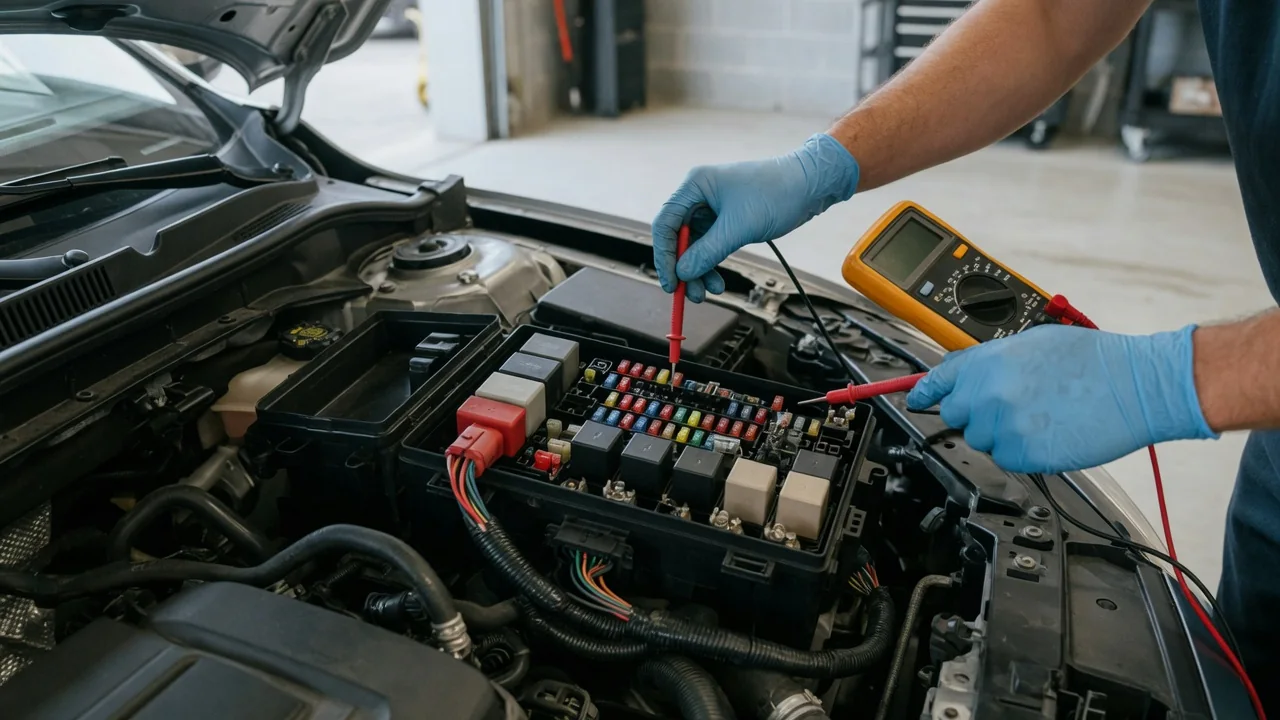
A car's power distribution box is the central hub that takes electrical power from the battery and charging system and divides it among the vehicle's circuits. Each circuit is protected by its own fuse and is often switched by a relay. Most owners know it as the underhood fuse box. Understanding how the box is fed, what its fuses and relays do, and how faults show up makes electrical problems far less mysterious.
Battery Feed: How Power Enters the Box
In most vehicles the power distribution box sits in the engine compartment, often close to the battery to keep the main cable short. A heavy positive cable runs from the battery to a main terminal stud or bus bar in the box. From that bus bar, power fans out through internal conductors to the individual fuse and relay positions. On many vehicles the alternator output also connects at or near this point, either directly or through a high-current fuse. The box then serves as the junction where charging current and battery current meet before reaching the rest of the car.
The main feed carries current for nearly everything electrical, so it is usually protected by a large main fuse or fusible link near the battery. Some circuits are designed to be live at all times, such as the hazard lamps or the memory that keeps clocks and module settings. Others receive power only when the ignition is on or the engine is running. The box handles both: constant-power circuits draw directly from the battery bus, while switched circuits are fed through an ignition relay or controlled by a module. Many vehicles also have a second fuse panel inside the cabin or in the trunk, fed from the main box, which distributes power to interior loads closer to where they are used.
The box distributes positive voltage, while the return path runs through ground connections to the body and engine. A poor ground can produce symptoms that look like a distribution box fault, which is worth remembering during diagnosis.
Fuses and Relays: Protection and Switching
Fuses are the protective layer of a vehicle power distribution box. Each fuse is a calibrated conductor designed to melt and open the circuit when current exceeds its rating, preventing an overloaded or shorted wire from overheating. A typical box holds several fuse types: small blade fuses for lower-current loads such as sensors and lighting, cartridge-style fuses for heavier loads such as cooling fans, and, on many vehicles, bolt-in high-current fuses or fusible links protecting entire branches of the system. Ratings are marked on each fuse and usually on a diagram printed on the lid or in the owner's manual.
Relays let a small control current switch a large load current. A dashboard switch or an output from a control module energizes the relay coil, and the relay's contacts then close a heavy-duty path from the power bus to the load. This keeps high current out of thin control wiring and small switches. Circuits commonly controlled through relays include the starter, fuel pump, cooling fan, horn, headlamps and air conditioning compressor clutch, although the exact list varies by vehicle. Many boxes use plug-in relays that can be removed by hand, while some have relays soldered to an internal circuit board.
In newer electrical architectures, some functions traditionally handled by relays are performed by solid-state switches inside an electronic module, sometimes built into or mounted beside the distribution box. Such designs can monitor current electronically and report faults as diagnostic trouble codes, but whether a particular vehicle works this way depends entirely on its design.
Diagnosing Power Distribution Box Problems
Diagnosis usually starts with the symptom: one component that stops working, several unrelated components failing together, or a battery that drains while the car is parked. A single dead circuit points first to its fuse and relay. With the ignition in the appropriate position, a test light or multimeter can check the two test points on top of a blade fuse. Power on both sides means the fuse is intact; power on only one side means it is open. Removing the fuse and inspecting its element also works, though hairline breaks can be hard to see.
A suspected relay can be checked by listening or feeling for a click when the circuit is commanded, by temporarily swapping it with an identical relay from a noncritical circuit, or by testing its coil and contact sides with a meter. When many circuits fail at once, attention shifts to the main feed: a loose or corroded battery terminal, a damaged main cable, a blown main fuse or fusible link, or a poor connection at the box's input stud. Measuring voltage drop across these connections while the circuit is loaded reveals resistance that a simple voltage check at rest can miss.
Physical inspection matters as well. Melted plastic, discoloration around a terminal, green or white corrosion, or signs of water entry indicate heat or contamination inside the box. A fuse that blows again right after replacement indicates a short or overload downstream rather than a bad fuse. For parasitic battery drain, technicians often measure the small voltage drop across each fuse while the vehicle is asleep to find the circuit still drawing current, avoiding fuse removal that could wake modules and mask the problem.
Practical Implications and Limits
For owners, the most useful habit is knowing where the box is and how to read its legend before something fails. Replacement fuses must match the original rating and type; a higher-rated fuse removes the protection the circuit was designed around and can let wiring overheat. Before working near the main input stud or high-current fuses, disconnecting the negative battery cable reduces the risk of an accidental short, although on some vehicles this resets radio presets, learned idle settings or window positions.
Fuse and relay checks have limits. Faults inside a box with an integrated circuit board, such as a cracked solder joint or a damaged internal trace, often cannot be fixed by swapping parts and may require replacing the whole unit, which is commonly specific to the vehicle's build and options. Functions managed by an electronic module may need a scan tool to read codes or command outputs. Tapping accessories into existing fuse positions can overload circuits or confuse module current monitoring, so a dedicated, properly fused feed is the safer approach.
Hybrid and electric vehicles still have a low-voltage distribution box similar to the one described here, but their high-voltage systems use separate, specially protected distribution hardware identified by orange cabling. That equipment is outside ordinary owner service and requires trained technicians and proper procedures. For any vehicle, its own wiring diagrams and service information remain the authoritative reference for fuse locations, ratings and relay functions.