What Is a Car Paint Polish Abrasive? How It Levels and Refines Paint
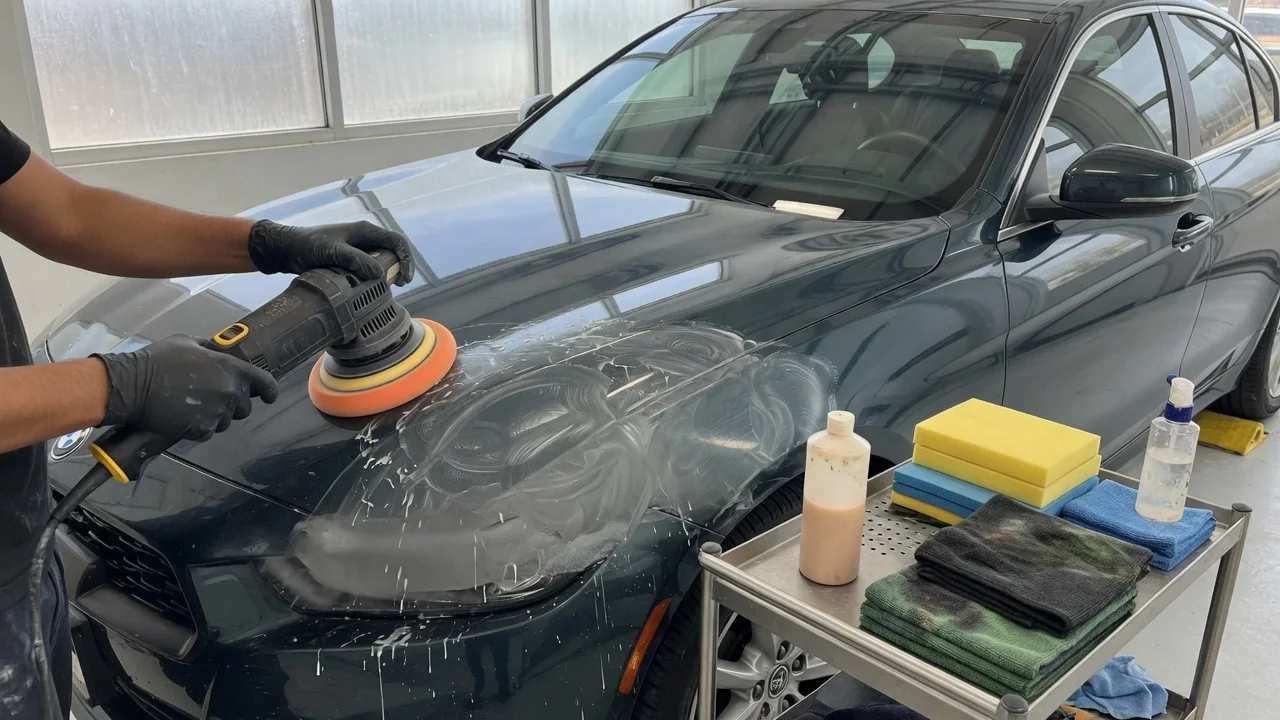
A car paint polish abrasive is the cutting component inside a polish or compound. It consists of microscopic particles that remove a very thin layer of clear coat so that scratches, swirl marks, and oxidation become less visible or disappear. Waxes and sealants add a layer on top of the paint, but abrasives work by taking material away. Knowing how they level the surface, where the clear coat sets limits, and how finishing refines the result helps owners polish more safely.
Surface leveling: how abrasive particles remove defects
Paint looks glossy when its surface is smooth enough to reflect light evenly. Swirl marks, light scratches, water-spot etching, and oxidation all disrupt that smoothness. A scratch is essentially a small valley in the clear coat, and its edges catch and scatter light. A polish abrasive does not fill that valley. Instead, its particles shave away the surrounding paint until the surface sits closer to the bottom of the defect. When the area around a scratch is lowered enough, the edges that scattered light are gone and the mark fades or disappears. Detailers call this process leveling.
In a typical product, car polish abrasive particles are suspended in a carrier made of water or solvents, oils, lubricants, and emulsifiers. The carrier spreads the particles, controls how long the product stays workable, and reduces friction so the abrasive cuts evenly rather than gouging. Aluminum oxide is one of the most widely used abrasive materials, and other mineral or silica-based abrasives also appear in formulations. How aggressively a product cuts depends on particle size, shape, hardness, and concentration. Larger or sharper particles remove material faster but leave a coarser scratch pattern of their own, while smaller, rounder particles remove less and leave a cleaner surface.
Abrasives are often described as diminishing or non-diminishing. Diminishing abrasives are designed to break down into smaller particles as they are worked, so their cut decreases and their finish improves during a single application. Non-diminishing abrasives keep a more consistent size and cut throughout the working cycle. In practice, the abrasive is only one part of a system: the pad material, hand or machine application, machine speed, pressure, and the number of passes all change how much paint is removed.
Clear-coat limits: why polishing is not unlimited
Most modern vehicles use a basecoat/clearcoat paint system. The basecoat carries the color, and the transparent clear coat on top provides gloss and helps shield the color layer from ultraviolet light, chemicals, and weathering. Polishing abrasives work almost entirely within that clear layer. Every correction step removes some of it, and removed clear coat does not grow back. Clear-coat thickness varies by manufacturer, by panel, and by whether the car has been repainted or polished before, so it cannot be assumed from the make or model. The only reliable way to know how much film is present is to measure it with a paint thickness gauge, ideally before any aggressive work begins.
Defect depth matters as much as total thickness. If a scratch has passed through the clear coat into the basecoat or primer, leveling the surrounding clear down to its bottom would require removing more film than is safe, and often more than exists. Such damage needs touch-up or refinishing rather than polishing. The common fingernail test, where a nail catching in the scratch suggests it is deep, is only a rough indicator, not a measurement. Edges and body lines tend to carry thinner paint and concentrate pad pressure and heat, which makes them more prone to strike-through, the point where abrasion cuts completely through the clear coat.
Older or single-stage finishes behave differently. Without a separate clear layer, the abrasive works directly in the pigmented paint, which is why color can transfer to the pad. The same principle still applies: the film is finite, and each pass consumes part of it.
Finishing: refining the surface after the cut
Any abrasive that cuts quickly also leaves its own pattern of very fine scratches. On dark paint these can appear as haze, micro-marring, or, with rotary machines, holograms that shift as the viewing angle changes. Finishing is the step that refines this pattern. A finer polish, often paired with a softer pad and lighter pressure, removes a much smaller amount of clear coat and replaces the coarser marks with ones too small to scatter light noticeably. The result is higher clarity and deeper gloss, not just the absence of visible scratches.
Some products are designed to handle both stages. A polish built on diminishing abrasives can start with a meaningful cut and finish more finely if it is worked long enough for the particles to break down; stopping too early can leave haze behind. It is also worth separating true correction from temporary concealment. Many polishes and glazes contain oils or fillers that can hide fine defects for a while, but these wash away over time and the marks return. Wiping the panel with a dedicated panel-prep product or a diluted alcohol solution after polishing removes these residues and shows what the abrasive actually achieved.
Polishing leaves the clear coat bare and clean, with no protective layer on top. Finishing work is therefore usually followed by a wax, sealant, or coating. These products add protection and can enhance appearance, but they do not level the surface; that work belongs to the abrasive.
Practical implications and limits
The most useful habit is to treat clear coat as a limited budget across the life of the vehicle. Choose the least aggressive combination of polish, pad, and technique that removes the defect, and confirm it on a small test section before working the whole car. Polishing as routine maintenance, rather than in response to actual defects, consumes film without a clear benefit. Washing and drying methods that avoid new swirl marks reduce how often correction is needed at all.
Product labels can help but have limits. Cut and finish ratings are set by each manufacturer and are not a shared standard, so they are most meaningful when comparing products within the same line. Paint also varies in hardness between vehicles and even between panels, which means the same polish and pad can cut quickly on one surface and barely work on another. That difference comes from the specific paint system, not from a general rule about a brand of car. The owner's manual or the paint manufacturer's care guidance is the appropriate reference for finish-specific restrictions.
Some surfaces should not be abrasive-polished at all. Matte and satin paints depend on a controlled surface texture for their look, and polishing can create shiny, uneven spots. Vinyl wraps and paint protection film are separate materials with their own care instructions. Finally, polishing cannot repair clear coat that is already failing, such as peeling, flaking, or turning cloudy and chalky over large areas. Once the clear layer has broken down, refinishing is the realistic fix, and continued polishing only removes more of what remains.