What Is a Car Paint Flop Effect? Flake Orientation, Viewing Angle and Matching
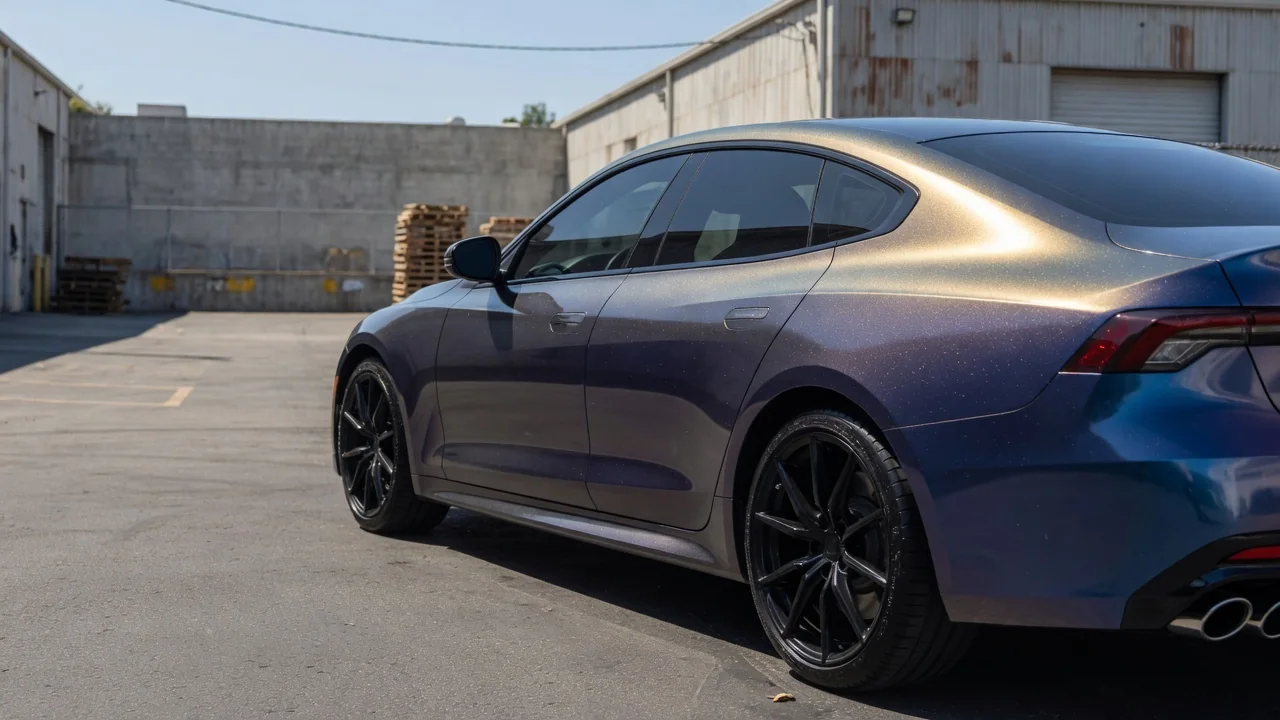
A car paint flop effect is the change in lightness, and sometimes color, that you see when you look at a metallic or pearl finish from different angles. Viewed head-on near the reflection of a light source, the panel may look bright and sparkly. Viewed at a glancing angle, the same panel can look noticeably darker or shift in hue. This behavior comes from how effect pigments sit inside the paint film, and it matters most when a repaired panel has to blend with the original paint.
Flake orientation
Metallic basecoats contain tiny, thin flakes, most commonly aluminum, suspended in the binder alongside any colored pigments. Each flake acts like a small mirror. When the flakes lie flat and parallel to the panel surface, they send most of the incoming light back in one direction, close to the mirror-like reflection angle. Look from that direction and the finish appears bright. Move away from it and far less light reaches your eye, so the color looks darker. The more uniformly the flakes are aligned, the stronger the contrast between the bright and dark views, which is often described as strong or high flop.
Flake alignment is set while the paint is still wet. As solvents or water evaporate, the film shrinks in thickness and tends to pull the flakes toward a flatter position. Application variables influence how far that settling goes, including atomization, gun distance, film build, flash time between coats and the speed of evaporation. Flakes that end up tilted or randomly angled scatter light in many directions, which brightens the dark side of the view and dulls the bright side, reducing flop. Uneven orientation across a panel can also appear as cloudy patches or stripes, often called mottling. Pearl or mica-type pigments add another layer: they work partly through light interference, so in addition to changing lightness they can shift hue as the angle changes.
Viewing angle
Paint specialists describe effect finishes in terms of where you look relative to the specular, or mirror, reflection of the light. The view close to that reflection is usually called the face or highlight, and the view far from it is called the flop or side tone. A middle angle sits between them. Because curved body panels catch light differently across their surface, a single car shows all of these angles at once: a fender may look bright where it faces you and noticeably darker where it curves away. That is why a metallic color can look like two different shades on the same vehicle, and why the metallic paint flop angle is such a common topic in refinishing.
Multi-angle spectrophotometers make this measurable by reading color at several fixed angles from the specular direction. Many instruments include a near-specular reading, a mid-angle reading and a far reading; a frequently used set is roughly 15, 45 and 110 degrees, though configurations vary by instrument. Comparing lightness across those readings shows how much the finish travels from face to flop. Solid, non-effect colors produce similar readings at every angle, while a strongly aligned metallic shows a large drop. Readings are still a model of appearance: they depend on the light source and measurement geometry, and they do not capture sparkle or graininess unless the instrument is designed to evaluate those properties.
Matching
Matching a metallic or pearl finish means matching both its face and its flop, not just the color seen from one position. A refinish mix can look correct straight on yet turn too dark or too light at a glancing angle, or the reverse. Painters usually start from the vehicle's paint code, but a single code may correspond to several production variants, so they compare variant chips or spray-out cards against the car before committing. Adjustments may involve tinting the formula, changing the proportion or type of effect pigment, or using additives intended to influence flake orientation.
Spray technique matters as much as the formula. In general, a wetter application tends to make a metallic look darker at the face, while a drier application tends to make it look lighter, because film build and evaporation change how the flakes settle. Many refinish systems call for a final, lighter orientation or control coat to even out flake alignment and reduce mottling; the exact procedure depends on the paint manufacturer's instructions. Test panels sprayed with the same equipment, settings and number of coats intended for the repair give a more realistic preview than a quick sample of wet paint.
Evaluation should happen from several angles and under more than one light source, since a match that holds in diffuse indoor light can fail in direct sun. Where a perfect match on a single panel is not practical, blending the basecoat into adjacent panels lets the eye transition gradually across a small difference instead of meeting it at a hard panel edge. Clear coat is then applied over the repair area according to the paint system's requirements.
Practical implications and limits
For owners, flop explains why a repaired door or bumper can look perfect in a parking garage and wrong at a gas station, or fine from the front but off when you walk along the side of the car. Parts painted separately from the body, such as plastic bumper covers or mirror caps, can show this more readily, because substrate, film build and application conditions may differ from those on metal panels. Inspecting a repair in daylight from a low, side-on viewpoint is a simple way to judge it, since that is where differences in flop tend to stand out.
Some limits are worth keeping in mind. Flake orientation is locked into the basecoat once it cures, so polishing or waxing the clear coat cannot change flop; those steps affect only gloss and surface defects. A noticeable difference between face and side views on a factory finish is a designed property of effect paint, not a defect in itself. Solid colors show little or no flop, so the issue mainly applies to metallic, pearl and similar effect finishes. How strongly a particular color flops depends on its formulation and the factory process, which vary by manufacturer and model, so general rules describe tendencies rather than guarantees for any specific vehicle.