What Is a Car Ground Connection?
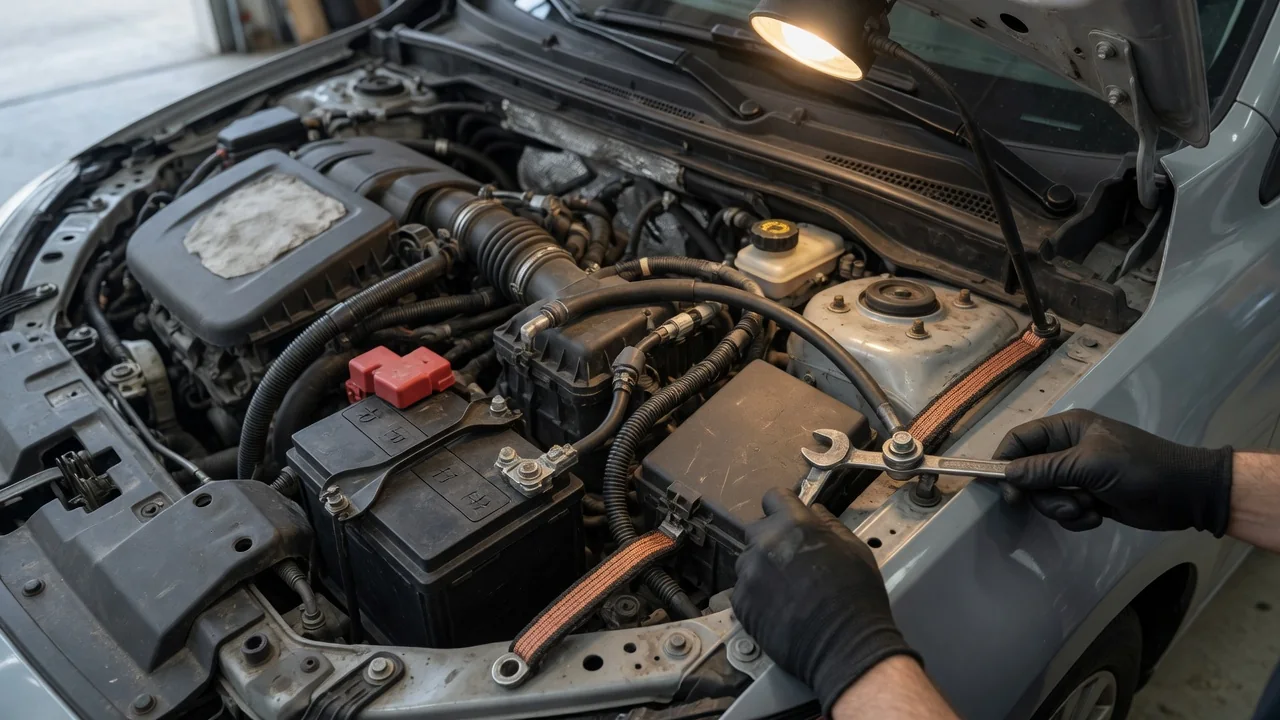
What is a car ground connection? It is the return path that lets electrical current flow back to the battery after passing through a lamp, motor, sensor, or control module. Most vehicles use the metal body, frame, and engine block as that shared path instead of running a separate wire to every component. When those joints corrode or loosen, strange electrical behavior often follows.
Circuit completion
Electricity only does work when it travels in a complete loop. Current leaves the battery's positive terminal, passes through fuses, switches, and wiring to a load such as a headlight bulb, and then must return to the negative terminal. In most passenger vehicles, the negative battery cable bolts to the body or engine, so the steel structure itself becomes the return conductor. A short wire from each component to a nearby bolt or stud finishes the loop without a long dedicated cable.
That shared arrangement saves weight and copper, but it means every circuit depends on clean metal-to-metal contact at the grounding point. A taillight, for example, may ground through its housing or through a small wire attached to the trunk floor. Paint, rust, or a loose fastener at that spot adds resistance, and the lamp receives less voltage than it should. Vehicles with aluminum or composite body panels often rely more heavily on dedicated ground wires, so layouts differ considerably between designs.
Ground straps
Ground straps are the heavy conductors that link major assemblies together. The engine and transmission usually sit on rubber mounts, which isolate vibration but also block current, so a braided strap or thick cable bridges the engine to the body or frame. Without it, the starter motor and alternator would have no reliable return path. The braided construction allows the strap to flex as the engine rocks under load, which a rigid cable would tolerate poorly over years of movement.
Under the hood, these straps typically appear as flat woven metal bands or thick black cables ending in ring terminals, bolted near the battery, firewall, or cylinder head. Their number and location depend on the manufacturer, and some vehicles add smaller straps for the hood, exhaust, or body panels to reduce radio interference. Corrosion tends to show as green or white deposits at the terminals, frayed strands, or a strap that has turned dull and brittle. Damage can also hide beneath intact insulation.
Symptoms
A weak ground rarely fails outright; it more often produces inconsistent behavior. Lights may dim or flicker when another accessory switches on, because current seeks an alternate route through a neighboring circuit. A turn signal that makes a brake light glow faintly is a classic example of this backfeeding. Slow cranking, a clicking starter, or gauges that sweep erratically can also trace back to resistance in the return path, though each of those complaints has other possible causes, including a weak battery.
Modern vehicles add another layer, since sensors and control modules compare small voltages against a ground reference. If that reference shifts, a module may report implausible readings and store fault codes for parts that are working properly. A code in that situation is evidence to interpret, not proof that the named component has failed, and many code definitions vary by manufacturer and need vehicle-specific confirmation. Several unrelated warnings appearing together, especially intermittently, often point toward a shared power or ground problem.
Everyday Use and Observations
Day to day, ground faults tend to follow conditions. Moisture, road salt, and temperature swings encourage corrosion wherever dissimilar metals meet, so problems may surface after rain, a winter of salted roads, or a car wash. Vibration matters too: a symptom that appears over bumps or when the engine torques under acceleration suggests a connection that is shifting. Noting when the trouble occurs, which accessories were running, and whether it clears on its own gives a technician a useful starting point.
Recent work on the vehicle is another clue worth remembering. Body repairs, fresh paint, undercoating, or an engine or transmission replacement can leave a strap disconnected or a mounting surface coated, interrupting contact that existed before. Aftermarket accessories such as audio amplifiers or auxiliary lights also depend on where their ground wire was attached. With the engine off, a visual check for loose, crusty, or broken straps is reasonable for most owners, bearing in mind that locations differ and some sit out of easy view.
Limits and Next Steps
Looking only goes so far, because a connection can appear clean and still carry current poorly. Corrosion often forms between the terminal and the metal beneath it, or wicks inside a cable where it cannot be seen. Technicians usually confirm the condition with a voltage drop test, measuring how much voltage is lost across the ground side while the circuit is operating. That measurement reveals resistance under real load, which a simple continuity check with the circuit switched off can miss entirely.
If symptoms persist, the vehicle's wiring diagram is the reliable guide to which ground points serve which circuits, since those assignments are specific to each model. Battery and charging system testing belongs in the same evaluation, as similar complaints overlap. Hybrid and electric vehicles contain high-voltage systems that should be left to trained personnel. Replacing parts on the strength of a code alone risks wasted expense, whereas verifying the return path first often narrows a confusing set of electrical faults to a single cause.