What Is a Car Body Reinforcement Plate? Loads, Joining and Inspection
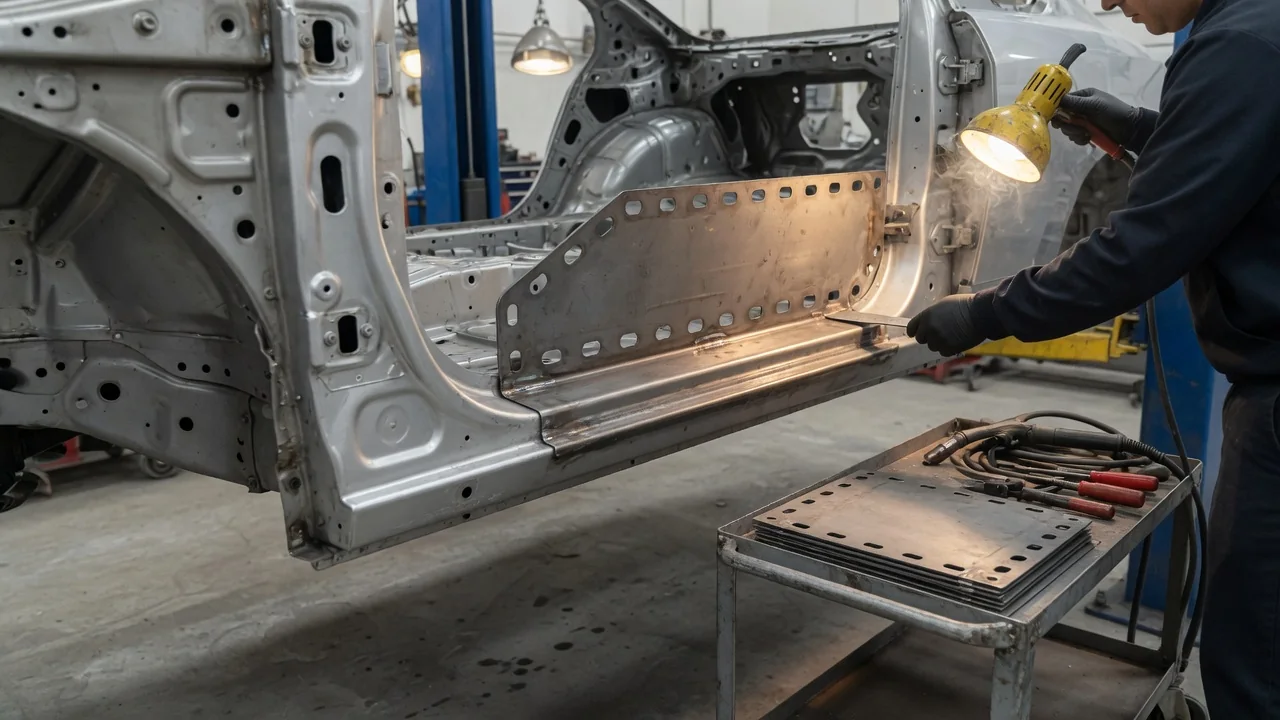
A car body reinforcement plate is a piece of sheet metal, usually steel, added to the body structure where force concentrates in a small area. Typical locations include seat belt anchors, seat mounts, suspension and subframe attachment points, door hinges, jacking points and repaired sections. The plate spreads that force over a wider area and stiffens thin metal so it resists tearing, buckling and fatigue. This guide explains how a vehicle body reinforcement plate handles localized loads, how it is joined, and how to inspect it.
Localized loads
Most modern passenger cars use a unibody, in which the floor, pillars, rails and roof form one load-bearing shell. The individual panels are relatively thin. They carry load well when they act together as box sections and spread force across their whole length. A bolt, stud or bracket works differently. It pulls or pushes on a small patch of metal, and the area around a hole carries more stress than the rest of the panel. Without extra support, thin sheet at such a point can dish, tear around the fastener, or develop cracks over time. A reinforcement plate adds local thickness and a larger footprint. Load enters the plate first, and the plate passes it into the surrounding structure over a broader area.
The loads involved are rarely just static weight. Suspension mounts see constant cyclic input from the road, and repeated small stresses can cause fatigue cracking even when a single load would be harmless. Seat belt and seat anchors must hold sudden, high loads in a collision. Hinge and striker areas take repeated opening and slamming forces. Plate shape matters as much as thickness. A sudden step from thin panel to thick plate can create a new stress concentration at the plate edge, which simply moves the crack to a different spot. For this reason reinforcements often have rounded corners, a generous footprint and sometimes formed contours that follow the panel. Common variants include doubler plates that thicken a section, backing plates behind bolted joints, and nut plates that combine reinforcement with a threaded fastening point.
Joining
At the factory, reinforcement plates are usually attached with resistance spot welds. Some locations add structural adhesive between the plate and the panel, a combination often called weld-bonding, which spreads load along the bond line rather than only at weld points. Nut plates may be welded in place or held captive in a cage so the fastener can be installed from one side. In repair and fabrication work, common methods include MIG plug welds through drilled holes, short stitch welds, approved rivets, structural adhesives and bolted backing plates. The right choice depends on the base material and the location. Many current bodies use high-strength steels that can lose strength if overheated, and aluminum structures need different equipment and techniques altogether. Manufacturer body repair procedures typically state which methods are permitted at which locations, and those procedures take priority over general shop habits.
Good joining depends on more than the weld itself. The plate must sit flat against the panel. Gaps make welds weak or inconsistent and can let the parts rub against each other under load. Excess heat on thin sheet causes warping and burn-through. Corrosion protection is the other critical factor. The overlap between a plate and a panel is a natural moisture trap, and bare metal there can rust from the inside out. Fabricators commonly use weld-through primer on mating surfaces, seal exposed seams, and apply cavity wax or similar coatings to enclosed areas after welding.
Inspection
Inspecting a reinforcement plate starts with cleaning the area so cracks and corrosion are visible. Useful signs include hairline cracks spreading from bolt holes or plate corners, elongated or deformed holes, panels that are dished or bulged around the mount, and rust staining or bubbling paint along the plate edges. Rust bleeding from a seam often indicates corrosion between the layers, which can be more extensive than it looks from outside. A good light, an inspection mirror and, for enclosed sections, a borescope help with hard-to-reach spots. On cleaned bare metal, dye penetrant can reveal fine cracks that are hard to see by eye. Fasteners that pass through the plate should be checked for looseness and tightened to the manufacturer's specified torque where that information is available.
Inspection should also consider whether the area has been repaired before. Weld beads that differ from factory spot welds, grinding marks, mismatched seam sealer or fresh undercoating over an old structure can all point to earlier work. That work may be sound, but it is worth examining more closely. If a mounting point appears to have shifted, for example after an impact to a suspension area, body measurements against the manufacturer's dimensional data can show whether the structure is still where it should be. Visual checks show surface condition. They cannot confirm the strength of a weld or a bond hidden between two layers of metal.
Practical implications and limits
A reinforcement plate cannot restore metal that has already lost its strength. If corrosion has thinned or perforated a panel, a plate welded over it leaves weak, rusting material underneath and usually hides the problem rather than solving it. The accepted approach is to cut back to sound metal and replace the section, adding reinforcement only where the repair method calls for it. Extra stiffness is also not automatically good. Crumple zones and other energy-absorbing parts of a body are designed to deform in a controlled sequence, and adding a plate in the wrong place can change how the structure behaves in a crash. That is why structural reinforcements on road cars are best guided by the vehicle manufacturer's repair information rather than improvised.
For owners, reinforcement plates matter most when something new is attached to the body or when a structural area is damaged. Tow hitches, aftermarket seats, harness anchors and roof equipment all put concentrated loads into the shell. Kits and instructions often specify backing plates for this reason, and skipping them can lead to cracked or torn mounting points. Requirements for structural repairs and modifications vary by jurisdiction and may affect vehicle inspection or insurance, so it is sensible to check local rules. For any work on load-bearing or crash-related structures, a qualified body shop working from the manufacturer's procedures is the safest route.