What Is a Car Audio Crossover?
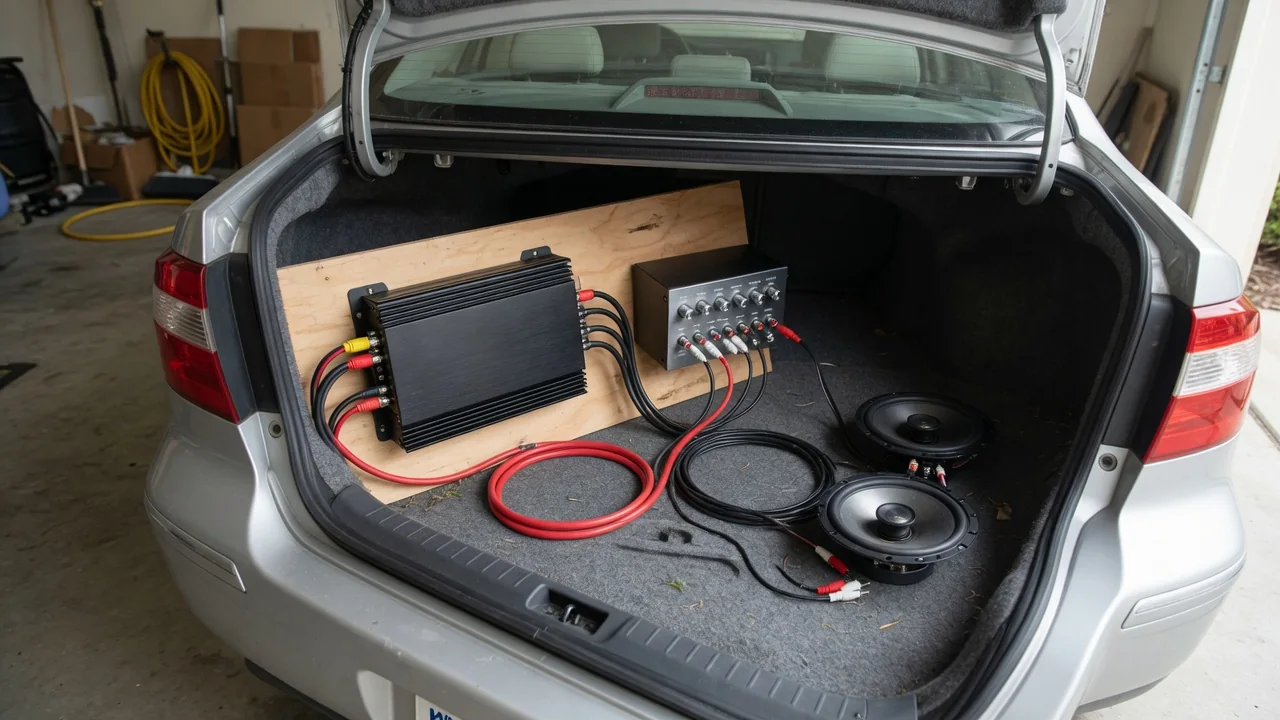
Anyone asking what is a car audio crossover is really asking how a sound system decides which speaker plays which notes. A crossover is a filter network that splits the music signal into frequency ranges and sends each range to the driver built to reproduce it, protecting small speakers and keeping the overall sound clean and balanced.
Speaker roles
Every speaker in a vehicle is built for a particular job. A subwoofer has a large, heavy cone with long travel so it can move the volume of air that deep bass demands. A door-mounted midbass or midrange driver handles vocals, guitars and most of the body of the music. A tweeter uses a very small, light dome that responds quickly enough to reproduce cymbals and other high-frequency detail. No single cone does all three jobs well, which is why most systems divide the work among several drivers.
The crossover assigns those roles electrically. A high-pass filter lets frequencies above a chosen point through and reduces everything below it, which keeps bass away from a tweeter that could be damaged by it. A low-pass filter does the opposite for a subwoofer, and a band-pass filter combines both for a midrange. Layouts differ widely between vehicles: some have tweeters in the dash or mirror pillars, others use coaxial speakers with the tweeter mounted in front of the woofer, and many have no subwoofer at all.
Passive and active approaches
A passive crossover sits between the amplifier and the speakers and needs no power supply of its own. It uses capacitors and inductors, sometimes with resistors, to filter a signal that has already been amplified. The simplest example is a small capacitor wired in line with a tweeter, often hidden behind the grille or attached to the speaker itself. Component speaker sets usually include a separate boxed network that takes one amplifier channel and divides it between the woofer and the tweeter, sometimes with a switch for tweeter level.
An active crossover filters the signal before amplification, so each speaker or speaker group gets its own amplifier channel. The filtering may live in the head unit, in an amplifier with built-in controls, or in a digital signal processor. This approach allows the crossover point and slope to be adjusted rather than fixed by parts values, and it avoids the small power loss of passive components. The tradeoff is more channels, more wiring and more setup. Many factory premium systems already work this way inside their amplifier, though the details depend on the vehicle.
Tuning basics
Two settings define a crossover: the frequency where filtering begins and the slope, which describes how quickly output falls beyond that point. Slope is expressed in decibels per octave, and a steeper slope removes unwanted frequencies more sharply. The right choices depend on the drivers involved, so the speaker manufacturer's stated usable range is the proper starting reference rather than a universal number. A small speaker generally needs its high-pass set higher than a large one, because cone size and excursion limit how much bass it can handle cleanly.
The goal is a smooth handoff, where one speaker fades out as its neighbor fades in. A gap between the subwoofer's low-pass and the door speakers' high-pass leaves a thin spot in the upper bass, while too much overlap produces a boomy, muddy hump. Phase matters as well, since two drivers playing the same notes out of step can partly cancel each other near the crossover point. Cabin acoustics shift the result in every vehicle, so adjustments are best made by listening from the driver's seat with familiar music at moderate volume.
Everyday Use and Observations
In daily driving, a well-set crossover mostly goes unnoticed, which is the point. Bass seems to come from the front of the cabin rather than from the trunk, voices stay clear when the volume rises, and door speakers do not rattle or distort on heavy bass notes. Drivers often notice that the system plays louder without strain once the small speakers are relieved of low frequencies, because cone movement that was wasted on bass they could not reproduce is no longer eating into their clean output.
Problems tend to show up in recognizable ways. Door speakers that buzz or bottom out on bass hits may be receiving frequencies below their comfortable range. Harsh, piercing treble can suggest a tweeter crossed too low or set too loud relative to the midrange. A subwoofer that reveals its location, or carries male voices, usually has its low-pass set too high. These are clues rather than proof, since similar symptoms can come from a damaged speaker, loose trim panels, poor source material or gain settings unrelated to the crossover.
Limits and Next Steps
A crossover directs frequencies; it does not create capability a speaker lacks. It will not make a small dash speaker produce deep bass, repair a torn surround, or correct every reflection in a cabin full of glass and hard plastic. Equalization, time alignment and level matching are separate tools that work alongside it. Fixed passive networks are also designed around specific drivers, so pairing one with a different speaker of another impedance can shift the actual crossover point away from what the label suggests.
A sensible next step is finding out what the vehicle already has. The owner's manual or audio menu may show whether the head unit offers high-pass and low-pass settings, and aftermarket amplifiers usually have labeled filter controls. Factory systems with separate amplifiers often apply their own filtering and equalization, which can complicate adding equipment, so confirming how that particular system is configured comes first. When replacing speakers or adding a subwoofer, a qualified car audio installer can measure the system and set the crossover to suit the actual drivers.