What Is a Car Audio Amplifier? Signal Power, Channels, and Heat Explained
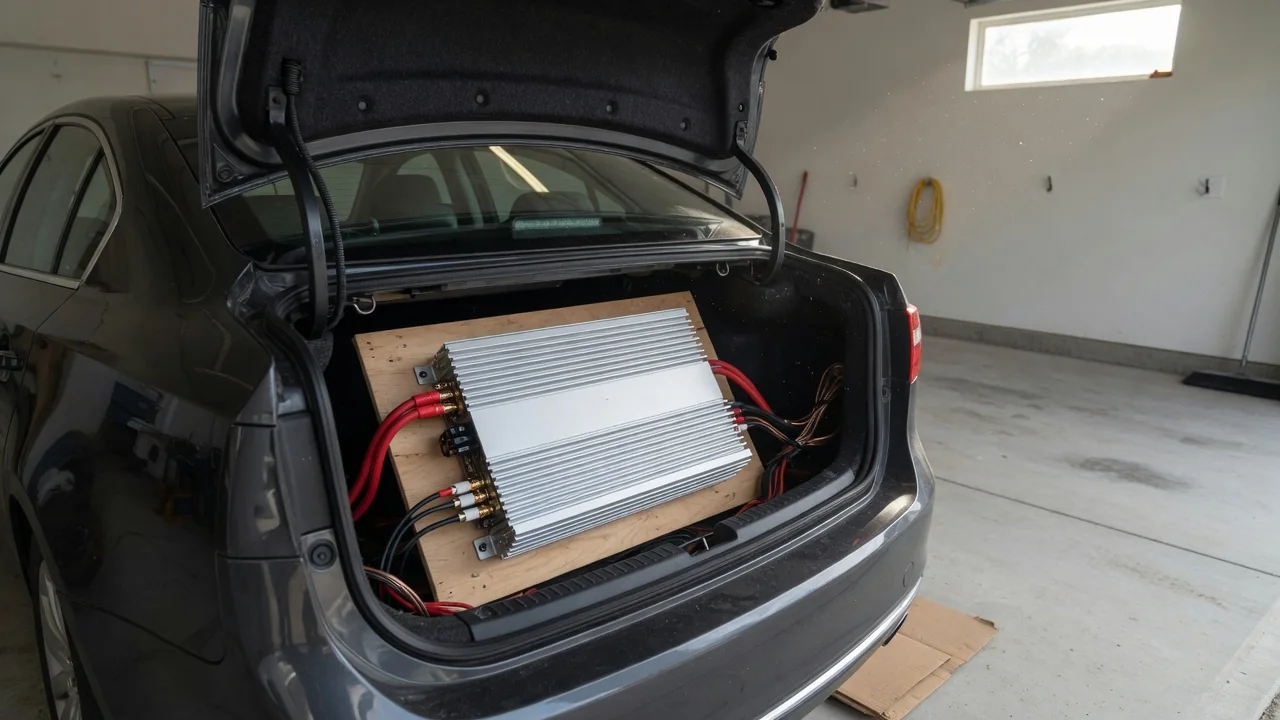
A car audio amplifier is an electronic component that takes the small audio signal produced by a head unit or other source and makes it strong enough to move speakers and subwoofers with control. Understanding what a car audio amplifier does comes down to three ideas: how it turns vehicle electrical power into signal power, how its channels divide that power among speakers, and how it manages the heat that every amplifier produces as a by-product of its work.
Signal power: turning a small signal into speaker motion
The core car amplifier function is gain. A source unit sends out an audio waveform at a low voltage, either through dedicated preamp outputs or through its own speaker outputs. That signal carries the shape of the music but very little energy. A speaker, by contrast, needs current to push its cone back and forth against the resistance of its suspension and the air in front of it. The amplifier reproduces the incoming waveform at a much larger scale, drawing the extra energy from the vehicle's electrical system rather than from the source itself.
Vehicles run on a nominal 12-volt direct-current system, which by itself limits how much voltage can be placed across a speaker. Many external amplifiers therefore include an internal power supply that converts the battery voltage into higher positive and negative supply rails. The output stage then swings between those rails to follow the music. This is one reason a separate amplifier can deliver more usable power than the small output circuitry built into many head units, which must work directly from the supply voltage and fit into a compact chassis.
Power ratings describe how much of that energy can be delivered, but the numbers depend on conditions. Continuous or RMS ratings refer to sustained output under defined test conditions, while peak or maximum figures describe brief bursts and are not directly comparable. Output also changes with speaker impedance and supply voltage, so the same amplifier can produce different power into different loads. The gain control on an amplifier is not a volume knob. It matches the amplifier's input sensitivity to the source signal so the system reaches full output without pushing either stage into clipping, the distorted, flattened waveform that occurs when an amplifier runs out of voltage headroom.
Channels: how amplifier output is divided
A channel is an independent amplification path with its own output terminals. Each channel typically drives one speaker or one group of speakers wired together. Common layouts include mono amplifiers, usually intended for subwoofers; two-channel units for a pair of speakers; four-channel units for front and rear speakers; and multichannel designs that combine several full-range channels with a separate bass channel. The number of channels determines how many speakers can be powered separately and how much control the installer has over each one.
Many multichannel amplifiers allow two channels to be bridged, which combines them to drive a single speaker with greater power than either channel provides alone. Bridging also changes the load the amplifier sees, so it is only appropriate when the speaker impedance falls within what the manufacturer specifies for bridged operation. Amplifiers frequently include crossover filters per channel or per channel pair. A high-pass filter keeps deep bass out of small speakers, and a low-pass filter limits a subwoofer channel to low frequencies, so each speaker receives the range it can reproduce effectively.
Some amplifiers also accept speaker-level inputs, which lets them work with a factory head unit that lacks preamp outputs. In vehicles with integrated factory audio, signal processing may already be applied before the amplifier stage, so how channels should be assigned depends on that specific system rather than on a general rule.
Heat: where the wasted energy goes
No amplifier converts all of the electrical power it draws into sound. The portion that does not reach the speakers is dissipated as heat in the output transistors and power supply. How much heat depends largely on the amplifier's design class. Class AB designs keep their output devices partly conducting much of the time, which favors low distortion but wastes a substantial share of input power. Class D designs switch their output devices rapidly on and off and filter the result back into an audio waveform, which generally wastes much less energy for the same output and allows a smaller chassis.
Heat is removed mainly through the amplifier's metal housing, which often doubles as a heat sink with fins to increase surface area. Some models add cooling fans. Because rising temperature affects component life and stability, most amplifiers include thermal protection that reduces output or shuts the unit down until it cools. Low speaker impedance, sustained high volume, clipping and inadequate supply voltage all increase heat, since they raise the current the output stage must handle or reduce its efficiency.
Practical implications and limits
These mechanisms explain why choosing an amplifier is not simply a matter of adding watts. Its output is only as stable as the electrical supply behind it, so wiring of adequate gauge, a fuse near the battery and a solid ground connection matter as much as the amplifier itself. A vehicle's charging system has finite capacity, and how much additional load it tolerates varies by vehicle, so manufacturer guidance for both the car and the amplifier should take priority over general assumptions.
Mounting location affects cooling. An amplifier tucked under carpet, packed against luggage or sealed inside a tight enclosure may reach protection mode sooner than one with free air around it. Likewise, a mismatch between channel count and speaker layout can leave speakers unpowered or force compromises such as bridging, rewiring or running speakers full range. Symptoms like an amplifier cutting out during long listening sessions often point back to heat, impedance or supply problems rather than to the source unit.
General principles also have limits. Factory systems with built-in amplifiers, active noise control or digital audio networks may not accept an aftermarket amplifier in a straightforward way, and procedures differ between vehicles. For any specific installation, the owner's manual, the vehicle's service information and the amplifier's own documentation remain the authoritative references.