What Is a Capacitor in Car Electronics?
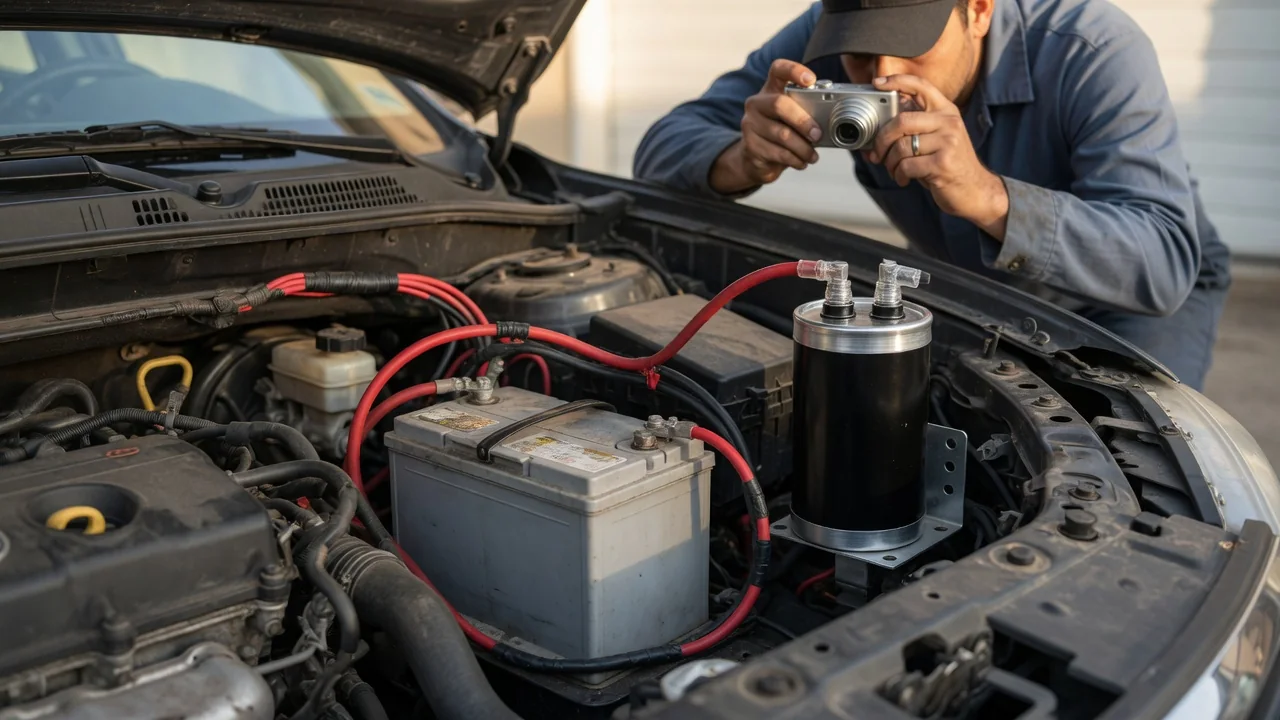
If you have ever wondered what is a capacitor in car electronics, the short answer is that it is a small component that stores electrical charge briefly and releases it when the circuit needs it. That simple behavior lets it smooth uneven voltage, absorb electrical noise, and cover very short gaps in supply across the many modules in a modern vehicle.
Electrical role
A capacitor consists of two conductive plates separated by an insulating layer called a dielectric. When voltage is applied, charge builds up on the plates, and when the supply dips, that charge flows back into the circuit. Unlike a battery, which produces energy through a chemical reaction, a capacitor holds energy in an electric field, so it charges and discharges very quickly but stores comparatively little. Its capacity is measured in farads, with most automotive parts rated in tiny fractions of that unit.
In a vehicle, the supply voltage is never perfectly steady. The alternator output carries ripple, and switching on a blower motor, starter, or cooling fan can pull the system voltage down momentarily. A capacitor placed across a supply line acts like a small reservoir, filling during peaks and giving back during dips, which is what smoothing means. Drivers rarely see this directly, and the size, type, and placement of these parts differ considerably between manufacturers and individual control modules.
Vehicle applications
Almost every electronic control unit contains capacitors on its circuit board. Near the power input, larger ones filter the incoming supply so the microprocessor receives a clean, stable voltage. Smaller ones sit beside individual chips to handle rapid current demands and to shunt high-frequency noise to ground. Similar filtering appears in instrument clusters, infotainment units, sensor circuits, and lighting drivers, where an unsteady supply could otherwise cause flicker, erratic readings, or audible interference through the speakers.
Temporary energy storage shows up in more specific roles. Some restraint systems are designed with reserve capacitors intended to keep the airbag circuit powered briefly if the battery connection is lost during a collision. Aftermarket audio installations sometimes add a large stiffening capacitor near the amplifier to support heavy bass peaks. Hybrid and electric vehicles use substantial capacitors inside inverters to steady the high-voltage link. Whether a particular vehicle uses any of these arrangements depends on its design and should be confirmed in its service information.
Safety limits
Because a capacitor can hold charge after the power source is removed, it deserves respect. In low-voltage modules the stored energy is usually small, but restraint system reserves can remain active for a period after the battery is disconnected, which is why manufacturers specify a waiting time before any work near airbag components. That time varies by vehicle, so the published procedure for the specific model is the only reliable guide, not a general rule of thumb.
High-voltage systems in hybrid and electric vehicles raise the stakes considerably. Inverter capacitors can hold a dangerous charge, and working on them calls for trained technicians, proper isolation steps, and verified discharge using suitable equipment. Large audio capacitors also demand care, since shorting their terminals can release heavy current instantly, causing sparks or burns. Every capacitor also has a rated voltage and temperature range, and polarized types must be connected the right way around, or they can fail, sometimes violently.
Everyday Use and Observations
When capacitors do their job, nothing noticeable happens, which is the point. Interior lights that stay steady when the window motors run, a radio free of whine that rises with engine speed, and a display that does not reset during cranking all reflect good filtering somewhere in the system. Some vehicles also keep certain functions alive for an instant after power is cut, allowing a module to save its settings before shutting down in an orderly way.
Aging capacitors can produce the opposite picture. Electrolytic types may dry out or leak over years of heat cycling, and a module with degraded filtering might show intermittent resets, flickering backlighting, noise in the audio, or stored fault codes relating to supply voltage or internal faults. Those symptoms are evidence to interpret rather than proof, because a weak battery, poor ground, corroded connector, or charging problem can create nearly identical behavior. Code meanings also differ between manufacturers and need vehicle-specific confirmation.
Limits and Next Steps
A capacitor is not a substitute for a healthy battery or charging system. It can cover gaps measured in fractions of a second, not sustain a load, so adding one will not cure dimming headlights caused by an undersized alternator, worn cables, or a tired battery. In audio setups, a stiffening capacitor may ease brief voltage sag, yet it cannot supply energy the electrical system does not produce. Understanding that boundary prevents money being spent on the wrong fix.
When electrical symptoms appear, the sensible sequence starts with the basics: battery condition, charging output, and the integrity of grounds and connections, checked against the specifications for that vehicle. If a module is still suspected, diagnosis and any board-level repair belong with a qualified technician or electronics specialist who has the correct wiring diagrams and test equipment. For owners, the practical takeaway is simply knowing that these small components quietly stabilize power throughout the car, and that their failure is one possibility among several.