What Is a Brake Rotor?
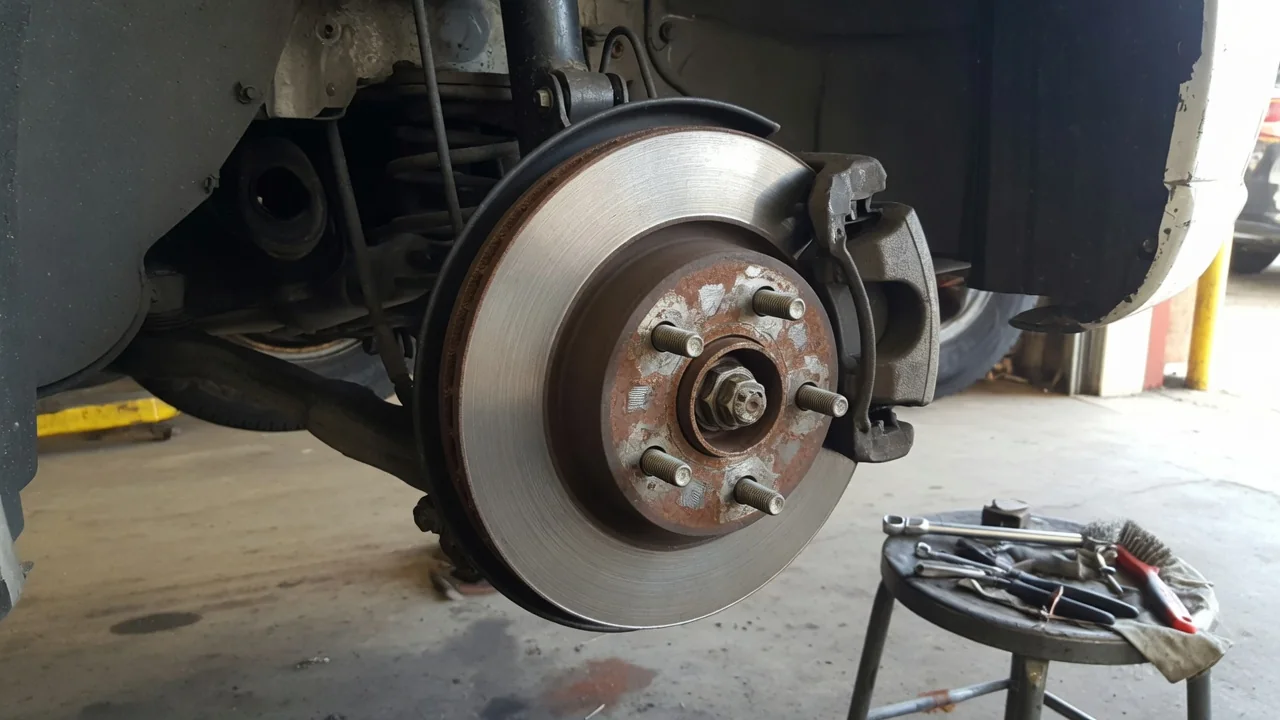
What is a brake rotor? It is the metal disc mounted behind each wheel that spins with the tire and gives the brake pads something to squeeze. When you press the pedal, the caliper clamps the pads against that disc, and friction turns the vehicle's motion into heat. Understanding this rotating friction surface makes it easier to interpret the noises, vibrations, and wear you notice.
Contact with pads
A brake rotor has two machined faces, one on each side, and a brake pad sits against each one. The caliper straddles the edge of the disc like a clamp. When hydraulic pressure builds from the pedal, the caliper's piston pushes the inner pad into the rotor, and the caliper body pulls the outer pad against the opposite face. Because the rotor is fastened to the wheel hub, slowing the disc slows the wheel and tire attached to it.
The contact area is the swept band where pad material rubs the rotor, and you can often see it through the wheel spokes as a smooth, shiny ring. A thin layer of pad material normally transfers onto that surface during use, which helps the pair grip consistently. Layout differs by vehicle: some use a sliding caliper with a piston on one side, others use fixed calipers with pistons on both sides, and some vehicles have drum brakes instead of rotors on the rear axle.
Heat
Stopping a moving vehicle means getting rid of its kinetic energy, and the rotor is where most of that energy ends up as heat. Friction between pad and disc raises the surface temperature quickly, so the rotor must absorb that heat and then release it to the passing air. Cast iron is a common rotor material because it tolerates repeated heating and cooling and provides a stable friction surface, though some performance vehicles use carbon-ceramic or other composite designs.
Many front rotors are vented, meaning two friction plates are separated by internal vanes that pump air through the center as the disc spins. Solid rotors, made as a single plate, are often found where braking loads are lighter, such as on the rear of some cars. Heavy use, such as a long downhill grade or towing, can overheat the system and cause brake fade, where the pedal feels less effective. Bluish discoloration or dark spots on the rotor face can hint at past overheating.
Wear observations
Rotors wear slowly as the pads scrub metal away, and the disc gradually becomes thinner. A raised lip at the outer edge of the friction surface is a common visible sign, since the pad does not sweep that outermost rim. Shallow, even lines running around the face are normal, while deep grooves you could catch a fingernail in suggest something abrasive, such as a pad worn down to its backing plate, has been cutting the surface.
Surface rust after rain or a car wash is ordinary on iron rotors and usually wipes off within the first few stops. Heavier corrosion that leaves pitting or flaking across the swept area, often seen on vehicles that sit for long periods, is a different matter. Uneven thickness or uneven deposits of pad material can also develop, and drivers often describe the result as warped rotors. Manufacturers set a minimum thickness for each rotor, frequently cast or stamped on the part, and that figure varies by vehicle.
Everyday Use and Observations
In normal driving, healthy rotors go unnoticed: the pedal feels firm and the vehicle slows smoothly and quietly. A pulsing pedal or a steering wheel that shakes during braking often points toward thickness variation in the front rotors, although worn suspension parts or wheel issues can produce similar sensations. A grinding or scraping sound deserves prompt attention because it may indicate metal contact with the disc, while a light squeal can have several causes, including pad wear indicators.
How quickly rotors wear depends heavily on use. Stop-and-go city traffic, mountain roads, heavy loads, and hard braking all work the friction surface harder than steady highway cruising. Hybrids and electric vehicles rely partly on regenerative braking, so their rotors may see less friction use and can be more prone to surface rust from sitting idle. Front rotors usually handle more of the braking effort than the rears because weight shifts forward as the vehicle slows, so the two axles often wear at different rates.
Limits and Next Steps
A look through the wheel reveals only part of the story. The inner face of the rotor is hidden, and it sometimes wears or corrodes worse than the side you can see. Thickness, runout, and parallelism have to be measured with proper tools against the specifications for that particular vehicle. Warning lights add evidence but not a verdict; a brake or ABS light, or a stored fault code, points to an area that needs diagnosis and does not prove the rotor itself has failed.
If you notice vibration, noise, deep scoring, or a longer stopping distance, having the brakes inspected by a qualified technician is the sensible next step, since the system is critical to safety. Depending on condition and the manufacturer's limits, a shop may resurface the rotors or recommend replacement, commonly alongside new pads so the surfaces bed in together. Rotors are generally serviced in axle pairs to keep braking balanced side to side. The owner's manual and service information provide the correct specifications for your vehicle.