What Is a Brake Light Switch?
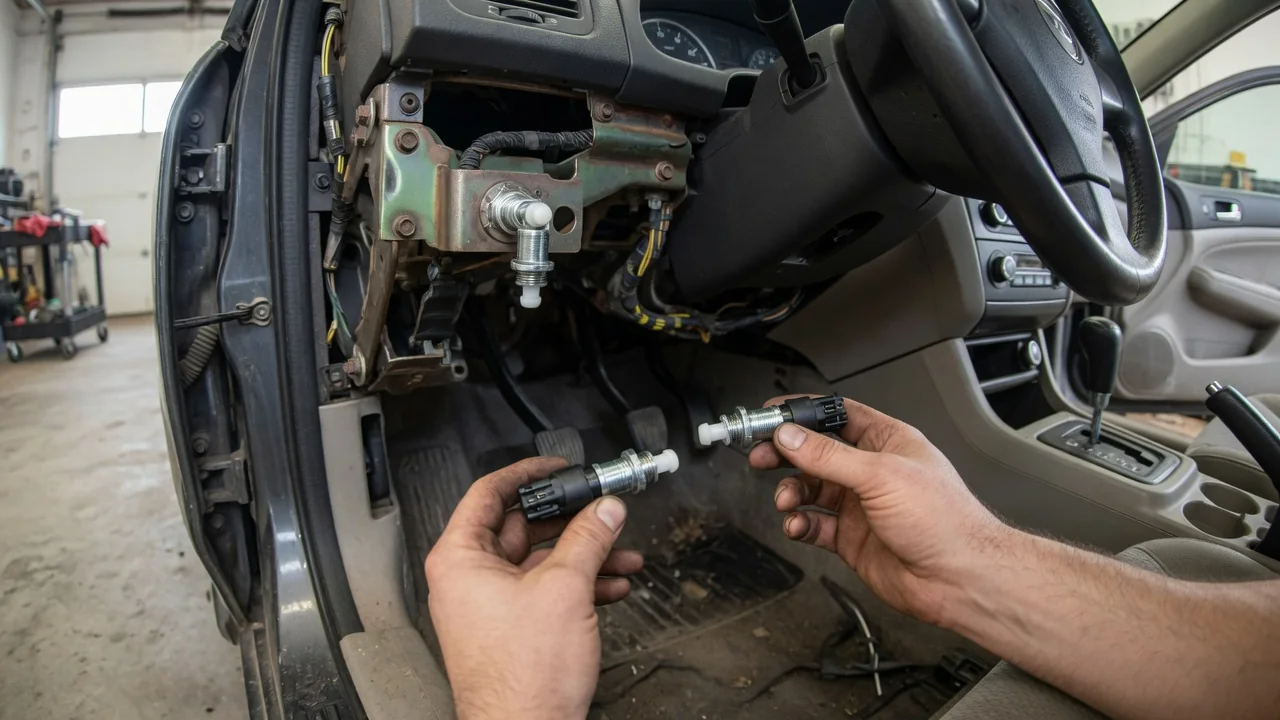
Drivers asking what is a brake light switch are usually trying to understand how a press of the pedal turns into light at the back of the car. The switch is a small electrical device that detects pedal movement and tells the vehicle the driver is slowing. This article explains where it sits, what its signal does, and how problems tend to show up.
Switch location
On most passenger vehicles, the brake light switch is mounted on a bracket above the brake pedal arm, tucked up under the dashboard near the steering column. A small plunger or contact rests against the pedal arm while the pedal is released. When the driver presses down, the arm moves away, the plunger changes position, and the electrical state of the switch changes. Looking into the driver footwell with a flashlight often reveals a compact plastic body with a wiring connector attached.
Location is not universal, though. Some older vehicles and certain designs use a pressure-operated switch in the hydraulic system, which reacts to fluid pressure rather than pedal travel. Newer vehicles may use a pedal position sensor instead of a simple on-off contact, and some integrate that sensing into an electronic brake unit. Trim panels, knee airbags, and wiring looms can also hide the part from view, so the service information for the specific vehicle is the reliable guide to where it actually lives.
Signal use
The most visible job of the switch is lighting the rear stop lamps. In a traditional circuit, pressing the pedal closes the contacts and sends battery voltage through a fuse to the brake lamp bulbs and the high-mounted center lamp. In many modern vehicles, the switch instead sends a low-current signal to a body control module, which then powers the lamps itself. Either way, the driver behind sees the same result: brighter red lights the moment the pedal moves.
That same signal is often shared with other systems. Cruise control typically cancels when it sees brake input, an automatic transmission shift interlock may need it before the selector leaves park, and push-button start systems commonly require a pressed pedal. Stability control, antilock braking, and engine management may also read it. Many switches carry two circuits for this reason, one for the lamps and one for control modules, though exactly which systems listen to the signal depends on the manufacturer and model.
Failure symptoms
A switch that fails open usually leaves the stop lamps dark when the pedal is pressed, which the driver cannot see from the seat. One that sticks closed or is out of adjustment can keep the lamps lit constantly, sometimes draining the battery overnight. Intermittent contacts may make the lamps flicker or work only with firm pedal pressure. Because bulbs, fuses, sockets, and wiring can produce identical symptoms, dark or stuck-on lamps point toward the circuit, not automatically toward the switch.
Secondary symptoms depend on which systems share the signal. A shifter that will not leave park, cruise control that refuses to set or drops out, an engine that will not start with the button, or stability and antilock warning lamps can all trace back to a missing or implausible brake signal. A stored fault code related to the brake switch circuit is evidence worth interpreting, not proof the part has failed, and code meanings can vary by manufacturer, so vehicle-specific confirmation matters.
Everyday Use and Observations
In daily driving, the switch works silently thousands of times, and its timing matters. The lamps should come on with light pedal pressure, before the vehicle slows noticeably, and go out as soon as the foot lifts. A simple check is to back up near a garage door, wall, or shop window at dusk and watch the red reflection while pressing the pedal. Asking a helper to stand behind the vehicle gives the same answer and also shows whether every lamp lights.
Small details are worth noticing. Some vehicles emit a faint click from the footwell as the pedal starts to move, while others with electronic sensors are silent. A driver who rests a foot on the pedal may light the lamps without really braking, which confuses following traffic. Certain vehicles also illuminate the stop lamps during strong regenerative braking or adaptive cruise slowing, without any pedal movement at all, because a control module commands them rather than the switch alone. Behavior like this varies by vehicle design.
Limits and Next Steps
Understanding the switch does not make it the answer to every brake lamp problem. One dark lamp with the others working suggests a bulb, socket, or ground fault rather than the switch, while all lamps failing together makes the fuse, switch, or shared wiring more plausible. Module-controlled lighting adds another layer, since software and bulb monitoring can influence what the lamps do. A dashboard warning about a lamp failure is a useful clue, but how it is worded and triggered differs between vehicles.
Since inoperative stop lamps are a safety problem and commonly a legal one, a suspected fault deserves prompt attention. The owner's manual identifies the relevant fuse and bulb types, and a qualified technician can test the switch signal with a meter or scan tool before anything is replaced. Some switches need precise adjustment or a specific installation sequence, and working under the dash near airbag components calls for care, so the manufacturer's procedure for the particular vehicle should guide any repair.