What Is a Brake Booster?
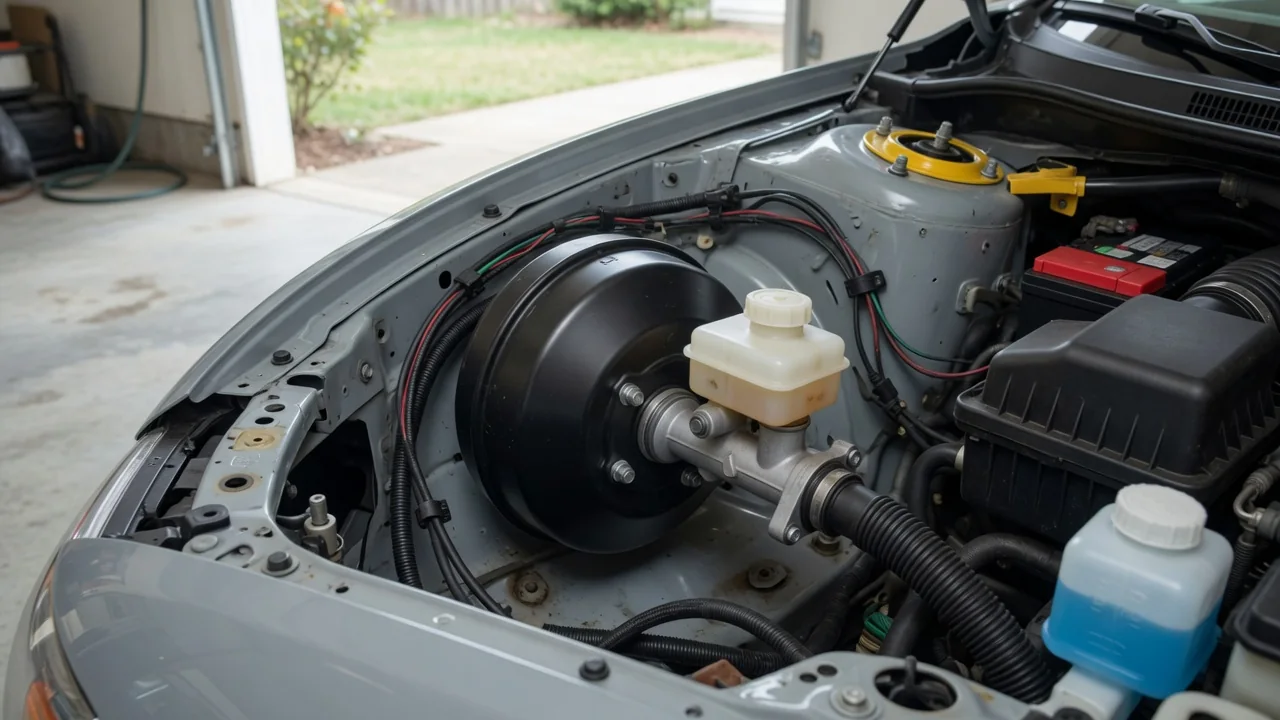
What is a brake booster? It is the component between the brake pedal and the master cylinder that multiplies the force of your foot, so a moderate press produces strong hydraulic pressure at the wheels. Understanding how this pedal assist works helps drivers recognize normal brake feel, notice early changes, and describe symptoms clearly when a vehicle needs professional attention.
Driver input
Every stop begins with the driver's foot. Pressing the brake pedal moves a pushrod that passes through the firewall into the booster, which sits in front of the master cylinder on most vehicles. The pedal itself is a lever, so it already multiplies leg force mechanically. The booster adds to that effort, responding in proportion to how hard and how far the pedal is pressed rather than simply switching full assistance on or off.
This proportional behavior is what makes braking feel controllable. A light touch in slow traffic produces gentle deceleration, while a firm push in an emergency delivers much greater force to the master cylinder. Drivers can observe this as a pedal that moves smoothly and predictably with modest effort. Pedal travel, firmness, and overall feel differ between a compact car, a heavy pickup, and a performance model, because manufacturers tune pedal ratio and assist level to each vehicle.
Assist source
The traditional design is a vacuum booster, a round metal canister containing a flexible diaphragm. In many gasoline engines, intake manifold vacuum is applied to both sides of the diaphragm while the pedal is at rest. Pressing the pedal opens a valve that admits atmospheric air to one side, and the resulting pressure difference pushes the diaphragm toward the master cylinder. A check valve in the vacuum hose holds reserve vacuum for a limited number of assisted stops.
Not every powertrain produces usable vacuum. Diesel engines, some turbocharged gasoline engines, hybrids, and electric vehicles often rely on a mechanical or electric vacuum pump instead. Other vehicles use hydraulic assist, which borrows pressure from the power steering system or a dedicated pump, and many newer models use an electromechanical booster driven by an electric motor. Which arrangement a particular car uses depends on the manufacturer and model year, so the owner's manual or service information is the reliable reference.
Hard-pedal clues
A brake pedal that suddenly feels stiff and demands much more leg effort is the classic sign of lost assist. The brakes still work hydraulically, but the driver is supplying nearly all the force, so stopping distances can grow noticeably. With vacuum systems, common contributors include a cracked or disconnected vacuum hose, a sticking check valve, a torn diaphragm, or a weak vacuum pump. A hissing sound near the pedal when it is pressed can point toward a leak.
Other clues may accompany the hard pedal. A vacuum leak through the booster can let unmetered air into the engine, sometimes causing a rough idle or a change in engine speed when the brakes are applied. On vehicles with electronic assist, a warning light or stored fault code may appear instead. A code is evidence to interpret alongside testing, not proof that the booster itself has failed, and many codes are manufacturer specific and need vehicle-specific confirmation.
Everyday Use and Observations
In daily driving, a healthy booster goes unnoticed. The pedal feels consistent from the first stop of the morning to the last one at night, and effort stays light whether parking or slowing from highway speed. One familiar observation involves vacuum-assisted cars: with the engine off, pressing the pedal several times uses up stored vacuum and the pedal becomes firm. When the engine starts with a foot resting on the pedal, it typically sinks slightly as assist returns.
Conditions can shape what a driver notices. After a cold start, at high altitude, or during repeated stops in quick succession, available vacuum may be lower and pedal feel may change slightly on some vehicles. Cars with electric or hydraulic assist may produce a brief pump or motor sound when the door opens or the ignition is switched on, which is often normal for that design. Knowing the usual sounds and feel of a specific vehicle makes genuine changes easier to spot.
Limits and Next Steps
A booster only multiplies pedal force; it does not create friction or hydraulic pressure on its own. Worn pads, glazed rotors, old or contaminated fluid, air in the lines, and seized calipers all affect stopping regardless of how well the assist works. For that reason, a soft or sinking pedal usually points elsewhere in the system, while a hard pedal can also come from causes other than the booster. Symptoms narrow the possibilities but rarely identify one part with certainty.
Any marked change in pedal effort deserves prompt attention, because braking performance is a direct safety matter. If the pedal becomes hard, allow extra following distance, avoid unnecessary driving, and arrange an inspection by a qualified technician. Proper diagnosis typically involves checking the vacuum or pressure supply, hoses, valves, and related electronics before any component is condemned. Sharing specific details, such as when the stiffness appears, any noises, and any warning lights, helps the technician reach an accurate conclusion efficiently.