What Is a Bedplate Engine Block? Crank Support, Stiffness and Assembly
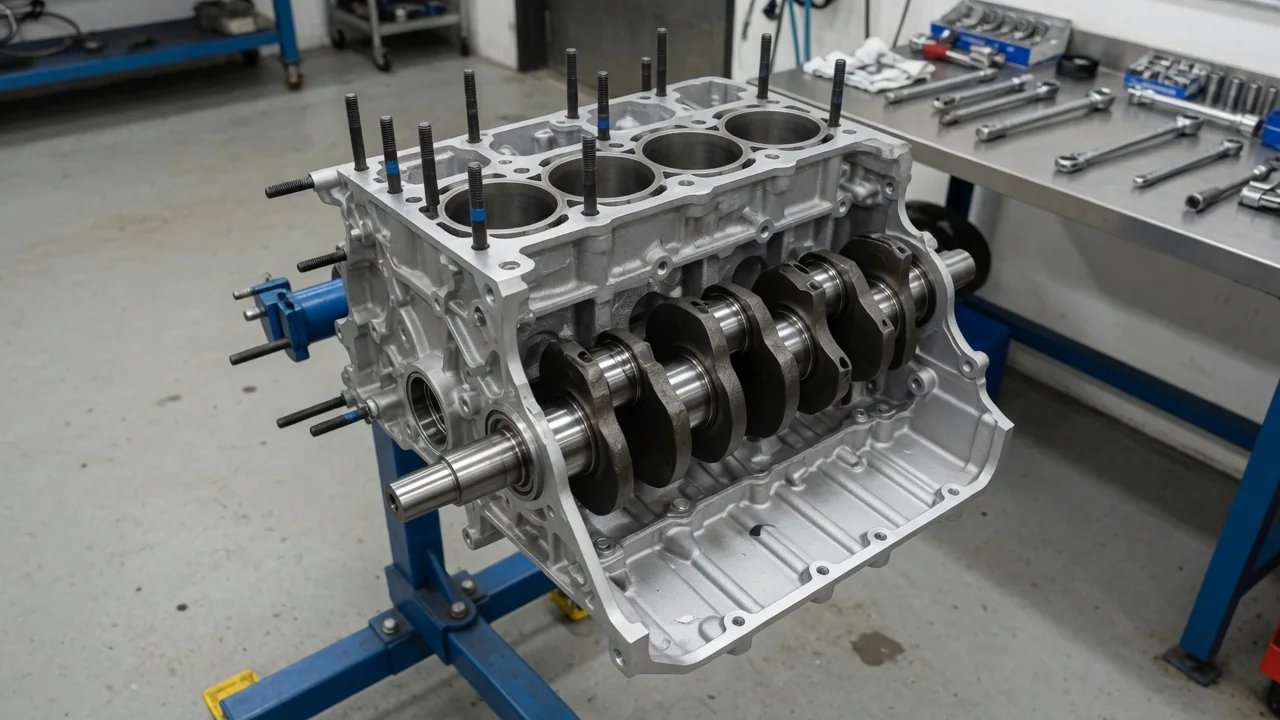
A bedplate engine block is a two-piece crankcase design. The lower half of the block is a single structural part that holds the crankshaft in place. Instead of bolting a separate cap over each main bearing, the engine uses one bedplate that contains all the lower main bearing saddles. The bedplate bolts to the upper block along the crankshaft centerline. This article explains how a bedplate supports the crank, why it adds stiffness, and what it means for assembly and repair.
Crank support: how a bedplate holds the crankshaft
In a conventional block, the upper half of each main bearing bore is machined into the block. The lower half is formed by an individual main cap. Each cap is a separate part held by two or more bolts, and the crankshaft turns in bearing shells clamped between the block and the caps. A bedplate replaces those individual caps with one continuous piece. The lower bearing saddles are part of the same casting or assembly. Every main journal is therefore supported by a structure tied to its neighbors rather than by an isolated cap.
The joint between the block and the bedplate usually sits at or near the crankshaft centerline. In effect, the crankcase is split horizontally into upper and lower halves. Main bearing shells sit in both halves, and the bolts that clamp them pass through the bedplate into the block. Many designs cast iron or steel inserts into the bearing areas, especially when the bedplate itself is aluminum. The general purpose is to keep main bearing clearances more stable as temperatures change, because aluminum expands more than a steel crankshaft. Whether a given engine uses inserts, and of what material, is a design-specific detail found in its service documentation.
Stiffness: why engineers choose a bedplate design
Combustion pressure pushes the pistons down, and the connecting rods pass that load to the crankshaft. On every power stroke, the crankshaft in turn loads the main bearings and tries to pull them away from the block. Individual caps can move slightly relative to one another and to the block, which is often described as cap walk or main bearing flex. When all the lower saddles are joined into one piece, the bottom end behaves more like a closed box. The bedplate ties the main bearings together side to side and front to back, and this resists bending and twisting of the crankcase.
That added rigidity helps keep the crankshaft running true in its bearings, which supports a consistent oil film and bearing life. It can also reduce vibration and noise transmitted through the lower engine structure. In some layouts, it gives the transmission bellhousing and engine mounts a stiffer surface to attach to. For engines with lightweight aluminum blocks, a bedplate is one way to regain stiffness without simply adding mass to the upper block. This is the main reason the engine block bedplate design appears in many modern aluminum engines and in engines intended for higher output.
A bedplate is related to, but not the same as, a main bearing girdle or ladder frame. A girdle typically ties separate main caps together after they are installed, while a true bedplate forms the caps itself. Manufacturers and technicians do not always use these terms consistently. The exact construction of a particular engine is best confirmed from its own manual.
Assembly: machining, sealing, and clamping
The block and the bedplate together form each main bearing bore, so the two parts are machined as a matched set. The bedplate is typically bolted to the block during manufacturing, and the main bores are line-bored in that assembled state. The bores are round and aligned only when the same two parts are reassembled in the same position. Dowels or other locating features keep them registered. As a result, a bedplate generally cannot be swapped between blocks the way many other engine parts can be exchanged.
The parting surface between the block and the bedplate must also seal the crankcase, because oil fills the area around the crankshaft. Depending on the design, the seal may be a formed-in-place sealant applied in a specified bead pattern, a gasket, or a combination of both. The manufacturer usually specifies the sealant type, the bead size, and how much time is allowed before the parts are joined. The mating surfaces must be clean and free of old material for the seal to hold.
Clamping follows a defined procedure. Main bearing bolts are commonly tightened in a specific sequence and in several stages. Perimeter bolts that hold the outer edges of the bedplate are sometimes tightened afterward. Many current designs use torque-to-yield or angle-torque bolts that are intended for one use only. Bearing clearance is checked before final assembly. Crankshaft end play is also verified, because the thrust bearing is captured between the block and the bedplate. Exact sequences, values, and bolt reuse rules vary by engine and come from its service information.
Practical implications and limits
For owners, the most visible effect of a bedplate shows up during repair. On a conventional engine, a technician can sometimes drop the oil pan and remove a single main cap to inspect or replace a bearing while the engine stays in the vehicle. With a bedplate, the crankshaft is usually reachable only after the entire lower section is unbolted and the joint is separated. In many vehicles, that means removing the engine and turning it over on a stand. Bottom-end work therefore tends to take more labor, which is worth weighing when deciding how to address a worn bearing or a damaged crankshaft.
Damage is also handled differently. If a main bearing spins or a bore is scored, the fix may require machining the block and the bedplate together. A replacement block is often supplied with its matching bedplate. Mixing parts from different engines is a common route to misaligned bores. A leaking bedplate seam is another possible maintenance item. It is resealed by separating the halves and applying new sealant, not by simply retightening the bolts.
A bedplate does not guarantee durability on its own. Bearing life still depends on oil quality, service intervals, cooling, and how the engine is driven. A well-designed engine with individual main caps can also be very reliable. The bedplate answers a structural question by giving the crankshaft a stiffer, more unified foundation. Whether that matters for a specific vehicle, and how that engine should be serviced, should be checked against its own repair manual rather than assumed from the general design.