What Is a Battery Maintainer for a Stored Car?
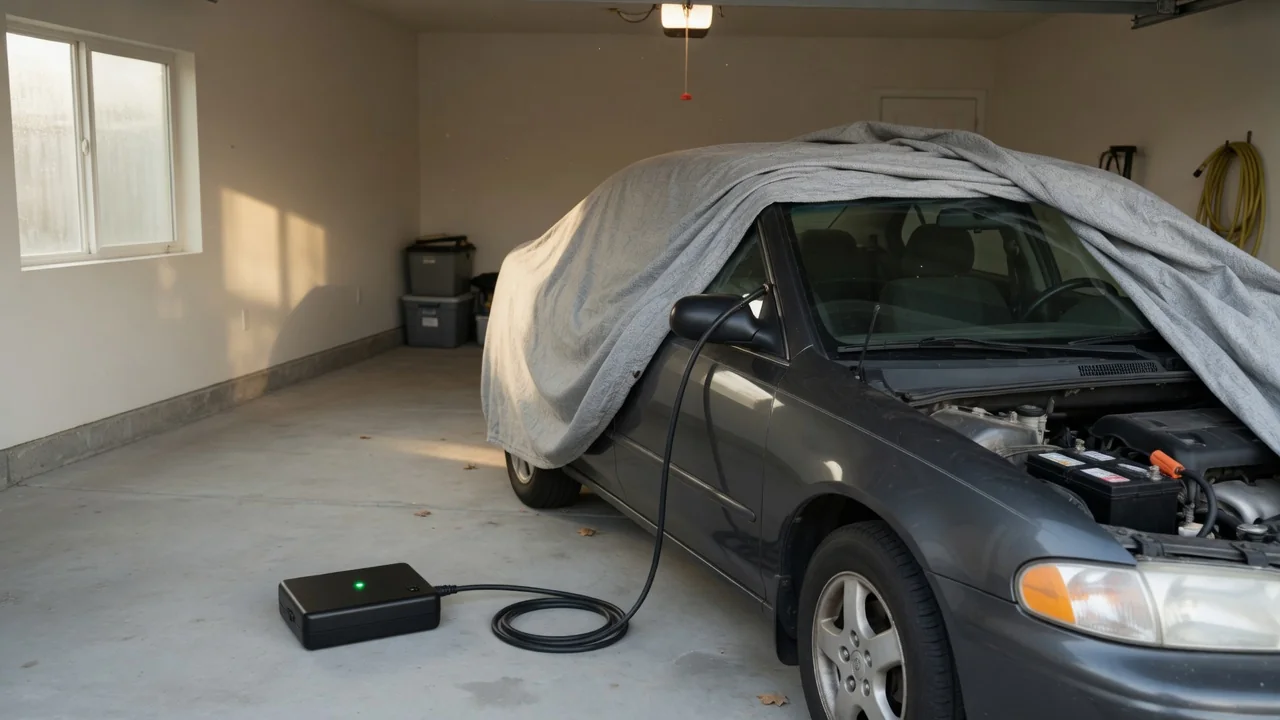
A battery maintainer is a low-output charger designed to stay connected to a vehicle's 12-volt battery for long periods, keeping it near full charge while the car sits unused. For anyone researching car battery maintainer storage, the core idea is simple: a parked car's battery slowly loses charge, and a maintainer replaces that loss automatically without overcharging. This guide explains how charge support works, how to connect a maintainer correctly, and what to check while the car is stored.
Charge support
Even when a car is parked and switched off, its 12-volt battery keeps losing energy. Part of the loss is natural self-discharge inside the battery, and part comes from parasitic loads such as control module memory, alarm systems, keyless entry receivers and clocks. How quickly the charge drops depends on the vehicle, the battery's age and condition, and the storage temperature. A lead-acid battery that sits partially discharged for weeks is prone to sulfation, a buildup of crystals on the plates that can permanently reduce capacity, and a deeply discharged battery is also more vulnerable to freezing in cold weather.
A battery maintainer counters this by supplying just enough current to replace what is lost. Most modern maintainers are microprocessor-controlled: they measure battery voltage, charge when it falls, and then switch to a float or maintenance mode that holds the battery at a steady level or cycles on and off as needed. This automatic control is what separates a maintainer from an older-style trickle charger, which delivers a small constant current regardless of the battery's state and can overcharge it over long periods, drying out electrolyte and damaging the plates.
Battery chemistry also matters. Flooded, enhanced flooded (EFB), AGM, gel and lithium batteries have different charging requirements, and many maintainers offer a mode selector for this reason. Choosing the mode that matches the installed battery, and using a lithium-compatible unit where the battery is lithium, lets the maintainer apply appropriate charging behavior. Maintainers are intentionally low-output devices built to hold a charge, not to recover a flat battery quickly, and some will not begin charging at all if battery voltage is very low.
Correct connection
The vehicle's owner's manual is the first reference for connection, because battery location and recommended charging points differ widely. Some batteries sit under the hood, others in the trunk, under a seat or beneath the floor, and some vehicles provide remote positive and ground posts specifically for charging or jump-starting. Vehicles with a battery monitoring sensor on the negative terminal may direct you to connect the negative lead to a body ground point rather than the battery post, so the car's electrical management can account for the charge being added.
A common general sequence is to leave the maintainer unplugged, attach the red positive clamp to the positive terminal or post, then attach the black negative clamp to the negative terminal or the specified ground point, away from the battery itself and from fuel lines. Only then is the unit plugged into the wall and set to the correct mode. To disconnect, reverse the order: unplug the maintainer first, then remove the negative clamp, then the positive. This order keeps sparks away from the battery, which can vent hydrogen gas while charging, particularly flooded types. If the maintainer's instructions specify a different procedure, follow them.
For seasonal storage, many maintainers support a ring-terminal harness that stays bolted to the battery terminals and ends in a fused quick-connect plug, which makes repeated connections easier and prevents clamps from slipping off. Route any cable so the hood or trunk can close without pinching it, keep the maintainer off the top of the battery and away from fuel or flammable materials, and place it where it cannot get wet. If an extension cord is needed, use one rated for the load and environment, plugged into a properly grounded outlet.
Monitoring
A maintainer works automatically, but it is not something to connect once and forget. Most units have indicator lights or a display that show whether they are charging, maintaining or reporting a fault. After the first connection, confirm that the unit eventually moves into its maintenance stage within the timeframe its manufacturer describes. A maintainer that stays in charging mode far longer than expected, or repeatedly shows a fault, may be pointing to a poor connection, a mismatched mode or a battery that can no longer hold a charge.
Periodic checks during storage should start with power. A tripped GFCI outlet, a power outage or an outlet controlled by a timer or wall switch can leave the maintainer silently off. Some maintainers resume automatically when power returns, while others need to be restarted, which the product manual will clarify. Beyond power, look at the battery itself: a swollen case, leaks, heavy terminal corrosion, excessive heat or a rotten-egg smell are reasons to unplug the maintainer and have the battery tested. Serviceable flooded batteries may also need their electrolyte level checked according to the battery maker's guidance.
For an independent check, a digital voltmeter reading taken with the maintainer disconnected and the battery allowed to rest can be compared with the battery maker's state-of-charge information. Some maintainers offer app connectivity or remote alerts, which help when the car is stored away from home, though they still depend on the outlet staying powered.
Practical implications and limits
A maintainer protects a battery that is already healthy; it cannot restore one that is heavily sulfated, has a failed cell or is near the end of its service life. If the battery is deeply discharged before storage begins, it is better to recharge it with a suitable charger or have it tested first, then let the maintainer take over. Likewise, a maintainer may mask an abnormal parasitic draw rather than fix it. If a battery drains unusually fast or the maintainer cannot keep up, the vehicle's electrical draw should be diagnosed.
Storage practices also vary by vehicle. Hybrids and electric vehicles use a 12-volt auxiliary battery alongside the high-voltage system, and their manufacturers may publish specific long-term storage procedures that should take precedence over general advice. Some owners disconnect or remove the battery instead of using a maintainer. That stops parasitic draw, but it can reset clocks, radio presets and some learned settings, and the battery still self-discharges, so a removed battery typically benefits from being maintained off the vehicle.
Any device left connected unattended for weeks or months deserves sensible placement and should be a product designed for continuous connection. Temperature also shapes results: cold reduces available capacity and heat speeds self-discharge, so a moderate, dry, ventilated space helps the maintainer do its job. When storage ends, disconnect the maintainer before starting the engine and make sure no leads or harness plugs are left loose near moving parts or hot components.