What Is a Battery Cooling Plate? How EV Packs Move Heat
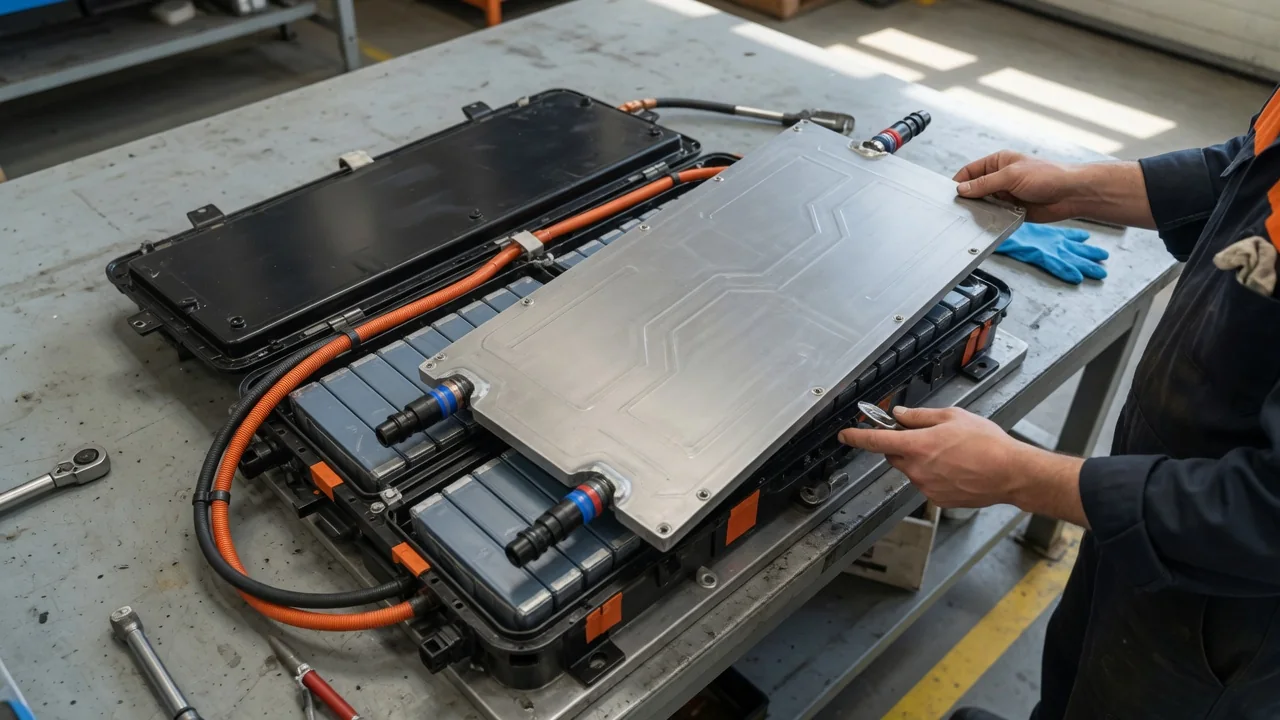
A battery cooling plate is a flat, usually aluminum panel with internal passages that carry liquid coolant beneath or beside the cells of an electric vehicle battery pack. It moves heat between the cells and the vehicle's thermal management loop. It removes heat during hard driving or fast charging and, in many systems, delivers warmth in cold weather. An EV battery cooling plate comes down to three things: how it touches the cells, what flows through it, and how evenly it keeps temperatures.
Cell Contact: How Heat Leaves the Cells
Battery cells produce heat whenever current flows, mostly because of their internal resistance. That heat has to cross several boundaries before coolant can carry it away. It moves through the cell casing, across whatever sits between the cell and the plate, and into the plate's metal wall. Air is a poor conductor of heat, and no cell or plate surface is perfectly flat, so designers place a thermal interface material in the gap. This may be a paste-like gap filler, a compliant pad, or a thermally conductive adhesive. It fills tiny voids and absorbs manufacturing tolerances so every cell has a continuous heat path to the plate.
Contact also has to respect electrical safety. The cells operate at high voltage, while the cooling plate is connected to a coolant circuit that runs through the rest of the vehicle. Insulating films, coatings, or the interface material itself keep the two electrically separated. Each added layer slightly increases thermal resistance, so engineers have to balance insulation, mechanical protection, and heat conduction. Cell format shapes the solution. Prismatic and pouch cells offer broad flat faces that can rest against a plate. Cylindrical cells touch a flat surface only at their ends, so some packs cool the cell bases and others use contoured cooling tubes along the sides of the cells.
Contact quality depends on more than materials. Clamping force, structural mounting, and the way modules are seated all affect how firmly cells press against the interface layer. If that layer is disturbed, for example when a module is removed, the original heat path is not automatically restored. For that reason, service procedures commonly call for new interface material during reassembly.
Coolant: What Flows Through the Plate
Inside an EV battery cooling plate are channels that carry liquid coolant. This is typically a water and glycol mixture formulated for the vehicle's thermal system. The coolant stays sealed inside the channels and never touches the cells directly. That separates cold plate cooling from immersion designs, where cells sit in a dielectric fluid. Plate channels can be made in several ways. Two aluminum sheets can be stamped and brazed together, a profile can be extruded with many small parallel passages, or tubes can be bonded to a flat panel. Aluminum is common because it conducts heat well, is light, and can be formed into complex shapes. The coolant chemistry has to be compatible with it to avoid corrosion.
The plate itself is a passive heat exchanger, and the rest of the loop decides what it does. An electric pump moves coolant through the circuit. When the pack needs cooling, heat can be rejected through a front radiator. It can also be transferred to the air conditioning refrigerant through a chiller, which allows cooling below ambient temperature. When the pack needs warming, an electric heater or, in some vehicles, a heat pump can raise coolant temperature instead. Valves route flow between these paths. Control software chooses the mode based on cell temperature sensors and on what the vehicle is doing, such as fast charging or driving at high load.
Channel geometry involves a trade-off. Narrow, numerous passages expose more surface area to the coolant and improve heat transfer, but they increase the pressure the pump must overcome. Wider passages flow more easily but may transfer heat less effectively, so the chosen balance affects pump energy use and system response.
Temperature Uniformity Across the Battery Pack
A cooling plate is judged not only by how much heat it removes but by how evenly it removes it. Coolant warms as it absorbs heat along its path, so it is coolest at the inlet and warmest near the outlet. In a simple design, cells near the outlet would consistently run warmer than cells near the inlet. This matters because the cells in a pack are connected together. The battery management system typically limits charging and discharging power based on the hottest or coldest cells it detects, so a few warm cells can restrict the whole pack. Over time, cells that run at different temperatures can also age at different rates, which can widen differences in capacity between them.
Designers use several methods to reduce these gradients. Splitting the flow into parallel channels shortens the distance coolant travels before it leaves the plate. Manifolds distribute coolant evenly across those channels. Some layouts run adjacent channels in opposite directions so that warm and cool regions offset each other. Channel width, spacing, and the placement of inlets and outlets can be varied to send more cooling to areas that produce more heat. Uniformity also applies within a single cell. Cooling only one face creates a temperature difference through the cell's thickness, which is one reason cell format and cooling surface are chosen together. The same logic applies when warmed coolant heats the pack in cold weather.
Practical Implications and Limits
For drivers, a battery cooling plate works out of sight, and its effects show up indirectly. Charging speed at a DC fast charger depends heavily on pack temperature. That is why many EVs offer battery preconditioning, sometimes triggered automatically when a fast charger is set as a navigation destination. Pump, fan, or compressor noise during or after charging is often the thermal system at work. These features and their behavior vary by manufacturer and model, so the owner's manual is the authoritative reference for a specific vehicle.
The plate and its loop have finite capacity. Repeated fast charging sessions in hot weather, or sustained high power demand, can generate heat faster than the system rejects it. When that happens, the battery management system reduces charging or drive power to protect the cells. In very cold conditions, warming the pack takes time and energy drawn from the battery or charger. The cooling plate therefore cannot fully cancel the effect of temperature on range and charging. These limits are protective by design and are not signs of failure.
The plate is usually built into the battery enclosure. Problems such as an internal coolant leak or damage from a hard underbody impact are therefore generally handled at the pack level by technicians trained for high-voltage work. Using the coolant type and service intervals the manufacturer specifies helps protect the plate's channels and seals. Battery temperature or coolant warnings should be checked promptly. Owners should not open a high-voltage battery pack themselves.