What Is a Ball Joint on a Car?
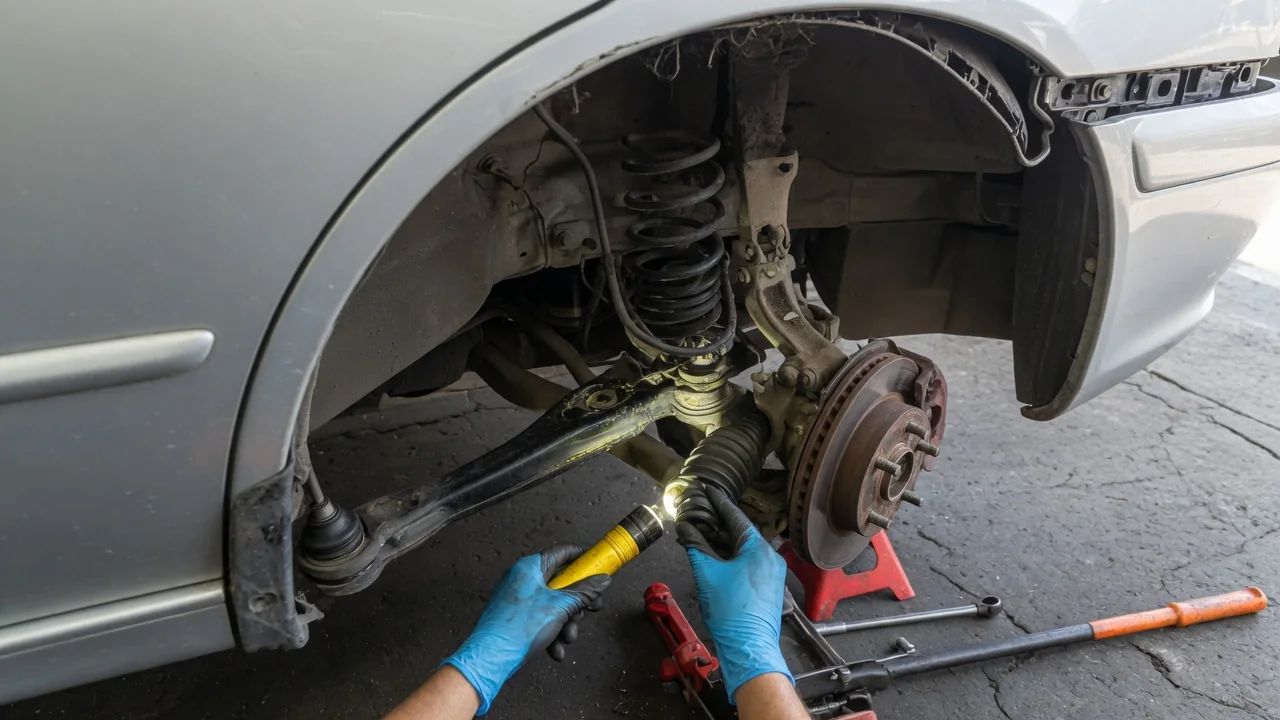
Anyone asking what is a ball joint on a car is really asking how a wheel can steer left and right while also riding up and down over bumps. The answer is a compact ball-and-socket pivot that links the suspension arms to the steering knuckle, carrying heavy loads while still allowing smooth, controlled movement in several directions at once.
Movement
A ball joint works much like a human hip. A hardened steel ball on the end of a tapered stud sits inside a lubricated socket, and that socket is fixed to a control arm while the stud clamps into the steering knuckle. Because the ball can rotate and tilt within its housing, the knuckle is free to swivel when the driver turns the steering wheel and to rise or fall as the spring compresses and extends over uneven pavement.
The exact arrangement depends on the suspension design. Many strut-type front ends use a single lower joint on each side, with the strut mount acting as the upper pivot, while double-wishbone layouts use an upper and a lower joint. One of them usually carries the vehicle's weight and the other mainly guides the knuckle. Some rear suspensions also use them. Similar ball-and-socket pivots appear in tie rod ends, although those belong to the steering linkage rather than the suspension arms.
Wear signs
Wear begins when the smooth fit between ball and socket loosens. A rubber boot normally keeps grease in and grit and water out, so a torn or missing boot is often the earliest visible warning. Once contamination gets inside, the bearing surface erodes and clearance develops. Drivers commonly notice a dull clunk or knock from one front corner over speed bumps and driveway entrances, or a creaking sound as the steering is turned at parking speeds.
Looseness also shows up in the way the car behaves. Steering may feel vague or wander on a straight road, and a tire can wear unevenly along one edge because the wheel no longer holds its alignment angles under load. None of these symptoms points to a ball joint with certainty, since worn bushings, tie rod ends, strut mounts and sway bar links produce similar noises. Some joints include a built-in wear indicator, but that feature varies by manufacturer.
Safety importance
The ball joint is one of the few parts physically holding the wheel assembly to the rest of the car. All braking, cornering and impact forces at that corner pass through a stud roughly the thickness of a finger and a socket not much larger than a golf ball. As long as the joint is tight, those forces are transmitted cleanly and the tire stays at the angle the engineers intended, which is what gives predictable steering and stable braking.
If wear is ignored for long enough, the stud can pull out of the socket. When that happens the knuckle loses its support, the wheel can fold outward or inward under the fender, and the driver loses steering control at that corner. Separation may occur at low speed in a parking lot or at highway speed, and the consequences differ greatly. That possibility is why inspectors treat excessive play as a reason to take a car off the road rather than a minor annoyance.
Everyday Use and Observations
In normal driving a healthy ball joint goes unnoticed. It articulates thousands of times on every trip, during each lane change, pothole and turn into a parking space, without sound or sensation. Many modern joints are sealed for life and need no routine attention, while others, particularly on older vehicles and some trucks, have a grease fitting that is meant to be lubricated during service. The owner's manual or a service guide will show which type is fitted.
Driving conditions shape how long that quiet service lasts. Rough roads, frequent curb strikes, heavy loads, towing and road salt all add stress or accelerate corrosion, and larger wheels or altered ride height can change the angles the joint works through. A useful habit is to listen for new noises with the windows down at low speed and to glance at tire wear when checking pressures. Changes that appear gradually on one side are worth mentioning at the next service visit.
Limits and Next Steps
There is a limit to what can be judged from the driver's seat or by looking through the wheel arch. Confirming play requires lifting the vehicle and loading or unloading the joint in the way its design demands, and the correct method and acceptable movement differ between vehicles. A technician will also separate ball joint looseness from wheel bearing or tie rod play, which can feel alike when a wheel is rocked by hand. Guessing from noise alone often leads to replacing the wrong part.
When a joint is confirmed worn, the repair varies as well. On some vehicles it bolts or presses into the control arm and can be replaced alone, while on others it is built into the arm and the whole assembly is changed. A wheel alignment check afterward is commonly recommended because suspension geometry may have been disturbed. Since the work involves spring tension and load-bearing fasteners, it is best left to a qualified shop, and a car with a clearly loose joint should not be driven far.