What Happens to Tire Pressure During a Cold Snap?
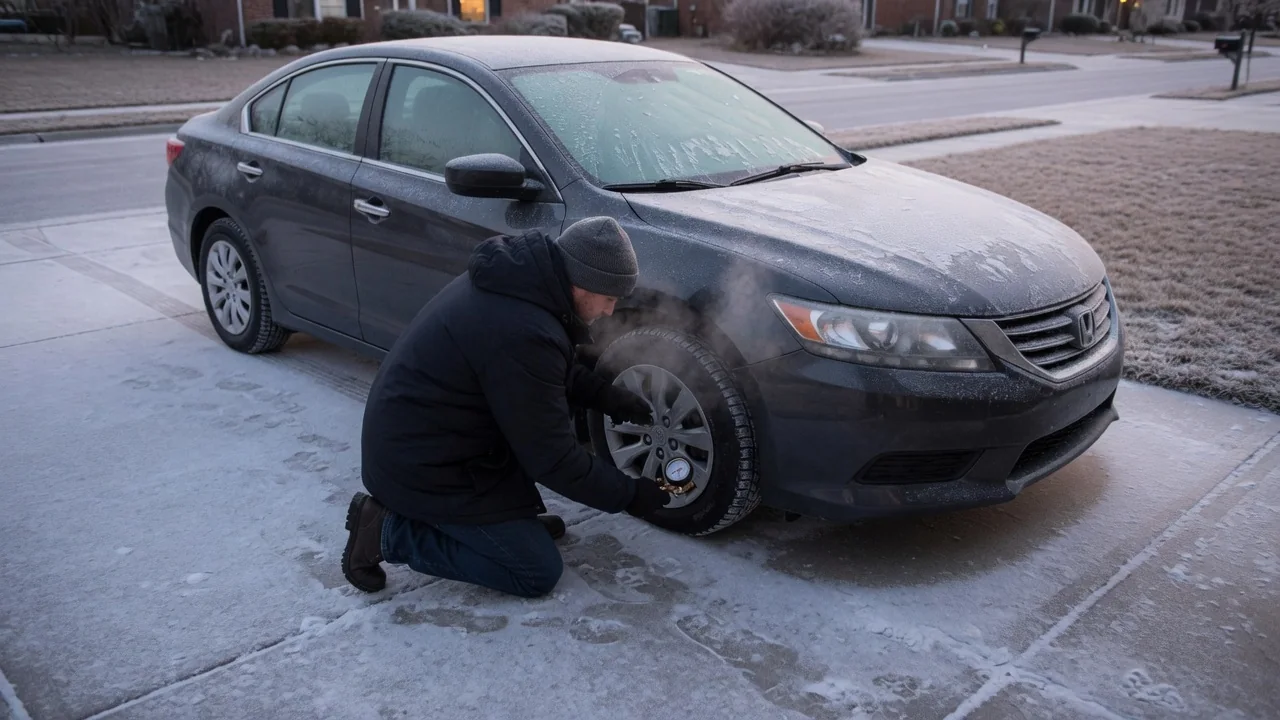
When temperatures plunge overnight, the air inside your tires contracts and inflation pressure falls with it. Understanding what happens to tire pressure during a cold snap helps explain a soft-looking sidewall, a dashboard warning on a frosty morning, and why a quick gauge check matters. This guide covers the physics, proper measurement, warning light behavior, and sensible next steps for winter driving.
Pressure change
Air is a gas, and gases contract as they cool. The tire's internal volume stays almost constant, so when the air inside loses heat, its molecules move more slowly and push less forcefully against the inner liner. The result is a lower gauge reading even though no air has escaped. A widely used rule of thumb puts the loss at roughly one psi for every ten degrees Fahrenheit of temperature drop, although the actual figure varies with tire size and starting pressure.
Consider a car whose tires were set on a mild autumn afternoon. If a front moves through and the next morning is thirty or forty degrees colder, all four tires may read several psi below where they were left, without any puncture involved. The drop tends to be fairly even across the set, which is a useful clue. Vehicles with higher recommended pressures, such as some trucks and loaded vans, can see a proportionally larger change in absolute terms.
Cold-tire measurement
The pressure listed on the door jamb placard or in the owner's manual is a cold inflation figure, meaning it applies to tires that have not been driven on recently and have settled to the surrounding air temperature. Driving flexes the sidewalls and tread, generating heat that raises the reading for a while. Checking right after a highway trip can therefore mask a cold-weather shortfall and suggest the tires are fine when they are actually low.
During a cold snap, the most representative reading comes first thing in the morning, before the car moves and before sunlight warms one side. A vehicle kept in a heated garage complicates this, because tires set indoors will lose pressure once they sit in outdoor air. In that case, checking after the car has been parked outside for a few hours gives a truer picture. Use the same reliable gauge each time, since inexpensive gauges may disagree with one another.
Warning light context
Tire pressure monitoring systems are designed to alert the driver when pressure falls a set amount below the recommended value. A sharp overnight temperature drop can push tires that were already slightly low past that threshold, which is why the warning light often appears on the first frosty morning of the season. The light may then go out after several miles as the tires warm and pressure recovers, only to return the following morning.
That on-and-off pattern does not mean the system is faulty; it usually indicates the tires are sitting near the trigger point and need air. How the warning behaves depends on the vehicle. Direct systems use sensors in each wheel and may display individual pressures, while indirect systems infer low pressure from wheel speed data and may need a reset after inflation. A light that flashes before staying on typically signals a system malfunction rather than low pressure, but the owner's manual should confirm what your vehicle means by it.
Everyday Use and Observations
Underinflated tires change how a car feels, though modest losses are hard to spot by eye. Modern low-profile and radial tires can look normal while being noticeably low, so a visual check is not a substitute for a gauge. Drivers may notice slightly heavier steering, a softer response in corners, or longer stopping distances on wet and icy pavement. Fuel economy can also slip, because a softer tire flexes more and has greater rolling resistance.
A practical winter routine is to check all four tires, and the spare if the vehicle has one, every couple of weeks and after any major temperature swing. Topping up to the placard figure on a cold morning restores the intended contact patch and load capacity. Keep in mind that when milder weather returns, pressure rises again, so tires filled during a deep freeze may read somewhat high later and benefit from a recheck. Compact spares often require a different, higher pressure than the road tires.
Limits and Next Steps
Cold weather explains a uniform, modest drop, but it does not explain everything. If one tire is much lower than the others, or the same tire keeps losing pressure after being topped up, temperature is unlikely to be the whole story. Slow leaks from a nail, a corroded wheel bead seat, or an aging valve stem often become noticeable in winter, partly because rubber seals stiffen in the cold. A tire shop can inspect it and determine whether a repair is appropriate.
Avoid compensating by inflating well above the recommended figure or by using the maximum pressure molded into the sidewall, which is a limit for the tire rather than a target for the vehicle. If the warning light stays on after all tires are correctly inflated, the system itself may need attention, since sensor batteries and relearn procedures differ between manufacturers. Any tire driven for a significant distance while severely low deserves a professional inspection, because internal damage is not always visible from the outside.