What Happens During an EV Charging Session?
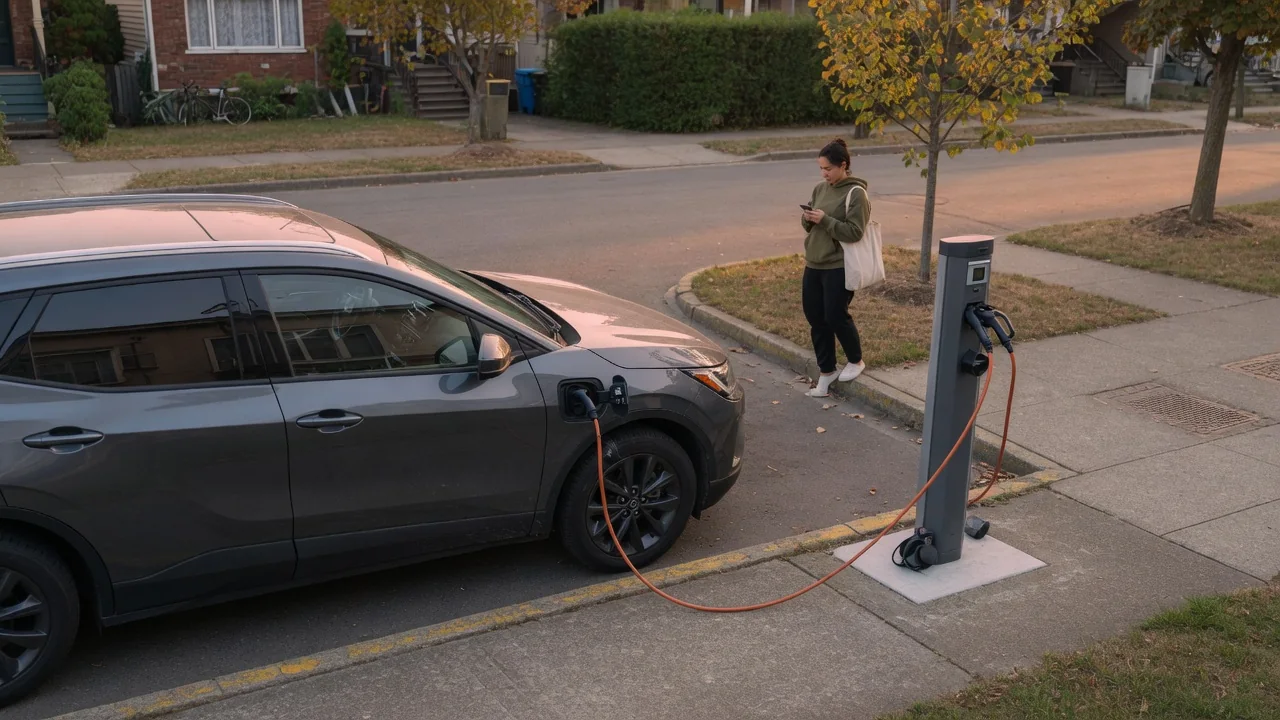
Plugging in an electric vehicle looks simple, but what happens during an EV charging session is a carefully ordered exchange between the car, the charging equipment, and the battery. From the first click of the connector to the moment the latch releases, each stage has a purpose. Understanding that sequence makes it easier to read the dashboard, the charger display, and the occasional interruption.
Connection handshake
A session begins before any meaningful energy moves. When the connector seats in the charge port, dedicated signal pins tell the vehicle that a plug is present and tell the charging equipment that a car is attached. The equipment advertises how much current it can supply, and the vehicle answers with a signal showing it is ready. Only after both sides agree do contactors close and power reach the cable, which is why a loosely seated connector carries no usable energy.
With alternating-current charging at home or work, this exchange is fairly simple, and the car's onboard charger handles the conversion to direct current. At a DC fast charger, the conversation is richer: the vehicle shares battery voltage and its requested current, and the station runs insulation and safety checks before energizing. Drivers usually notice the port locking, a light changing color or pulsing, a click from the contactors, and sometimes a short pause for payment authorization. Light colors and timing differ by manufacturer.
Power ramp
Once the handshake is complete, power does not jump straight to its peak. The battery management system requests current in steps, watching cell voltages and temperatures as the flow increases. On the display, the kilowatt figure climbs over a short period and then settles. With AC charging the plateau is usually steady, limited by whichever is lowest: the onboard charger's capacity, the station's output, or the circuit feeding it.
DC fast charging follows a more visible curve. Power typically rises quickly when the battery is at a low state of charge, holds near its highest level for a while, then tapers as the pack fills and cell voltage approaches its upper limit. Temperature shapes the curve as well; a cold pack may accept less power until it warms, and some vehicles precondition the battery on the way to a station. Cooling fans or pumps may be heard working, and the exact curve varies by model.
End and unplug
A session ends in one of several ways: the battery reaches the charge limit set in the vehicle, the driver stops it from the car, app, or station screen, or a scheduled window closes. In each case the vehicle asks for current to fall toward zero before the contactors open, so the connector is not separated under load. Near a full charge, power may linger at a low level while the pack balances its cells, so the final few percent can seem slow.
After current stops, the port lock releases, though how that happens depends on the car. Some vehicles unlock the connector when the doors are unlocked, others need a button on the port, key fob, or touchscreen, and many keep the cable locked until the session is formally ended. Pulling hard on a locked connector risks damaging the latch. The station display normally shows a summary of energy delivered and time elapsed, and returning the cable to its holster keeps the contacts clean and dry.
Everyday Use and Observations
In routine use, most of this sequence passes unnoticed. A typical overnight charge at home involves plugging in, seeing an indicator confirm that charging has started or that a schedule is waiting, and waking to a battery at the chosen limit. Many drivers set that limit below full for daily driving, following their owner's manual guidance, and reserve a full charge for longer trips. Energy added is counted in kilowatt-hours, which is what utility bills and public networks generally measure.
A few observations are normal and worth recognizing. Fans, pumps, or a faint hum may run while the car is parked, because the thermal system manages battery temperature during charging. Estimated time remaining can shift as power changes, especially on a fast charger during the taper. Charging speed can also drop when another vehicle shares the same station cabinet or when cabin climate control draws power. A cable that feels warm is common; one that is too hot to hold comfortably deserves attention.
Limits and Next Steps
Every session is governed by the weakest link in the chain. A powerful station cannot push more than the vehicle will accept, and a capable vehicle cannot draw more than the station, cable, or household circuit allows. Connector standards also matter, since a car must match the plug or use an adapter approved for it. Because acceptance rates, connector types, and charge-limit recommendations differ between models, the owner's manual and the vehicle's own charging screens are the reliable references.
When a session will not start or stops early, the simplest checks come first: reseating the connector fully, trying another stall, and reading any message on the dash or station. A charging fault message or stored code is evidence to interpret rather than proof that a specific part has failed, and many such codes are manufacturer-specific and need vehicle-specific confirmation. Repeated failures across different chargers point toward the vehicle and warrant a qualified technician, since high-voltage components are not suited to home diagnosis.