What Gives Pearl Car Paint Its Depth? Layers, Light and Care
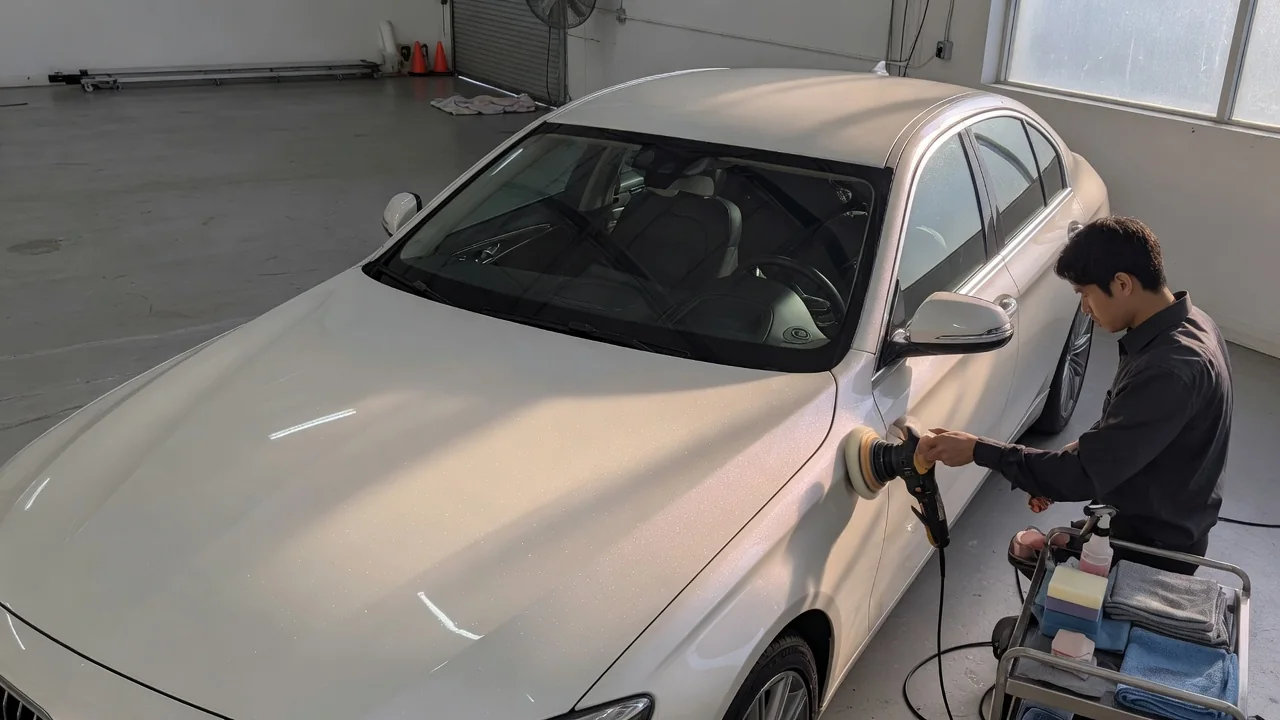
Pearl car paint can look as if the color sits beneath the surface rather than on it. That sense of depth does not come from a single ingredient. It comes from how light moves through several translucent layers, reflects off tiny coated flakes, and returns to the eye at different angles. These mechanisms explain why pearl car paint appearance changes so much between sunlight and shade, and why the finish rewards careful maintenance.
Pearlescent layers
The core of a pearl finish is a special-effect pigment made of thin, flat platelets. Traditionally these are mica flakes coated with a very thin layer of a metal oxide such as titanium dioxide or iron oxide. Many modern formulas use synthetic substrates such as synthetic mica, aluminum oxide or glass flakes, which can be made smoother and more uniform. Conventional pigments absorb some wavelengths and scatter the rest. These platelets work differently because they are partly transparent. Some light reflects from the top of the oxide coating and some from the boundary beneath it, and the two reflected waves interfere. Depending on the coating thickness, certain colors are reinforced and others cancel out. Each flake also passes part of the light onward, so deeper flakes and the layer underneath add to what you see.
How the pigment is applied matters as much as the pigment itself. In a two-stage pearl, the effect pigment is mixed into the colored basecoat, which is then covered with clearcoat. In a three-stage, or tri-coat, system, a solid-color ground coat goes on first. A translucent mid-coat containing the pearl follows, and then the clear. This arrangement separates the base hue from the shimmer. Light passes through the pearl layer, reflects off the ground coat, and travels back out through the pearl again. That repeated trip through partly transparent material is a major reason tri-coat pearls are often described as having more depth than paints where the color sits right at the surface.
The clearcoat completes the effect. A smooth, transparent top layer produces a sharp, mirror-like reflection on its surface while letting the eye see through it to the flakes below. The brain reads that combination of a crisp surface reflection with color appearing beneath it as depth. When the clear is level and free of haze, the separation between surface and color is easy to see. When the clear is dull or textured, the layers visually merge and the finish looks flatter.
Viewing angles
Pearl paints depend strongly on viewing angle, a behavior painters often call flop or color travel. Looking straight at a panel, near the angle where light reflects most directly, you usually see the brightest shimmer and the face color. As the panel curves away toward a grazing angle, the interference color weakens and the ground or base color takes over. As a result, a single door can show a bright highlight, a mid-tone, and a darker side tone at the same time. Body lines and curved surfaces exaggerate this gradient, which is why pearl colors tend to emphasize a vehicle's shape.
Pearl handles light differently from a standard metallic. The aluminum flakes in metallic paint are opaque and act like tiny mirrors, which creates sparkle and a pronounced light-to-dark change. Pearl platelets reflect more softly and let some light through, so the effect reads as a glow with possible hue shifts rather than glitter. Many factory finishes combine both types of flake, so one color can show traits of each. The light source changes the result as well. Direct sun produces strong highlights and visible color travel, and an overcast sky softens the contrast. Artificial lighting with a limited spectrum can mute or shift the pearl tone, so a color that looks rich outdoors may look plainer under a garage light.
Finish care
Depth depends on seeing cleanly through the clearcoat, so most pearl care is really clearcoat care. Fine scratches and swirl marks scatter light at the surface. The resulting haze hides the flakes underneath and blurs the reflection that gives the paint its layered look. To reduce the chance of new marks, wash with a pH-neutral car shampoo and a clean wash mitt, and use a rinse bucket or a similar method that keeps grit off the paint. Dry with soft microfiber rather than rough towels or a squeegee blade. Remove bird droppings, tree sap, and bug residue promptly, because they can etch the clear.
Bonded contamination, which leaves paint feeling rough even after washing, can be removed with a clay bar or a similar decontamination product. This restores a smoother surface for clean reflections. Light polishing removes swirls by leveling a small amount of clearcoat. The clear is thin, though, and polishing cannot put it back, so avoid aggressive or frequent correction. Wax, synthetic sealant, or a ceramic-type coating adds a sacrificial layer that helps resist environmental exposure and makes washing easier. These products can improve gloss and clarity, but they do not add pearl or change the pigment beneath.
Practical implications and limits
The layering that creates depth also makes pearl finishes harder to repair invisibly. A tri-coat repair has to match three things: the ground coat color, the amount of pearl in the mid-coat, and the number of mid-coat passes. Each extra pass changes how much light reaches the base and returns. Body shops commonly spray test panels, sometimes called let-down panels, to compare against the car. They often blend the color into adjacent panels so that any slight difference is less noticeable. Owners should expect a pearl repair to take more time and material than a solid color. Before accepting the work, check it in several lighting conditions and from several angles.
Because pearl is so sensitive to angle and lighting, photos, online configurators, and showroom lights rarely show a pearl color fully. To get a truer impression, view the actual paint outdoors in both sun and shade and walk around the car. The vehicle's paint code identifies the formula, and the location of its label varies by manufacturer. The code alone does not guarantee a perfect match, because factory application and aging both affect the final look.
Maintenance also has limits. If the clearcoat has oxidized, peeled, or been polished too thin, no surface product will restore the original depth, and the affected area needs refinishing. Long-term sun exposure can change how some colors look over time, and how much depends on the paint system, the climate, and how the car is stored. Products marketed as adding depth mainly improve surface smoothness and gloss. The pearl effect itself is set by the pigment and layer structure applied at the factory or during refinishing, and care simply keeps the view to it clear.