What Does OEM Mean for Car Parts?
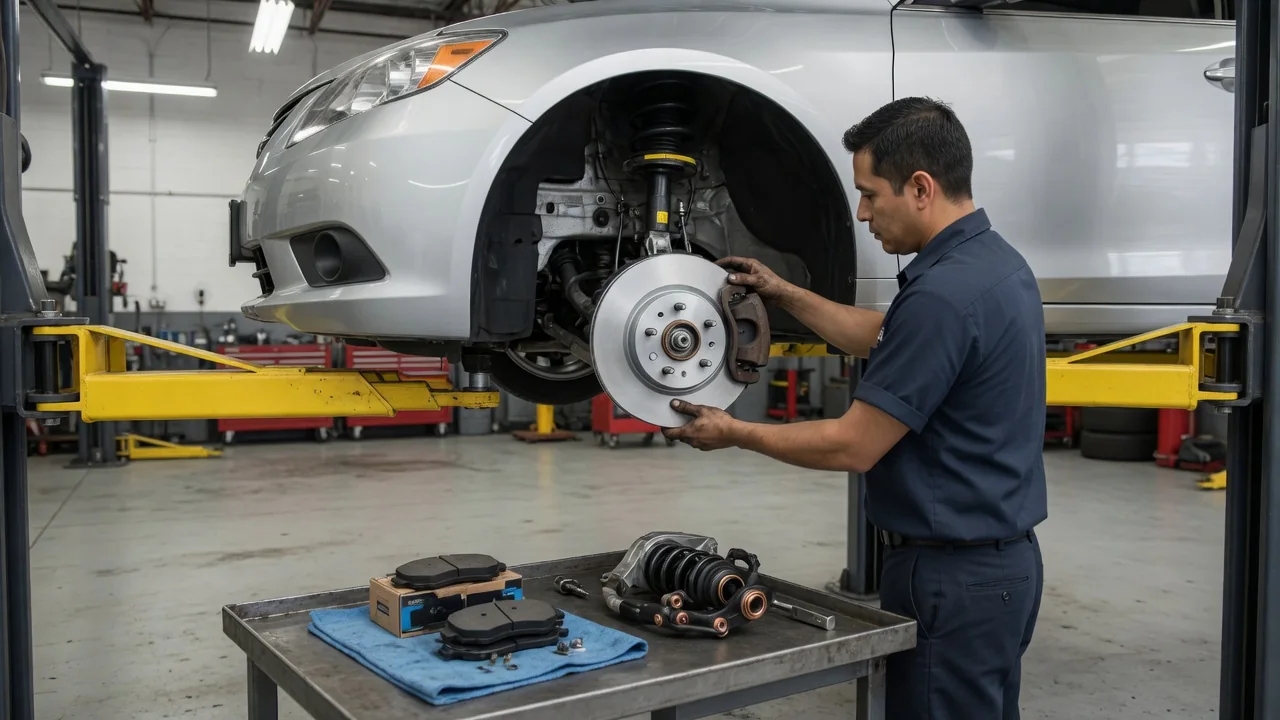
OEM stands for original equipment manufacturer. When applied to car parts, it usually means a component made by, or for, the company that built the vehicle, matching what was installed at the factory. So what does OEM mean for car parts in practice? The simple definition leaves out several details: who actually manufactures the part, how it is sold as a replacement, and where the label stops being a reliable guide. This explanation covers each of those points.
Original Equipment: What the Term Covers
Automakers rarely make every component of a vehicle themselves. Many parts, such as sensors, brake components, filters, lighting assemblies and electrical modules, are produced by outside suppliers to the automaker's design and specifications. The parts fitted on the assembly line are called original equipment, or OE. An OEM part, in the replacement sense, is the same part or its official successor, supplied through the automaker's own parts channel, typically in automaker-branded packaging and identified by the automaker's part number.
This is why the OEM car part meaning can seem confusing. The company whose logo is on the box is often not the company that manufactured the part. What makes it OEM is that the part was specified, approved and released by the vehicle manufacturer for that application. Some suppliers also sell the same or a very similar part under their own brand through retail channels, which is commonly described as OES (original equipment supplier) or OE-equivalent. Whether such a part is truly identical to the dealer version depends on the specific part and supplier, so the label alone does not settle the question.
Replacement Use: OEM Parts After the Car Leaves the Factory
When a component wears out or is damaged, an OEM replacement is ordered by part number, and the automaker's catalog links that number to specific vehicles, often through the VIN. This matters because the same model can use different parts depending on production date, engine, trim, market or optional equipment. Over a vehicle's life, manufacturers may also revise a part to address a known issue or to consolidate inventory; the old number is then superseded by a new one. A replacement OEM part may therefore differ slightly from the original while still being the correct, approved fit.
The main alternative is aftermarket parts, made by independent companies to fit one or more vehicles. Aftermarket products range widely: some are engineered to match or exceed original specifications, some target a lower price point, and some intentionally change performance or appearance. OEM replacement parts sit at a predictable point on that spectrum. They are designed to restore the vehicle to its factory configuration, with fitment, connectors, mounting points and calibration already matched to the application.
Warranty and repair context also shapes replacement choices. In the United States, federal law generally prevents a manufacturer from denying warranty coverage simply because non-OEM parts were used, although coverage can still be refused if a part is shown to have caused the failure. Repairs performed under a manufacturer's warranty normally use OEM parts. In collision repair, insurance policies differ on whether OEM or aftermarket parts are specified, so the policy wording is the reference point rather than an assumption either way.
Limits: What the OEM Label Does Not Guarantee
OEM describes origin and approval, not a universal quality ranking. An OEM part meets the automaker's specification for that vehicle, but a specification reflects trade-offs among cost, durability, noise, weight and performance chosen for typical use. An aftermarket part can be better or worse for a particular owner's needs. Marketing language adds another layer: phrases such as OEM-style, OEM-quality, OEM-grade or OEM-replacement are descriptive claims by the seller and do not by themselves mean the part came from, or was approved by, the vehicle manufacturer.
There are practical limits too. Automakers eventually stop supplying some parts for older vehicles, leaving aftermarket, used or remanufactured components as the only options. Counterfeit parts packaged to look like OEM products exist in some categories, which is one reason buying from authorized channels matters. Finally, OEM status is tied to a specific application: a part that is OEM for one model, year or market is not automatically an approved fit for another, even if it physically bolts on.
Practical Implications and Limits for Car Owners
In practice, the OEM question is most useful when weighed against what the part does. For components where exact fit, electronic compatibility or calibration is critical, such as some sensors, control modules, safety-related systems and driver-assistance hardware, staying with the specified part reduces the risk of warning lights, mismatched software or repeat repairs. For routine wear items, a reputable aftermarket or OES part that meets the published specification may serve the same purpose. The right choice depends on the specific vehicle and part, not on a blanket rule.
Verification is more reliable than labels. Comparing part numbers against the automaker's catalog for the VIN, checking the seller's channel, and reading the owner's manual or service information for required specifications all give firmer ground than a product title. Fluids are a good example of where specifications matter more than branding: the manual typically lists a required standard or approval, and products meeting it are appropriate whether or not they carry the automaker's name. Keeping receipts and part numbers also helps if warranty or resale questions arise later.
Cost and availability are the remaining variables. OEM parts are frequently priced higher than aftermarket alternatives and may need to be ordered through a dealer, while aftermarket parts can be easier to find locally. Neither pattern holds for every part or region, so comparing the exact part number, the warranty terms on the part itself and return policies gives a clearer picture than assuming one category is always the better value.