What Does Lift-Off Oversteer Mean? Load Transfer and Handling Explained
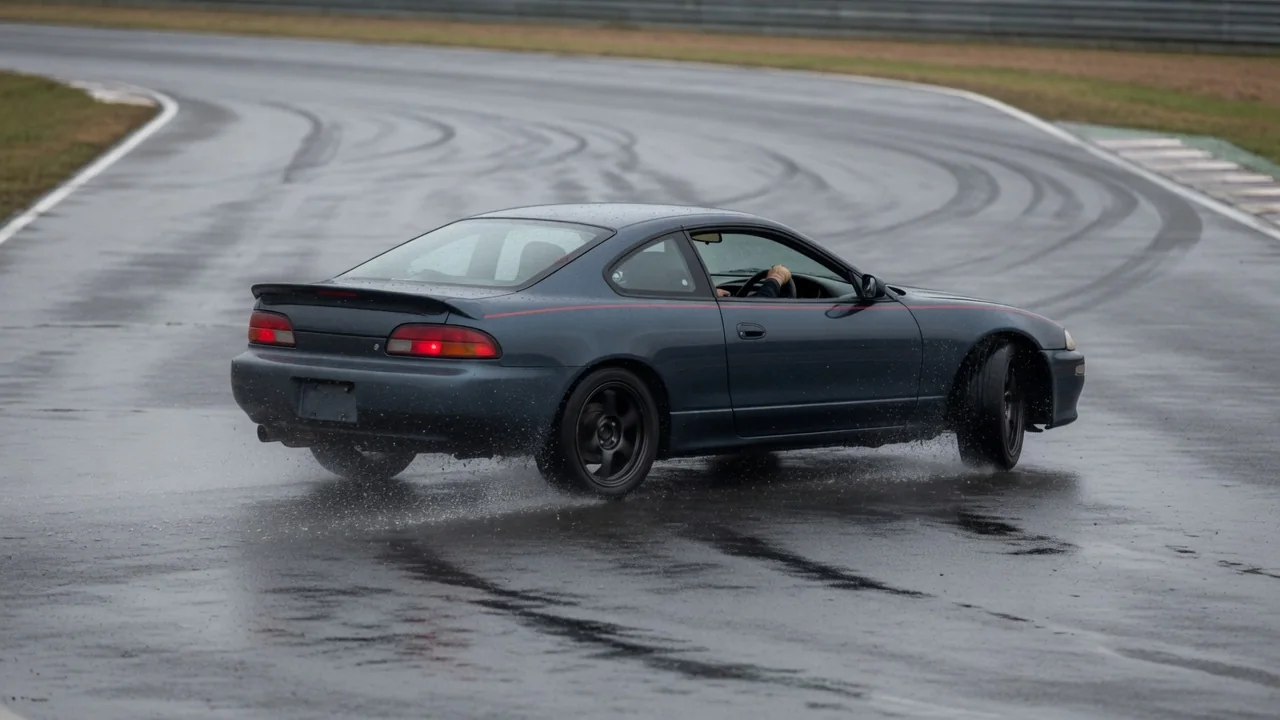
Lift-off oversteer is the tendency of a car's rear tires to lose grip, letting the tail swing outward, when the driver suddenly releases the accelerator while cornering. It is also called trailing-throttle oversteer. To understand what lift off oversteer means beyond the jargon, look at how weight shifts between the axles. This guide explains the lift off oversteer concept through load transfer, the way different vehicles respond, and the situations where drivers manage it on purpose.
Load transfer: why lifting unloads the rear tires
A moving car does not keep a fixed weight on each tire. Its mass sits above the road at the center of gravity, so any change in speed or direction shifts vertical load between the tires. Under steady acceleration, load moves toward the rear axle. When the driver lifts off the throttle, engine braking and drivetrain drag slow the car, and load moves forward instead. In a corner this happens on top of lateral load transfer, which already pushes load toward the outside tires. The result of a sudden lift mid-corner is that the front tires, especially the outside front, gain load while the rear tires, especially the inside rear, lose it.
Tire grip depends heavily on vertical load. A more heavily loaded tire can generate more cornering force, though not in direct proportion, and a lightly loaded tire can generate less. During a corner the rear tires are already producing a large share of the lateral force needed to hold the car on its line. If a lift reduces their load faster than the cornering demand falls, the rear can exceed its available grip and begin to slide. At the same moment the front tires gain grip, so the nose bites harder into the turn. Reduced rear grip and increased front grip work together, and the car rotates more than the steering input alone would produce.
How abruptly the driver lifts matters. A snap release causes a rapid pitch forward and a quick change in tire load, giving the rear tires little time to adjust. A gradual release produces the same direction of load transfer at a slower rate, which is often easier for the chassis and the driver to manage. Speed, cornering force and road surface also determine how close the rear tires were to their limit before the lift began.
Vehicle response: what happens when the rear lets go
The first sign of lift-off oversteer is usually a tightening of the cornering line, sometimes described as tuck-in, as the more heavily loaded front tires pull the nose toward the inside of the turn. If the rear tires keep their grip, the effect ends there and may even feel helpful. If they slide, the car's yaw rate increases beyond what the steering angle calls for, and the rear end moves toward the outside of the corner. In a mild case this is a brief twitch; in a severe case, or one met with a delayed or excessive correction, it can become a spin.
How strongly a particular car reacts is vehicle-specific rather than a general rule. Relevant factors include weight distribution, center of gravity height, wheelbase, rear suspension geometry and toe changes under load, the spring and anti-roll bar balance between axles, damping, and the strength of engine braking. Tires matter as well: type, wear, temperature and pressure all shift the front-to-rear grip balance. Front-, rear- and all-wheel-drive cars can all show the behavior, because the rear axle unloads regardless of which wheels are driven; in a rear-wheel-drive car, engine braking also acts through the rear tires and uses part of their grip. A car carrying much of its mass toward the rear can be harder to catch once rotation starts.
Many modern vehicles have electronic stability control, which compares the car's actual yaw against the driver's steering input and can brake individual wheels or reduce engine output to counter unwanted rotation. Such systems can reduce the severity of lift-off oversteer, but they cannot create grip the tires do not have, and their calibration differs between vehicles and driving modes.
Controlled context: deliberate use on track
Lift-off oversteer is not only a hazard. On a racetrack or autocross course, experienced drivers sometimes use a measured, partial lift to help a car that is understeering turn toward the apex. Shifting a little load to the front axle adds front grip and allows the rear to rotate slightly, tightening the line without large steering inputs. The difference between a useful adjustment and a loss of control comes down to how much the driver lifts, how quickly, and how close the tires already are to their limit.
This kind of control is normally learned in a safe setting such as a track day, driving school or skid pad, with instruction and open runoff space. Recovering from a slide generally involves steering toward the direction of the slide and smoothing out throttle inputs so load returns to the rear tires, but the right technique and timing depend on the vehicle, its drivetrain and the situation. Overcorrecting can trigger a slide in the opposite direction, often called a pendulum or tank-slapper effect, which is why supervised practice matters.
It also helps to separate lift-off oversteer from related terms. Power oversteer occurs when a driven rear axle receives more torque than its tires can handle. Trail braking involves easing off the brakes into a corner and can rotate the car through the same forward load transfer. Lift-off oversteer specifically describes rotation triggered by releasing the throttle.
Practical implications and limits
For everyday drivers, the most common setting for lift-off oversteer is a corner entered too fast, such as a tightening off-ramp or an unfamiliar bend, where the instinctive reaction is to come off the accelerator abruptly while still turning. Wet pavement, cold tires, gravel and worn rear tires reduce the margin before the rear lets go. Doing most of the slowing in a straight line before the turn, and keeping throttle and steering changes smooth once committed, leaves more grip in reserve.
The term describes a tendency, not a defect. Many road cars are tuned by their manufacturers to lean toward stable understeer, so a lift in normal driving may produce little more than a slight tightening of the line. Modifications can change that balance: mismatched or worn tires, incorrect pressures, altered alignment or stiffer rear anti-roll bars can all make the rear more willing to slide. Because behavior varies so widely, what is true of one car cannot be assumed for another. The owner's manual, a qualified alignment or suspension specialist, and professional driving instruction are the appropriate sources for how a specific vehicle should be set up and driven.