What Does Factory Option Mean on a Car?
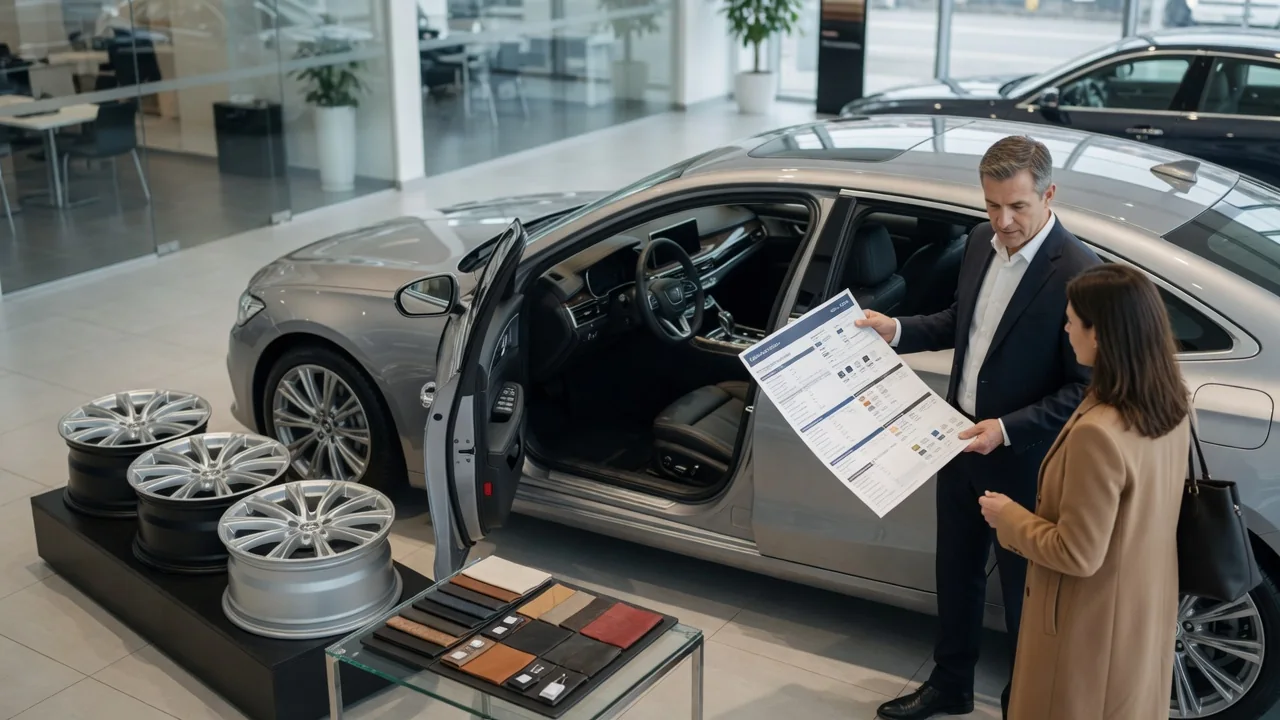
A factory option is equipment that the manufacturer installs during assembly because it was selected for that specific vehicle. It is not included on every example of the model, and it is not added later by a dealer or owner. Knowing the term helps when you read a window sticker, decode a build record, evaluate a used car, or order service parts. This guide explains how factory options are configured, documented, and serviced.
Order Configuration
A vehicle starts from a model and trim level, and each trim comes with a defined list of standard equipment. Anything beyond that list that the factory can install on the assembly line is offered as an option. Some factory options are mechanical, such as a different engine, transmission, axle ratio, or suspension package. Others are convenience or appearance items, such as a sunroof, an upgraded audio system, specific wheels, or a paint color. Put simply, a factory option vehicle is one where the feature left the plant already installed, as part of that car's original build.
Manufacturers usually offer options in two ways. Some are standalone choices, and others are bundled into packages of related items. Options can also depend on or exclude each other: one feature may require another, or may be unavailable with a particular engine or trim. These rules exist because the factory has to build each car from a compatible set of parts, wiring, and software. A buyer may order a car directly or choose one from dealer inventory. Either way, the configuration was fixed when the build order was scheduled, and the plant assembled the car to that specification.
Factory options are different from other kinds of added equipment. Port-installed or distributor-installed items are fitted after the car leaves the plant but before it reaches the dealer. Dealer-installed accessories are added at the dealership. Aftermarket parts can come from any supplier at any time. All of these can be legitimate, but none of them is a factory option in the strict sense. Enthusiasts often draw that line carefully when they describe how original a car is.
Documentation
For new vehicles sold in the United States, the best-known record of factory options is the window sticker, often called the Monroney label. It lists the base model, highlights of the standard equipment, and the options and packages installed on that car, along with their prices at the time of sale. If the original sticker survives, it is one of the clearest pieces of evidence for what the car came with. Some manufacturers and dealers can reprint a sticker or produce equivalent build information from the vehicle identification number (VIN). This service is not available for every brand or model year.
Many manufacturers also record each vehicle's configuration as a list of option codes. These are short alphanumeric identifiers assigned to individual features or packages. The codes may appear on a build sheet produced for the assembly line, on a label somewhere on the vehicle, or in the manufacturer's internal records tied to the VIN. Each manufacturer uses its own locations, formats, and meanings for these codes, so you cannot read one brand's codes with another brand's chart.
The VIN identifies the vehicle and usually encodes broad attributes such as the manufacturer, model line, body style, model year, and assembly plant, and sometimes the engine. It generally does not list every factory option. To see the full option content, you usually use the VIN to look up the stored build record. Owner's manuals are often written to cover every configuration of a model, so a feature described in the manual does not prove that a particular car has it.
Service
Factory options matter in the service bay because they change which parts fit a vehicle. Two cars with the same model name and year may use different brake components, cooling parts, wiring harnesses, or electronic modules, depending on how they were optioned. Parts departments commonly look up components by VIN so the catalog can account for the original build. If that lookup is unavailable or the car has been modified, a technician may need to inspect the car to confirm what is installed before ordering parts.
On modern vehicles, many factory options involve software as well as hardware. Control modules are often programmed to match the equipment the car was built with, so a replacement module may need to be set up for the correct options. This is one reason factory-installed features usually work cleanly with the vehicle's diagnostics and warning systems: the car's software expects them to be there.
Factory options installed by the manufacturer are generally covered by the new-vehicle warranty along with the rest of the car. Dealer and aftermarket accessories may have separate warranty terms. Service procedures, maintenance schedules, and recall applicability can also depend on which options a car has. Coverage and procedures vary by vehicle, so check the warranty booklet and official service information for your car.
Practical Implications and Limits
If you are shopping for a used car, remember that a factory option describes how the car was originally built, not necessarily what it has today. Parts can be removed, swapped, or added over the years. When a listing claims a car has a factory option, documentation tied to that VIN is stronger evidence than the presence of the feature alone. For enthusiast and collectible vehicles, verified factory equipment can be an important part of how a car is described and valued. How much it affects a particular sale depends on the market and the car.
Adding a feature later is sometimes possible, but a retrofit does not make it a factory option. Depending on the vehicle, a retrofit may require extra wiring, brackets, or software changes, and it may not work with the car exactly as the factory version would. Some features are difficult or impractical to add because they depend on structural, electrical, or programming differences built in during assembly.
Records also have limits. Original stickers get lost, build data may be unavailable for older vehicles or some brands, and option codes need the right manufacturer reference to interpret. Terminology changes too: package names can change between model years, and a feature that was optional one year may become standard the next. Treat the term as a description of where a feature came from, and confirm it with the records for the specific car. When the answer affects parts, programming, or warranty, rely on the manufacturer's service information.