What Does Engine Oil Actually Do?
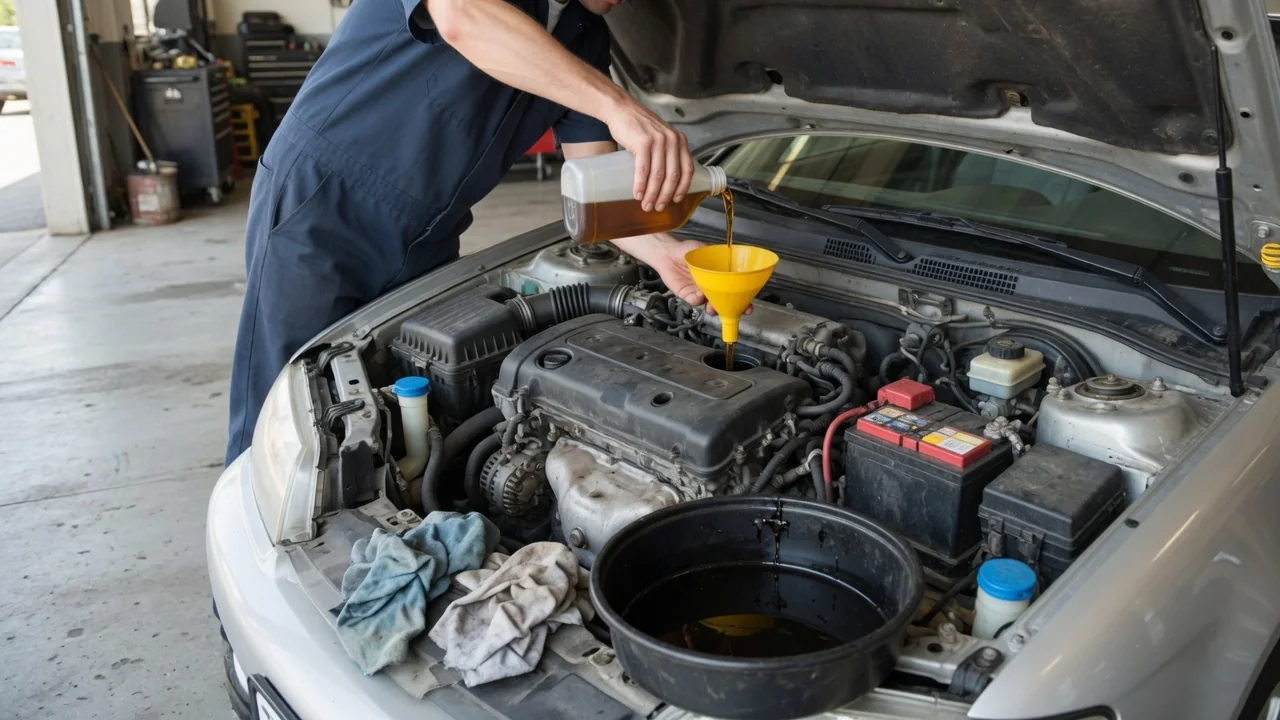
Ask what engine oil actually does and most drivers will say it lubricates. That is true, but incomplete. Oil also carries heat away from parts the coolant never reaches, and it collects the soot, metal and acids that combustion and wear leave behind. Understanding those three jobs makes it easier to read a dipstick, interpret a warning light and judge when service is due.
Oil film
Inside a running engine, metal parts that appear to touch are meant to ride on a thin layer of pressurized oil. The pump draws oil from the pan and pushes it through the filter into passages feeding the crankshaft and connecting rod bearings. As the crankshaft spins, it drags oil into a wedge that lifts the journal off the bearing surface. When that film holds, the shaft floats on liquid, and friction and wear stay remarkably low even under heavy load.
Not every surface gets that full cushion. Cam lobes, piston rings near the top of their stroke and parts at the moment of a cold start rely on a far thinner layer, where anti-wear additives in the oil form a protective coating on the metal. Viscosity matters here: oil that is too thick flows slowly when cold, while oil that is too thin may not keep surfaces apart when hot. The grade a given engine needs varies, so the owner's manual is the reference rather than general habit.
Heat
Coolant handles the cylinder walls and cylinder head, but it cannot reach the underside of a piston, the crankshaft bearings or the shaft of a turbocharger. Oil does that work. As it flows across those surfaces it absorbs heat from both friction and combustion, then drains back to the pan, where some of that heat passes into the surrounding air. Many engines spray oil at the piston undersides through small jets, and some add a dedicated oil cooler to shed heat faster.
Heat also changes the oil itself. It thins as it warms, which is why multigrade oils are formulated to stay within a usable viscosity range from a cold morning to a long highway climb. Sustained high temperatures speed up oxidation, thickening the oil and leaving varnish or deposits on hot parts. Drivers with an oil temperature gauge may see it rise more slowly than coolant temperature and climb during towing or spirited driving. Whether a vehicle has such a gauge, or an oil cooler, depends on the model.
Contaminants
Combustion is not perfectly sealed. A small amount of gas slips past the piston rings into the crankcase, bringing soot, unburned fuel, moisture and acidic byproducts with it. Add in fine metal particles from normal wear and dust that gets past the air filter, and the oil is constantly receiving debris. Detergent additives keep hot surfaces clean, while dispersants hold tiny particles in suspension so they travel with the oil instead of settling as sludge in the pan or valve cover.
The filter traps the larger particles on each pass, but the finest material and dissolved contaminants remain in the oil until it is drained. That is why oil darkens with use; a dark color often means the additives are doing their job, not that the oil has failed. Other signs deserve more attention. A milky, light brown residue can indicate moisture or coolant, a fuel smell suggests dilution, and a gritty feel between the fingers points to abrasive particles. Diesel oil typically blackens quickly from soot.
Everyday Use and Observations
Driving patterns shape how hard the oil works. Short trips may never bring the oil fully up to temperature, so condensation and fuel that would otherwise evaporate stay in the crankcase. Stop-and-go traffic, towing, dusty roads and long idling periods load the oil with heat or contaminants faster than steady highway miles. This is why many maintenance schedules distinguish between normal and severe service, and why some vehicles calculate oil life from operating conditions rather than distance alone.
A few simple checks reveal a lot. On engines with a dipstick, reading the level on flat ground shows whether oil is being consumed or leaking; some newer vehicles report the level electronically instead. A brief ticking from the valvetrain right after a cold start can occur while oil reaches the top of the engine, though noise that persists is worth investigating. Spots under the parked car, a burning smell or bluish exhaust smoke are other observations that connect directly to what the oil is doing.
Limits and Next Steps
Oil cannot do its jobs indefinitely. Additives are consumed, viscosity drifts as the oil shears or oxidizes, and the load of suspended contaminants eventually exceeds what the dispersants can carry. Fresh oil also cannot repair worn bearings, restore lost compression or seal a failed gasket. Topping off replaces volume but leaves the old contaminants in place, so it is not a substitute for a change. The correct specification, capacity and interval come from the manufacturer's documentation for that particular engine.
Warning signs should be read carefully. A red oil pressure light means the engine should be shut off as soon as it is safe, because running without pressure can destroy bearings quickly; the cause might be low level, a faulty sensor or a mechanical problem. A stored fault code related to oil pressure or variable valve timing is evidence to interpret, not proof a specific part has failed, and many such codes are manufacturer-dependent. Rapid oil loss, contamination or persistent noise justifies a professional diagnosis.