What Does DC Fast Charging Mean?
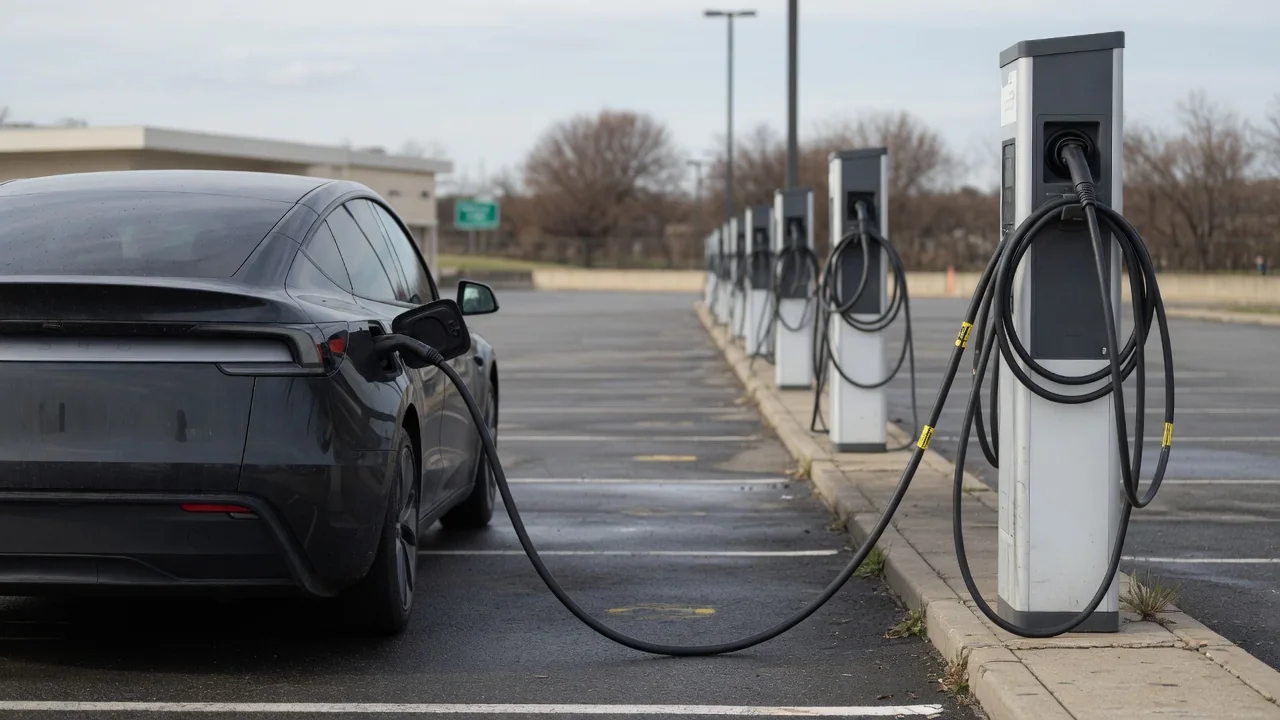
Anyone new to electric vehicles eventually asks what does DC fast charging mean. In short, the station converts grid alternating current to direct current itself and sends it straight to the battery pack, bypassing the smaller onboard AC charger built into the car. That one change in where conversion happens explains the higher power, the heavier cables, and the different charging behavior drivers notice.
Power path
A battery stores energy only as direct current, while the grid supplies alternating current. During home or workplace charging, AC flows through the charge port into the onboard charger, a compact converter inside the vehicle that rectifies it to DC at a power level limited by its size, weight, and cooling. That component, not the wall unit, typically sets the ceiling for AC charging speed, which is why two cars on the same wall unit can charge at different rates.
At a DC fast charger, the rectification hardware lives in the station cabinet, where space and cooling are far less constrained. After the connector locks and the car and station complete a communication handshake, contactors inside the vehicle close and current travels through dedicated DC pins directly to the pack, with the battery management system dictating how much voltage and current it will accept. Drivers can see the difference in the larger connector and thick, sometimes liquid-cooled cable. Port location and connector standard vary by vehicle and market.
Charging curve
Bypassing the onboard charger removes one bottleneck, but the battery itself becomes the limit. Power delivery is not constant; it follows a charging curve shaped by state of charge, cell temperature, and pack design. Typically, power climbs quickly when the battery is at a low state of charge, holds near a peak for a period, then tapers as cells fill, because pushing high current into nearly full cells risks excessive heat and accelerated wear.
Readers can watch this on the station screen or the instrument display, where the kilowatt figure rises, plateaus, and steadily falls as the percentage climbs. A cold pack may start well below its potential until it warms, which is why some vehicles precondition the battery when a fast charger is set as a navigation destination. The shape of the curve differs considerably between models; some hold high power across a wide range while others peak briefly, so the owner's manual and real sessions are the best guides.
Appropriate use
DC fast charging suits situations where time matters more than cost or convenience at home: long highway trips, unexpected detours, or days when the vehicle must return to service quickly. Because the taper slows things markedly near the top, many drivers on road trips unplug once the battery reaches a comfortably high level rather than waiting for full, then stop again later. Adding the energy needed to reach the next stop is often quicker overall than filling completely.
For routine overnight replenishment, AC charging through the onboard charger remains the gentler and usually cheaper choice, since the car sits parked for hours anyway. Frequent high-power sessions generate more heat in the cells, and manufacturers differ in how they advise balancing the two methods; some recommend limiting routine reliance on fast charging, while others design thermal management to tolerate it well. Checking the guidance for the specific vehicle matters more than following a universal rule.
Everyday Use and Observations
In practice, a session begins by parking so the cable reaches the port, plugging in, and authorizing payment through an app, card reader, or automatic vehicle recognition where supported. A short pause follows while the station and car verify insulation and agree on voltage, then cooling fans or pumps may become audible as power ramps up. These sounds from the vehicle's thermal system are normal during high-power charging and can continue for a while after the session ends.
Observed speed frequently differs from the number printed on the station. The car may accept less than the dispenser can supply, the station may share power between two stalls, or a hot or cold battery may hold the rate down. A vehicle with a higher-voltage architecture may also behave differently on older equipment than on newer hardware. Comparing the displayed kilowatts with the vehicle's stated maximum DC rate helps explain why a session feels slower than expected.
Limits and Next Steps
Not every plug-in vehicle can use this method. Some plug-in hybrids and older electric models have no DC pins at all and charge only through the onboard AC charger, while others offered fast charging as an option. Connector standards also differ, so an adapter approved by the manufacturer may be required at certain networks, and not every adapter works with every station. Confirming the port type and maximum DC acceptance rate before a trip prevents an unpleasant surprise.
If a session refuses to start, stops repeatedly, or delivers far less power than usual across several different stations, the cause may lie with the station, the cable connection, battery temperature, or the vehicle itself. Trying another stall is a reasonable first check. A warning message or stored fault code is evidence to interpret rather than proof that a particular part has failed, and the high-voltage system should never be opened by an owner; persistent problems belong with a qualified technician who has vehicle-specific information.