What Does Charging Amperage Mean for an EV?
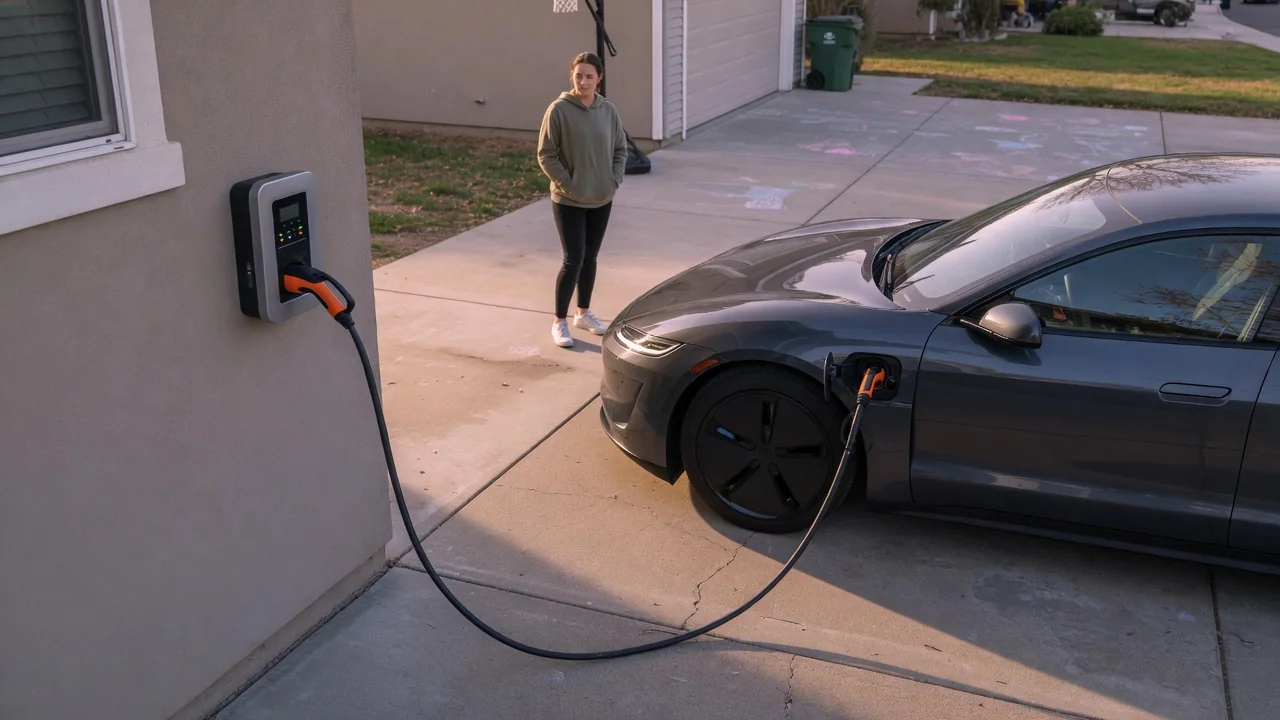
What does charging amperage mean for an EV? In simple terms, it is the rate of electrical current flowing from the supply into the car, measured in amps. That number, combined with voltage, determines how much power reaches the battery and how quickly range is added. Understanding the current limit helps drivers charge efficiently without overloading household wiring.
Amps and volts
Amperage describes how much electrical current moves through the charging cable, while voltage describes the pressure pushing that current. A common comparison is water in a hose: volts are the pressure, amps are the flow rate. Neither figure alone tells you charging speed. Multiply them together and you get watts, the real measure of power delivered. A supply at 240 volts carrying 32 amps, for instance, delivers roughly 7.7 kilowatts before any losses are counted.
That relationship explains why a standard 120-volt household outlet charges so slowly. At 12 amps, it provides only about 1.4 kilowatts, so the same current at double the voltage would deliver twice the power. Drivers can usually see these values on the instrument display, the charging screen, or a phone app, shown as amps, volts, and kilowatts. The exact layout and the level of detail vary by manufacturer, and some vehicles show only power rather than current.
Vehicle setting
Many electric vehicles let the driver set a maximum charging current through the touchscreen or companion app. Lowering that setting tells the onboard charger to draw fewer amps than the equipment offers, which reduces power and lengthens the session. This is useful when plugging into an unfamiliar outlet, sharing a circuit with other appliances, or charging at a location where the wiring quality is uncertain. Some cars remember the chosen limit for a specific location; others reset it each time.
The vehicle also has a ceiling of its own. The onboard charger, which converts alternating current from the wall into direct current for the battery, is built to accept only so much. If that hardware tops out at a lower current than the wall unit can supply, the car simply takes what it can handle, and a bigger charging station brings no extra speed. The acceptance rate differs between models and even trim levels, so the owner's manual or vehicle specifications are the place to confirm it.
Circuit limit
The home circuit sets another boundary. Every circuit is protected by a breaker rated for a certain current, and the wire gauge is matched to that rating. EV charging counts as a continuous load because it runs for hours, so US electrical practice generally limits the draw to 80 percent of the breaker rating. A 50-amp circuit therefore typically supports charging at up to 40 amps, and a 40-amp circuit supports 32 amps.
Charging equipment communicates its available current to the car through a pilot signal in the connector, and the vehicle is not supposed to pull more than advertised. Hardwired wall units are usually configured during installation to match the breaker, while portable units may rely on the plug adapter or a manual selection. Trouble arises when that setting does not match the real circuit. A breaker that trips repeatedly, a warm outlet, or a discolored plug suggests the current is too high for the wiring and deserves an electrician's attention.
Everyday Use and Observations
In daily driving, the lowest limit in the chain always wins. The circuit, the charging equipment, the cable, and the car each have a maximum current, and the session runs at whichever is smallest. That is why the same vehicle may charge briskly at one home and slowly at another. Watching the displayed amperage at the start of a session is a quick way to confirm everything is working as expected, since a lower than usual number points to a setting or supply change.
Current does not always stay constant. Many vehicles taper the amperage as the battery approaches full, and some reduce it in very hot or cold weather to protect the cells. Supply voltage can also sag when other large appliances are running, and certain cars respond by cutting current automatically. For most commuters, overnight charging at moderate amperage easily replaces a day's driving, so maximum current matters mainly for those with long daily mileage or short charging windows.
Limits and Next Steps
These principles apply to alternating current charging at home and at public Level 2 stations. DC fast charging works differently: the station bypasses the onboard charger and feeds the battery directly at much higher voltage and current, with the battery management system dictating the rate throughout. The numbers shown at a fast charger are therefore not comparable with the amperage setting used at home, although the same rule holds that power equals volts multiplied by amps.
Before raising the current limit or buying a higher-output wall unit, it helps to check three things: the car's maximum AC acceptance rate, the rating of the charging equipment, and the capacity of the electrical panel and circuit. A licensed electrician can assess whether the service can support a new dedicated circuit and what permits apply locally. If charging current drops unexpectedly or a warning appears, treat it as a clue to investigate rather than proof that any particular component has failed.