What Does an EV Inverter Do? DC to AC, Motor Control and Cooling
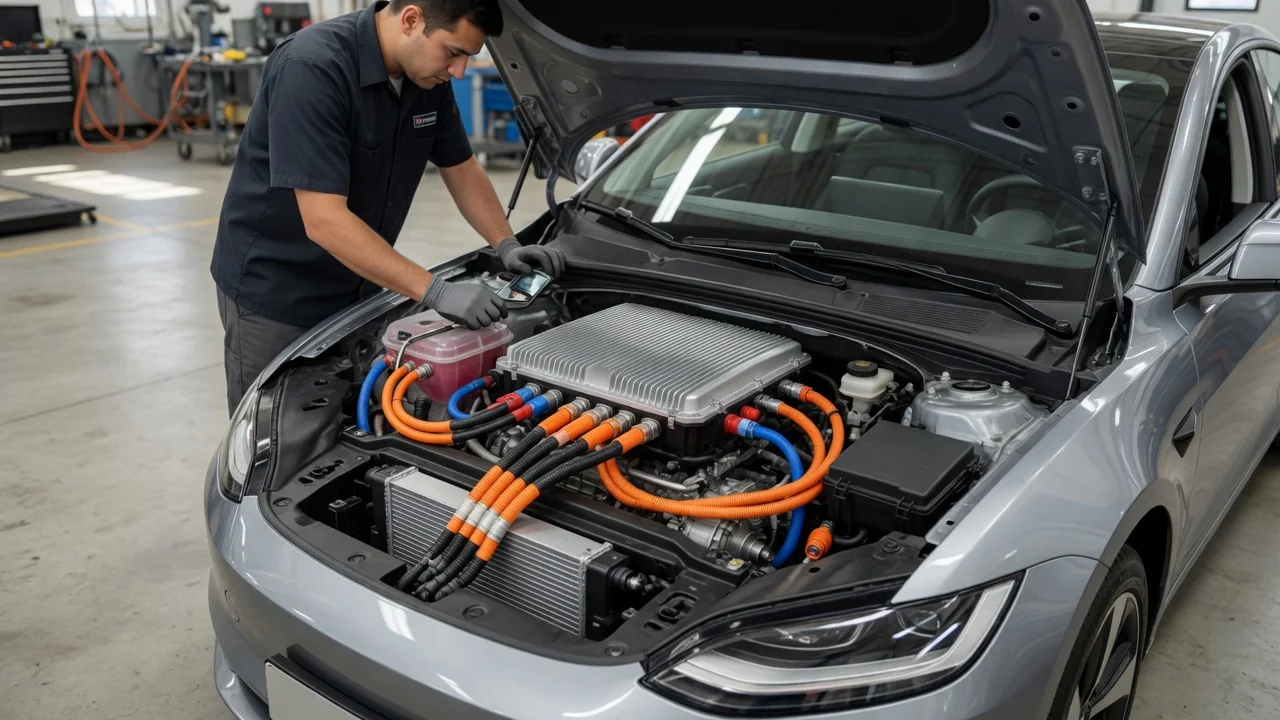
An electric car's battery stores energy as direct current, but most traction motors in modern EVs run on alternating current. The inverter sits between the two, and it does much more than change one kind of electricity into another. It sets how much power reaches the motor, how fast and in which direction the motor turns, and how energy returns to the battery during regenerative braking. This guide explains what an EV inverter does in three parts: conversion, motor control and cooling.
DC to AC Conversion
The battery pack supplies DC, a current that flows in one direction at a voltage that changes only gradually with state of charge and load. Most EV traction motors, including permanent magnet synchronous and induction designs, need three-phase AC instead. That means three alternating currents offset from one another in time, so the magnetic field inside the motor rotates smoothly. Creating that rotating supply from the battery's one-directional current is the inverter's core job.
It does this with power semiconductor switches, usually arranged as three pairs, one pair per motor phase. Common devices are IGBTs and, increasingly, silicon carbide MOSFETs. Each switch turns on and off thousands of times per second. By varying how long each switch stays on within every short switching period, a technique called pulse-width modulation, the inverter makes the average voltage on each phase rise and fall in a pattern that approximates a sine wave. The inductance of the motor windings smooths these pulses, so the current follows a much smoother waveform. A large capacitor on the DC side, often called the DC-link capacitor, steadies the supply against the rapid switching demands.
The process also runs in reverse. During regenerative braking, the motor acts as a generator and produces AC. The same switches, controlled differently, convert that AC back into DC the battery can accept. The traction inverter is therefore a bidirectional power converter rather than a one-way adapter. Charging from a wall outlet or AC station is usually handled by a separate onboard charger, although some designs integrate functions differently.
Motor Control
Converting power is only useful if the output matches what the motor needs at every instant. In an AC motor, the frequency of the supply sets the speed of the rotating magnetic field and therefore the rotor speed, while the size and timing of the phase currents determine torque. The inverter adjusts both continuously. When the driver presses the accelerator, the vehicle's control system turns pedal position into a torque request, and the inverter's control electronics calculate the switching pattern needed to deliver it.
Accurate control depends on feedback. Current sensors measure what flows in each phase, and a rotor position sensor such as a resolver or encoder reports where the rotor is; some designs estimate position from electrical signals instead. Many inverters use field-oriented control, which mathematically separates motor current into a part that produces torque and a part that affects magnetic flux. Controlling the two independently gives precise, responsive torque across a wide speed range. At high speed, the controller can deliberately weaken the effective magnetic field so the motor keeps accelerating even as its back voltage approaches what the battery can supply.
The inverter also handles direction and protection. Reversing the motor is a matter of changing the phase sequence, which is why EVs generally do not need a reverse gear. The control board watches for overcurrent, overvoltage, high temperature and sensor faults, and it can limit output or shut the switches off. It also exchanges data with other modules over the vehicle network, so limits requested by battery management or stability control are carried out through the inverter.
Cooling
No conversion is perfectly efficient. Power semiconductors lose energy in two main ways: conduction losses while current flows through a switch that is on, and switching losses during each transition between on and off. Modern traction inverters are highly efficient, but at high power even a small percentage becomes substantial heat concentrated in small chips. Semiconductor junctions have temperature limits, and repeated heating and cooling cycles stress solder joints and internal bonds over time.
For these reasons, traction inverters are commonly liquid cooled. The switching modules are mounted on a cold plate or heat sink with internal channels through which coolant, typically a water and glycol mixture, circulates. In many vehicles the same loop also serves the motor and other power electronics and rejects heat through a radiator or heat exchanger, sometimes as part of a wider thermal management system. Layouts vary from vehicle to vehicle. Temperature sensors inside the inverter report to the control system so it can track thermal conditions as they change.
When temperatures approach their limits, the controller reduces available power, a strategy called derating, to keep components within safe operating conditions instead of risking damage. Device choice affects this balance as well. Silicon carbide switches generally produce lower losses than silicon IGBTs in many operating conditions, leaving less heat to remove or allowing more power from the same cooling capacity.
Practical Implications and Limits
For owners, the inverter shows up in how the car drives more than in routine maintenance. Strong response from a stop, smooth single-speed acceleration and the feel of one-pedal or regenerative braking all depend heavily on inverter programming. Because much of that behavior lives in control software, an update can sometimes change how power or regen is delivered, though what any update actually changes is up to the manufacturer. The faint high-pitched whine some EVs make under load is often linked to switching frequency and motor magnetics.
Thermal limits explain why repeated hard acceleration, sustained high-speed driving, towing or long climbs in hot weather may bring reduced power. That can be normal protection rather than a defect. A reduced-power message, warning light or loss of propulsion can also point to an inverter, sensor or cooling problem, and only diagnostic trouble codes and the manufacturer's test procedures can tell these causes apart. Coolant level and condition matter, so follow the owner's manual for the correct coolant type and service intervals, which differ between vehicles.
The inverter is a high-voltage component and not a do-it-yourself repair. It connects directly to the battery pack, and its DC-link capacitor can hold a dangerous charge after the car is switched off. Service requires the manufacturer's high-voltage disable procedure, insulated tools and proper training, and on some vehicles repair means replacing the complete inverter assembly. To understand the inverter's role in a particular electric car, including its location and cooling arrangement, consult that vehicle's official service documentation.