What Does a Torque Converter Do?
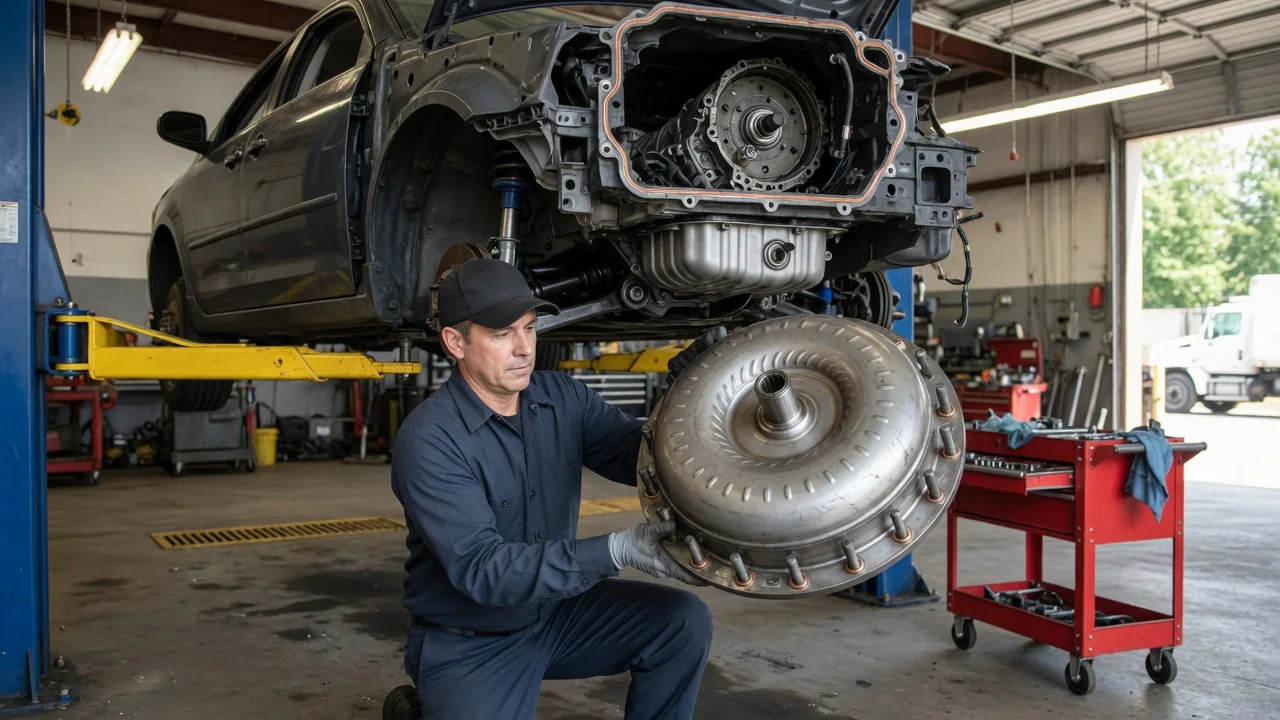
Anyone asking what does a torque converter do is really asking how an automatic transmission stays connected to a running engine without a clutch pedal. The answer is fluid coupling: a sealed, fluid-filled unit between the engine and the gearbox that transfers power through moving transmission fluid, lets the car stop in gear, and multiplies torque when pulling away.
Coupling at idle
The converter bolts to the engine's flexplate, so its outer shell spins whenever the engine runs. Inside, a set of vanes called the impeller, or pump, flings transmission fluid outward and toward a second vaned wheel, the turbine, which is connected to the transmission input shaft. At idle the impeller turns slowly, so the fluid strikes the turbine with little force. That weak push is easily held back by the brakes, which is why the engine keeps running at a stoplight in Drive.
Drivers feel this weak coupling as creep. Release the brake on level ground and most automatic vehicles roll forward gently, because the fluid is still delivering a small amount of torque to the turbine. Shifting from Park into Drive often produces a slight drop in engine speed as the converter takes up load. How strong the creep feels depends on idle speed, converter design, and vehicle weight, and some vehicles reduce the load at a stop through transmission controls, so behavior varies between models.
Acceleration
Press the accelerator and the impeller speeds up well ahead of the turbine. Fluid leaving the turbine would normally return against the impeller's rotation and waste energy, so a third element, the stator, sits between them on a one-way clutch. Its angled blades redirect the returning fluid so it reinforces the impeller instead of opposing it. The result is torque multiplication: for a moment, the transmission receives more twisting force than the engine alone is producing, which helps a heavy vehicle leave a standstill.
This effect is strongest when the difference between impeller and turbine speed is greatest, and it fades as the vehicle gains speed and the two halves approach the same rpm. At that point the stator freewheels and the unit behaves like a simple fluid coupling. From the driver's seat, it shows up as engine speed rising quickly before road speed catches up, a sensation more noticeable in trucks and towing setups. The amount of multiplication and the rpm where it occurs depend on the converter chosen by the manufacturer.
Lockup concept
A fluid coupling always slips a little, because fluid can only transfer power when the impeller turns faster than the turbine. That slip becomes heat and wasted fuel during steady cruising. To solve it, modern converters contain a lockup clutch, a friction disc that presses against the converter cover under hydraulic pressure. When it applies, the engine and transmission input shaft are joined mechanically, the fluid path is bypassed, and nearly all engine power passes straight through.
Lockup is commanded by the transmission control system, typically once the vehicle is cruising under light, steady load, and it releases when the driver brakes or demands strong acceleration. On a vehicle with a tachometer, engagement may appear as a small drop in rpm at constant speed, almost like an extra upshift. Some transmissions lock in several gears or allow controlled partial slip to smooth the transition, while older designs lock only in top gear, so the pattern depends on the vehicle.
Everyday Use and Observations
In daily driving, a healthy converter is mostly invisible. The car creeps smoothly in a parking lot, holds on the brakes without stalling, pulls away without a jolt, and settles to a steady engine speed on the highway. On a hill, the fluid coupling may hold the vehicle briefly or let it roll back slightly, depending on grade and idle torque. Towing or climbing a long grade can keep the clutch unlocked for longer, which sends more heat into the transmission fluid.
Changes in that familiar behavior are worth noting. A shudder during light acceleration at cruising speed, similar to driving over rumble strips, can be associated with the lockup clutch applying unevenly. Engine speed that flares without matching acceleration, a stall when coming to a stop, or unusual whining can also involve the converter. None of these observations is conclusive by itself, since worn fluid, engine misfires, mounts, and internal transmission faults can produce very similar sensations.
Limits and Next Steps
A torque converter cannot be judged reliably from the driver's seat alone. It is a sealed unit, so its internal condition is inferred from fluid condition, scan data such as commanded lockup versus measured slip, and road testing. If a warning light appears, a stored fault code related to converter clutch performance is evidence to interpret, not proof the converter has failed; solenoids, wiring, fluid level, valve body wear, or software can set similar codes, and manufacturer-specific codes need vehicle-specific confirmation.
Sensible next steps start with the owner's manual and the manufacturer's maintenance guidance, since fluid type and service recommendations differ widely and the wrong fluid can affect clutch behavior. Note when a symptom occurs, including speed, temperature, and load, because those details help a technician reproduce it. Because the converter sits between the engine and transmission, replacing it means separating the two, a job suited to a qualified shop. Continuing to drive with heavy slipping or overheating risks spreading damage through the transmission.