What Does a Sway Bar Do?
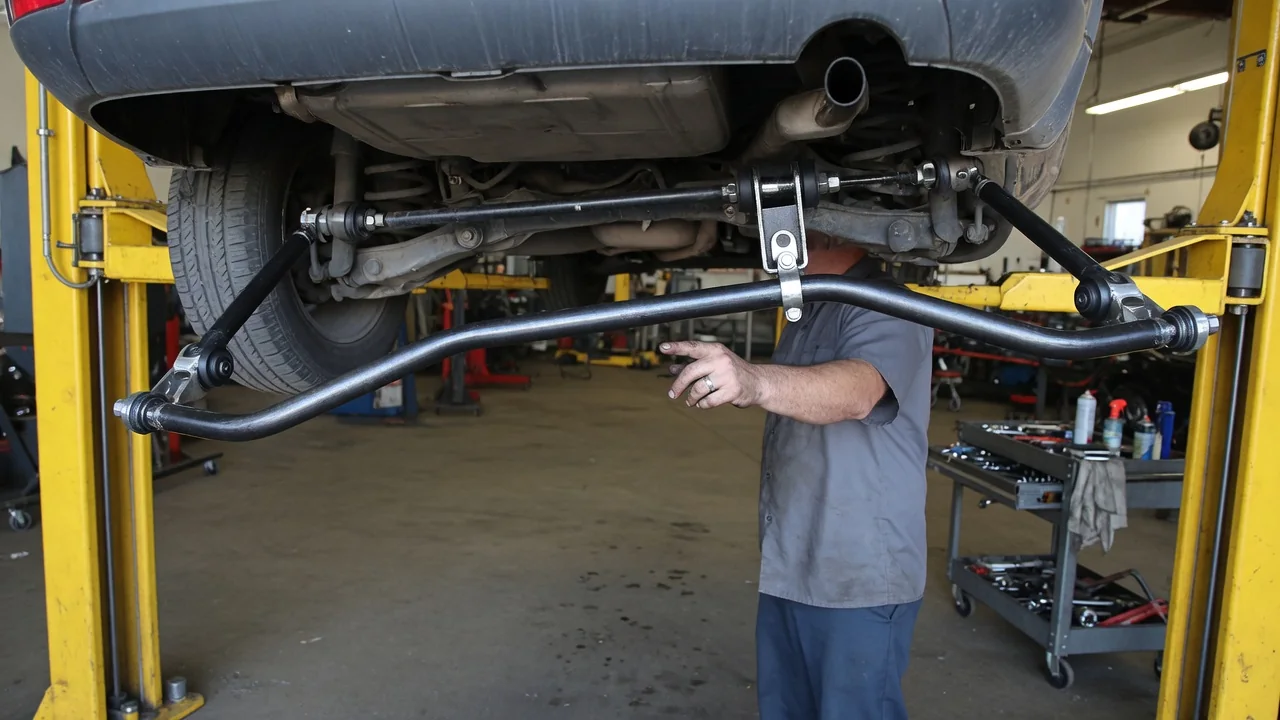
Anyone who has asked what does a sway bar do is really asking why a car stays fairly level through a turn instead of tipping toward the outside. This simple steel bar links the suspension on both sides of an axle and resists body roll. Understanding how it works makes handling changes and suspension noises easier to interpret.
Left-right connection
A sway bar, also called an anti-roll bar or stabilizer bar, is a length of spring steel that runs across the vehicle and ties the left and right suspension together on the same axle. Its center section is held to the frame or subframe by rubber bushings that let it rotate, while each end connects to a control arm or strut through a short link. When both wheels rise together over a speed bump, the bar simply pivots in its bushings and adds almost nothing.
The bar only goes to work when the two sides move differently. If the right wheel compresses while the left extends, the ends are pushed in opposite directions and the steel has to twist, behaving like a torsion spring that resists the difference. Looking under a car, you can usually spot it as a U-shaped rod near the front axle, and many vehicles carry a second one at the rear. Diameter, shape, and mounting points differ widely between a compact sedan, a pickup, and a sports car.
Cornering feel
In a turn, weight shifts toward the outside tires, compressing the outside suspension and letting the inside rise. The bar twists against that motion, borrowing some force from the loaded side to pull the inside of the body down, so the cabin stays flatter. Drivers feel this as less lean on a highway ramp, steadier steering response during a quick lane change, and less of the top-heavy sensation that taller SUVs and trucks can produce.
The bar also shapes handling balance. Stiffening one axle's roll resistance makes that end take on more of the load transfer, which tends to reduce its grip relative to the other end. Engineers use this to tune whether a car pushes wide at the front or rotates more willingly at the rear. That is why a comfort-oriented crossover and a performance coupe can feel so different through the same curve, and why changing bar stiffness changes more than body lean alone.
Link wear
End links are the small rods that join the bar to the suspension, and they live a hard life. Each one has ball-type joints or rubber bushings at its ends that swivel constantly as the wheels move. Over time, protective boots crack, grease escapes, and water and grit get in, leaving play in the joint. The frame bushings that hold the bar's center section can also harden, shrink, or split with age and heat.
Looseness usually announces itself as a clunk, rattle, or knock over small bumps, driveway entrances, or uneven pavement at low speed, often from one corner. A broken link can leave that end of the bar doing nothing, so the vehicle leans more and feels less settled in turns. Similar noises can come from struts, ball joints, or control arm bushings, though, so the sound alone is a clue to investigate rather than confirmation of which part is worn.
Everyday Use and Observations
On a normal commute the bar is working whenever the road asks one side to do something different from the other: curving ramps, roundabouts, crowned roads, crosswind corrections. A healthy system goes unnoticed; the vehicle simply leans a predictable amount and recovers without wallowing. One trade-off drivers may notice is side-to-side head toss over single-wheel bumps or angled driveways, because the bar passes some of one wheel's movement across to the other.
Vehicle type changes the experience. Some off-road-oriented trucks and SUVs offer disconnecting bars so wheels can articulate independently over rocks and ruts, then reconnect for pavement stability. Certain luxury and performance models use active systems that vary roll resistance with motors or hydraulics. Simple visual checks are possible on many cars: with the vehicle parked, cracked rubber, torn boots, or a link hanging loose may be visible behind the wheel, though access and layout vary by design.
Limits and Next Steps
A sway bar manages lean; it does not replace the springs that carry the vehicle's weight or the shock absorbers that control bounce. It cannot make up for worn tires, tired dampers, or poor alignment, and it does not prevent rollover on its own. Fitting a much stiffer bar can sharpen response but may also reduce ride comfort on rough roads and shift handling balance in ways that surprise a driver at the limit, especially in wet conditions.
If new noises or extra lean appear, a hands-on inspection with the suspension properly supported is the sensible next step, since play in links and bushings is often easier to find by feel than by sight. Links are commonly replaced in pairs on an axle so both sides respond evenly, but the right parts and tightening procedure depend on the specific vehicle. Checking the service information for that model, or asking a qualified technician, keeps the diagnosis grounded in the actual hardware.