What Does a Rear Fog Light Do?
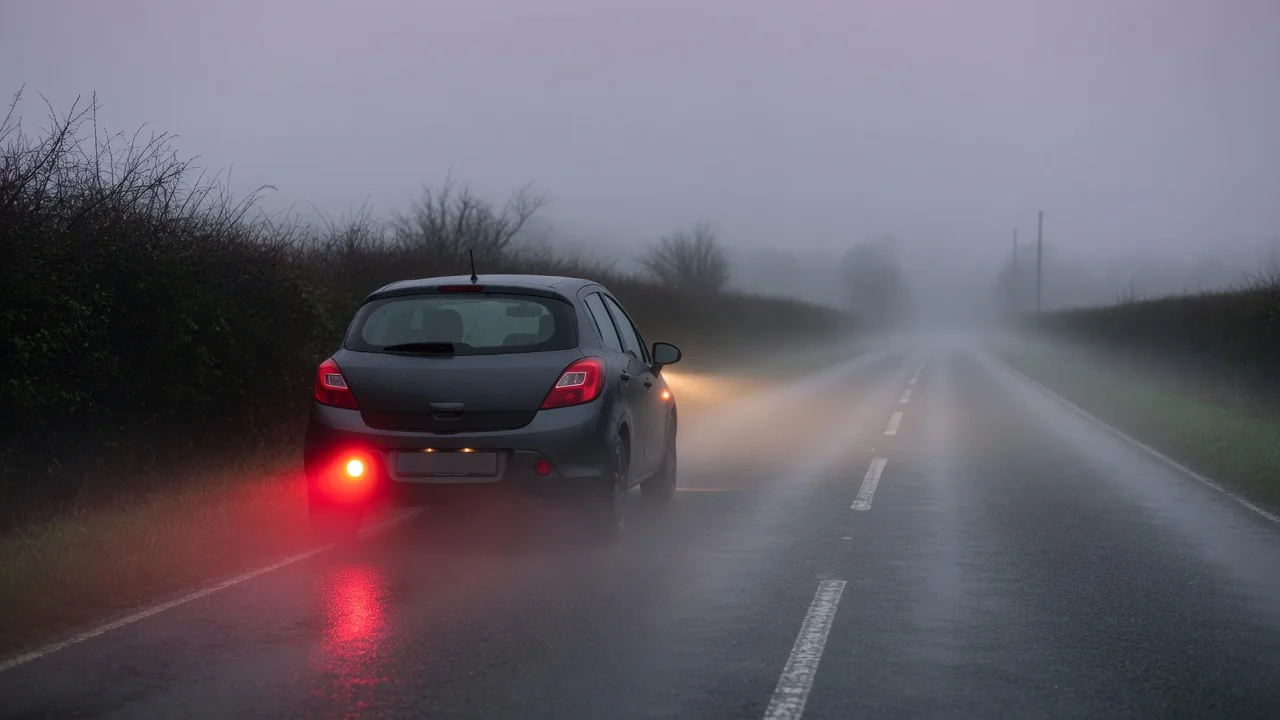
What does a rear fog light do? It is a high-intensity red lamp at the back of a vehicle that makes the car easier to see from behind when fog, heavy spray, or snow swallows ordinary taillights. It does nothing for the driver's own view of the road, and used in clear weather it dazzles following drivers instead of protecting anyone.
Lamp position
A rear fog light sits in the rear lamp cluster or low in the bumper, and its layout differs noticeably between vehicles. Some cars carry a single lamp, often on the driver's side or at the centerline, while others use a matched pair. A single unit is a deliberate design choice rather than a burned-out bulb on the opposite side, and it helps following drivers distinguish the steady fog lamp from the two brake lights that brighten together when the car slows.
On the road, the lamp appears as a steady red light clearly brighter than the taillights, closer in intensity to a brake light. Designers generally keep it separated from the brake lamps so the two signals are not confused. Many vehicles sold in the United States have no rear fog light at all, since the feature is more common on European-market designs, so the owner's manual is the reliable place to confirm whether a particular car is equipped and where the lamp is located.
Conditions for use
The lamp is meant for seriously reduced visibility: dense fog, heavy snowfall, blowing dust, or thick highway spray in which ordinary taillights fade into the gray at a short distance. In those conditions a driver approaching from behind may not perceive a vehicle until dangerously late, and the stronger red output cuts through suspended moisture earlier. A practical test is whether the taillights of vehicles ahead disappear at a modest following distance; if they do, your own probably do as well.
Misuse starts when the condition passes. In light rain, mist, or clear night air, the intense beam glares off wet pavement and into the eyes of following drivers, and it can mask the brake lights so that slowing becomes harder to notice. Once a following vehicle has closed in and can plainly see your car in traffic, the lamp has done its job. Rules on when it may be lit vary by state and country, so local requirements deserve a check.
Indicator recognition
The dashboard tell-tale for a rear fog light is typically amber. The usual symbol shows a lamp shape with straight horizontal lines pointing to the right, crossed by a wavy vertical line representing fog. The front fog light indicator looks similar but is usually green, faces left, and has lines slanting downward. Confusing the two is a common reason drivers leave the rear lamp burning unknowingly, because they assume the lit symbol refers to the front lamps.
The switch varies by manufacturer. It may be a separate button on the dash, a collar on the turn-signal stalk, or a second pull or twist position on the headlight control, and it commonly works only with the headlights or front fog lights already on. Some vehicles cancel the rear fog light whenever the ignition or headlights are turned off, requiring a fresh selection on the next drive, while others retain the setting. The owner's manual shows the exact control and symbol.
Everyday Use and Observations
In daily driving, the most frequent observation is someone else's rear fog light glowing on a clear evening. From behind it looks like a single stuck brake light, or one side shining much brighter than the other, and it stays constant while the car accelerates. Following closely behind it for miles is tiring on the eyes, particularly on wet roads at night, which is exactly why switching it off promptly matters as much as switching it on.
Checking your own car is straightforward. With the vehicle parked and the lamp selected, walk around to the back or look for the reflection in a garage door or shop window; the fog lamp should be visibly stronger than the taillights beside it. Drivers who have just bought a used or imported car, or picked up an unfamiliar rental, sometimes switch it on by accident while hunting for the headlight control, so a glance at the instrument cluster after starting off is worthwhile.
Limits and Next Steps
A rear fog light has firm limits. It does not light the road ahead, it does not shorten stopping distances, and it cannot make up for speed that is too high for the visibility available. Slowing down, lengthening the following gap, and running low-beam headlights remain the core responses to fog. It also is not a substitute for hazard flashers or brake lights, and treating it as a general be-seen lamp in ordinary traffic defeats its purpose.
If the indicator lights but the lamp stays dark, or the lamp will not switch off, the cause may be a bulb, fuse, switch, wiring, or a trailer connection, since some vehicles disable the rear fog light when a trailer is plugged in. A bulb-failure message on the dash is a prompt for diagnosis rather than proof of any single failed part. A qualified technician can test the circuit, and the owner's manual confirms the correct bulb type and vehicle-specific behavior.