What Does a Clicking Sound While Turning Suggest?
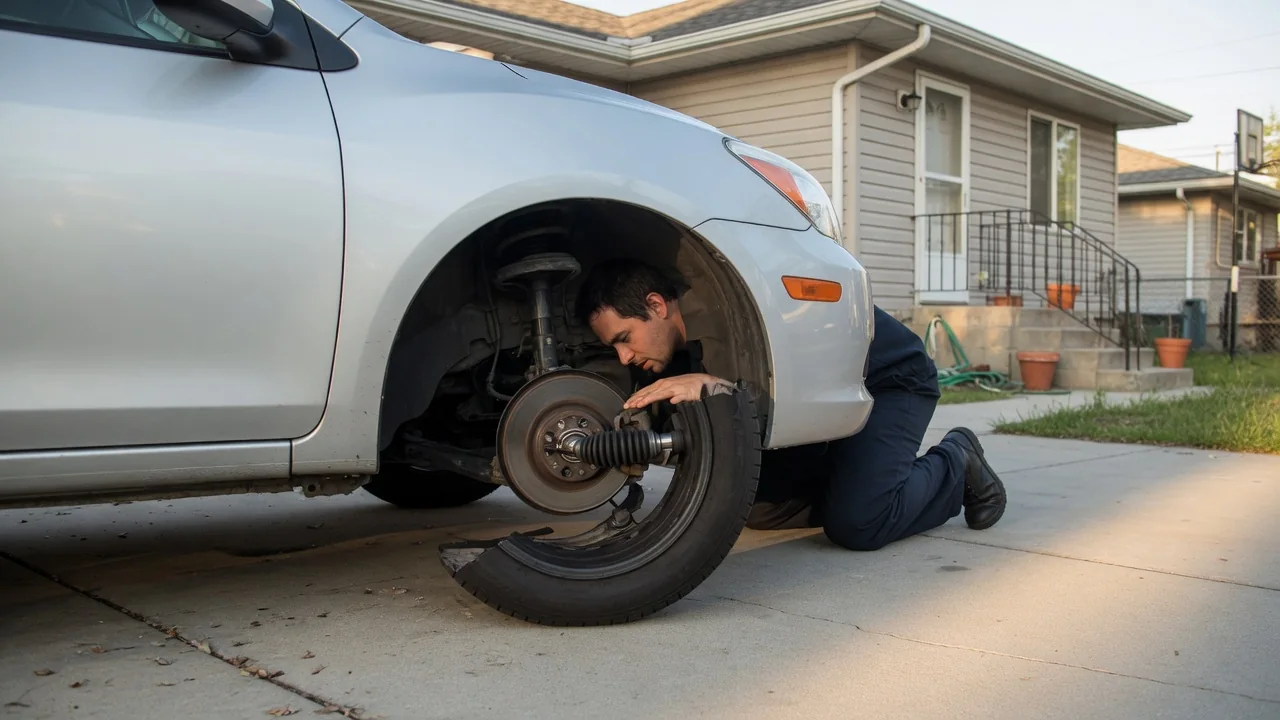
What does a clicking sound while turning suggest? In many front-wheel-drive and all-wheel-drive vehicles, it points attention toward the outer constant velocity joints on the drive axles, but wheel bearings, brake hardware, suspension parts, and even loose trim can produce similar noises. The pattern of the sound, rather than the sound alone, helps narrow the possibilities before anyone inspects the car.
Turning direction
The direction of the turn changes how load and joint angle are distributed across the vehicle. During a left turn, body weight shifts toward the right side, and the outer joints on both drive axles operate at steeper angles than they do when driving straight. A rhythmic click that appears only when steering one way is often associated with the outer CV joint on one side, though which side is implicated is not something the sound alone can settle reliably.
A useful observation is whether the noise appears in both directions or only one, and whether it requires full steering lock or shows up in gentle curves. Clicking limited to tight parking lot maneuvers hints at a joint working near its angular limit, while noise in sweeping highway bends leans more toward bearing or tire-related sources. Rear-wheel-drive vehicles with solid rear axles lack front drive axle joints, so the same symptom there directs attention elsewhere, such as steering stops, suspension mounts, or wheel covers.
Speed relation
How the clicking tracks with road speed is one of the more telling clues. A sound produced by something rotating with the wheel or axle speeds up as the vehicle does, turning from distinct clicks at walking pace into a rapid chatter as speed climbs. A worn outer joint typically behaves this way, and it often becomes louder when power is applied through the turn, because torque forces the internal balls against worn tracks in the joint housing.
A noise that does not follow wheel rotation tells a different story. A single click or pop each time the steering wheel is turned, even with the car barely moving, may relate to a strut mount, ball joint, tie rod end, or sway bar link rather than the axle. A light ticking that matches wheel speed but persists when driving straight could be a stone in the tread, a loose hubcap, or a bent brake dust shield touching the rotor.
Inspection priority
Because several of the possible sources affect steering and drive integrity, the inspection order usually begins with the items that carry the most safety weight. Wheel fasteners come first, since loose lug nuts can click under side load and deserve immediate attention. Next are the rubber boots covering the axle joints. A torn or split boot, often revealed by dark grease flung onto the inside of the wheel or nearby suspension parts, lets lubricant escape and grit enter, which accelerates joint wear.
After the axles, a technician commonly checks wheel bearing play, ball joints, tie rod ends, and strut mounts with the vehicle safely raised, then looks over brake hardware and shields for contact marks. Intact boots do not clear a joint, and a torn boot does not prove the joint has already worn, so the visual findings are weighed alongside the road test. Layouts differ between vehicles, and some all-wheel-drive models have rear axle joints or a center driveshaft that add further candidates.
Everyday Use and Observations
Daily driving offers plenty of chances to gather useful details without tools. An empty parking lot allows slow circles in each direction with the windows down, which makes it easier to judge whether the sound comes from the front or rear, the left or right. Noting whether it changes between gentle acceleration and coasting through the same turn is helpful, since a noise that fades when the throttle is released tends to involve parts that transmit engine torque.
Conditions matter too. Some clicks appear only when the car is cold, after rain, over bumps in a corner, or with a full load of passengers, and each pattern shifts the likely source. A noise that began soon after tire, brake, or suspension work may trace back to that service, such as a wheel cover not fully seated or a clip out of place. Writing down when the sound started and how it has progressed gives a shop far more to work with than a general description.
Limits and Next Steps
Sound is an unreliable witness. Noise travels through the body structure and suspension, so a click that seems to come from the driver's side may originate on the opposite corner, and two different faults can sound nearly identical from the cabin. A clicking joint also rarely sets a warning light or stored fault code, so the absence of dashboard alerts says little about mechanical condition. Any conclusion drawn from listening alone should be treated as a working theory rather than a diagnosis.
The sensible next step is a hands-on inspection by a qualified technician, sooner rather than later if the clicking is growing louder, has been joined by vibration, or occurs alongside looseness in the steering. A severely worn axle joint can eventually fail and leave the vehicle unable to drive, while loose wheel or steering components carry more serious risks. Repair choices, parts design, and service recommendations vary by make and model, so the vehicle's own service information should guide what is done.