What Does a Car Heater Core Do?
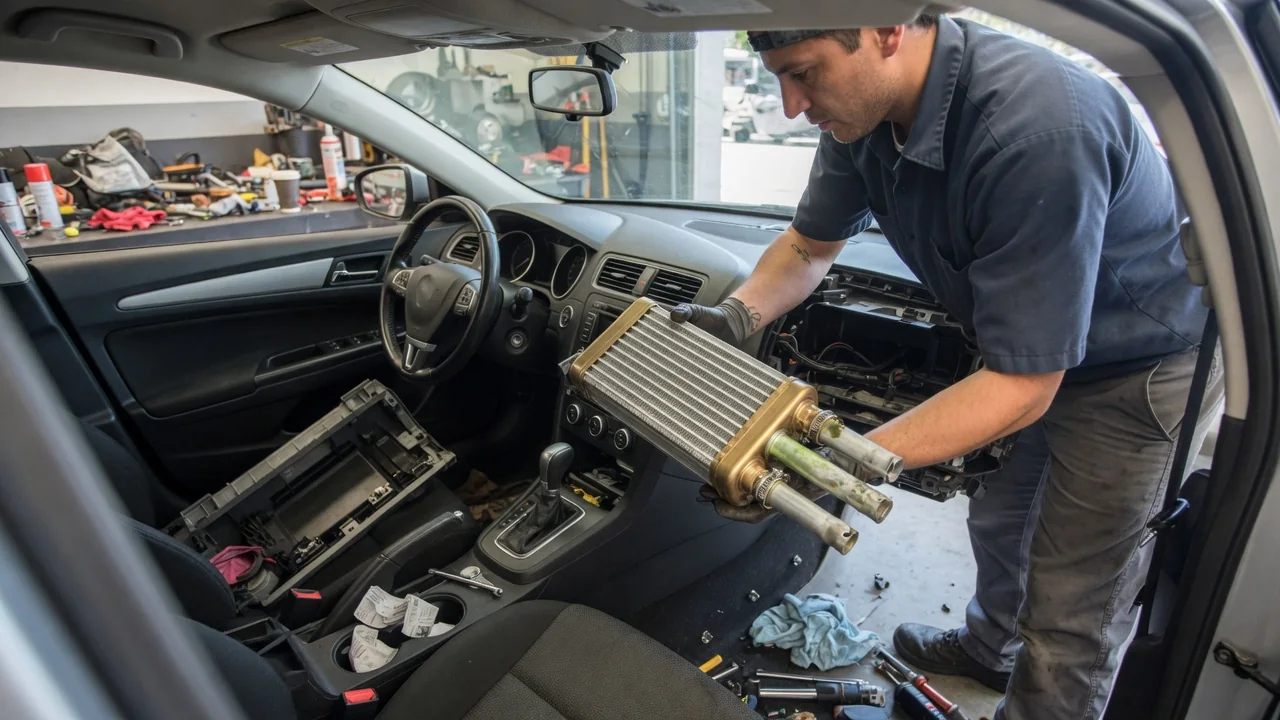
Drivers who ask what does a car heater core do are usually trying to understand where cabin warmth actually comes from. The short answer is that it works as a small radiator behind the dashboard, borrowing heat the engine has already produced and passing it to the air you breathe. Knowing how it works makes heating problems far easier to interpret.
Coolant path
An engine produces far more heat than it can use, and liquid coolant carries that surplus away from the cylinder block and head. The water pump pushes some of this hot coolant through a pair of hoses that pass through the firewall and into the heater core, a compact assembly of thin tubes and fins. After giving up part of its heat there, the coolant returns to the engine circuit and continues around the loop, eventually reaching the radiator at the front of the vehicle.
Layouts differ between manufacturers. Some vehicles send coolant through the heater core whenever the engine runs, while others use a heater control valve to restrict or stop flow when warmth is not requested. Hybrids and electric vehicles may rely on an electric pump, an electric heating element, or a heat pump instead of engine heat alone. Under the hood, the two heater hoses near the firewall are usually visible, and both should feel warm once the engine reaches operating temperature, though care is needed around hot components.
Airflow
Hot coolant alone does not warm the cabin; air has to move across the core to collect the heat. The blower motor draws air from outside or from inside the car, pushes it through the heating and air conditioning housing, and forces it past the heater core fins. The thin metal surfaces transfer heat from the coolant to the passing air in the same way a radiator sheds heat outdoors, except this time the warmth is directed toward the passengers.
Temperature control usually depends on a blend door, a movable flap that decides how much air crosses the heater core and how much bypasses it. Turning the dial toward hot sends more air through the core, while cooler settings mix in unheated air. Other doors steer the flow to the floor, dash vents, or windshield. Dual-zone systems use separate blend doors for each side, which explains why one side of the cabin can sometimes blow warm while the other stays cool.
Leak symptoms
Because the heater core sits inside the cabin side of the vehicle, a leak tends to show itself in ways an engine bay leak does not. A sweet, syrupy smell from the vents is a common clue, since coolant has a distinctive odor when warmed. A greasy film or persistent fog on the inside of the windshield, especially with the defroster running, can come from coolant vapor carried in the airflow and condensing on the cooler glass.
Damp carpet on the passenger side, sometimes with a slippery feel, is another sign worth noting, although a blocked air conditioning drain or a water leak from a door or windshield seal can produce wet flooring too. A coolant reservoir level that keeps dropping without visible drips under the car adds weight to the suspicion. None of these observations proves the core has failed on its own; hoses, clamps, and connections at the firewall can leak nearby and mimic the same symptoms.
Everyday Use and Observations
In normal driving, the heater produces little warmth for the first few minutes because the coolant itself is still cold. As the temperature gauge climbs toward its usual position, vent air warms steadily. Short trips in freezing weather may never give the system time to reach full output, and heat often feels stronger while driving than at idle. That pattern is ordinary, but heat that fades noticeably at idle and returns with engine speed can hint at low coolant or trapped air.
The heater core also supports defrosting, since warm dry air clears the windshield far faster than cold air. Many vehicles run the air conditioning compressor in defrost mode to remove moisture before the heater core reheats the air. Drivers may notice that the engine temperature gauge sits slightly lower with the heater on full, because the core rejects some engine heat into the cabin. It is a modest effect and should never be treated as a substitute for a healthy cooling system.
Limits and Next Steps
Weak or absent cabin heat does not automatically point to the heater core. A thermostat stuck open can keep coolant too cool, low coolant can leave the core partly empty, a failed blend door actuator can route air around it, and a tired blower motor can simply move too little air. A core can also become restricted internally by deposits from neglected or mixed coolant, reducing flow without leaking a drop. Sorting these possibilities apart requires checking each one rather than assuming.
Sensible first steps include checking the coolant level only when the engine is fully cold, watching the temperature gauge, and noting whether both heater hoses warm up. Coolant is toxic and sweet-tasting, so spills should be kept away from children and pets. Reaching the core often involves substantial dashboard disassembly, and the work varies widely by vehicle, so a pressure test and inspection by a qualified technician is the reasonable route. The correct coolant type and maintenance schedule should come from the owner's manual.