What Are One-Touch Power Windows?
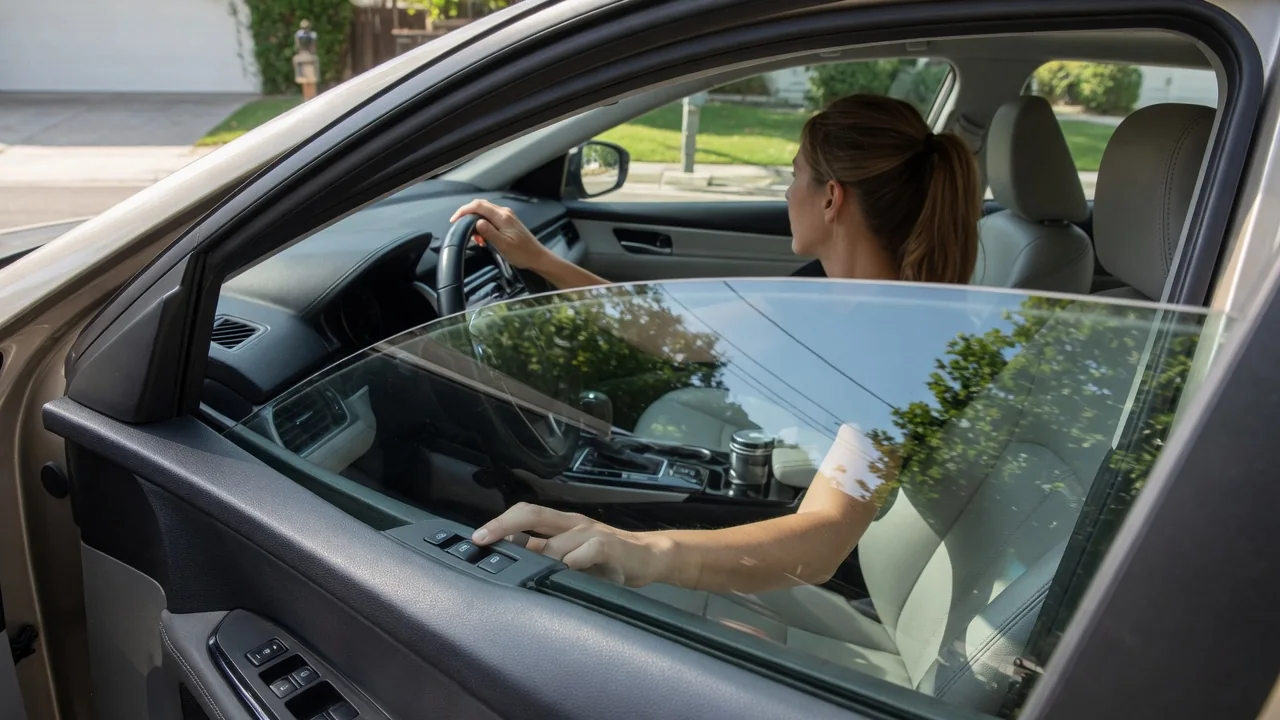
Drivers who ask what are one touch power windows are usually describing a convenience feature: a single firm press or pull of the switch sends the glass all the way down or up without holding the button. Many systems pair that automatic travel with pinch protection, which reverses the glass if something blocks its path.
Switch behavior
A one-touch window switch typically has two stages of travel in each direction. Pressing lightly to the first stage moves the glass only while the switch is held, which is useful for cracking the window an inch for ventilation. Pressing or pulling past a second, firmer detent tells the control electronics to run the motor on their own until the glass reaches the end of its travel. Tapping the switch again during automatic movement usually stops the glass wherever it happens to be.
What a given vehicle offers depends on how it was equipped. Some cars provide automatic down on the driver's window only, others add automatic up, and others extend both functions to every door. The switch itself may carry an auto marking, though not all do. A quick way to learn the layout is to try each switch with the ignition on and note which windows complete their travel after a brief press. The owner's manual describes the exact arrangement for a specific model and trim.
Relearn symptoms
For automatic travel to work, the window control needs to know where the glass is, especially its fully closed position. That knowledge can be lost when power is interrupted, such as after a battery is disconnected or runs flat, or after work on the door. The typical sign is a window that still moves normally while the switch is held but no longer finishes the trip after a single press. Automatic up is often the first function to disappear, because the system will not close unassisted without a known stopping point.
Another clue is a window that climbs to the top, then drops back down partway by itself. This can mean the system is mistaking the top seal for an obstruction because its stored limits no longer match reality. Many vehicles restore the function through a relearn or initialization routine, commonly involving holding the switch at the end of travel, but the steps and timing differ by manufacturer. The correct sequence should come from the owner's manual or service information for that vehicle rather than a general recipe.
Keeping tracks clear
Pinch protection generally works by watching how hard the motor is working or how quickly the glass is moving. If resistance rises sharply before the window reaches the top, the system assumes something is in the way and reverses. That logic cannot tell a hand from a clogged channel. Grit, leaf fragments, ice, or a dried and sticky rubber run can add enough drag to trigger a false reversal, leaving the driver with a window that refuses to stay shut on automatic.
Keeping the glass channels clean helps the feature behave predictably. Wiping the visible rubber runs and the top edge of the glass removes the dirt that builds drag over time, and clearing ice before operating a frozen window avoids straining the motor and regulator. Some manufacturers recommend a specific rubber-safe conditioner for the seals, while unsuitable products can swell rubber or attract more dust, so it is worth checking the vehicle's guidance. Slow, noisy, or uneven movement that persists after cleaning points to a mechanical issue worth inspecting.
Everyday Use and Observations
In daily driving, the benefit is that hands and attention return to the road sooner. A single press at a parking garage ticket machine, toll booth, or drive-through lowers the glass completely, and a single pull closes it while the driver is already steering away. Some vehicles also allow the windows to operate for a short time after the ignition is switched off, or to be opened and closed from the key fob, though these extras vary widely and may be adjustable in the vehicle settings.
Paying attention to normal behavior makes changes easier to spot. A healthy window travels at a steady speed, stops quietly at the top, and sounds the same from one day to the next. Slowing near the top, a tilt in the glass, clicking from inside the door, or an occasional unexpected reversal are all worth noting, along with the conditions when they occur. Cold weather, for example, stiffens seals and can make a marginal window act up on winter mornings while behaving normally in the afternoon.
Limits and Next Steps
Pinch protection reduces risk but does not eliminate it. The system needs to sense a certain amount of resistance before it reacts, and sensitivity can be reduced close to the fully closed position, where the glass must press firmly into the seal. Holding the switch manually may also override the reversal on some vehicles. For those reasons, occupants should still be checked before closing a window, and the rear window lockout is a sensible habit when children or pets are riding in back.
When automatic operation stops working, the sensible order is to start simple. Confirm the window still moves with the switch held, look for obvious debris or ice in the channel, and try the relearn procedure given for that vehicle. If the function does not return, or the window is slow, crooked, or noisy, the cause could lie in the switch, motor, regulator, wiring, or control module, and a stored fault code only indicates where to look. A qualified technician can test those parts before anything is replaced.