What Are Brake Lines and Hoses?
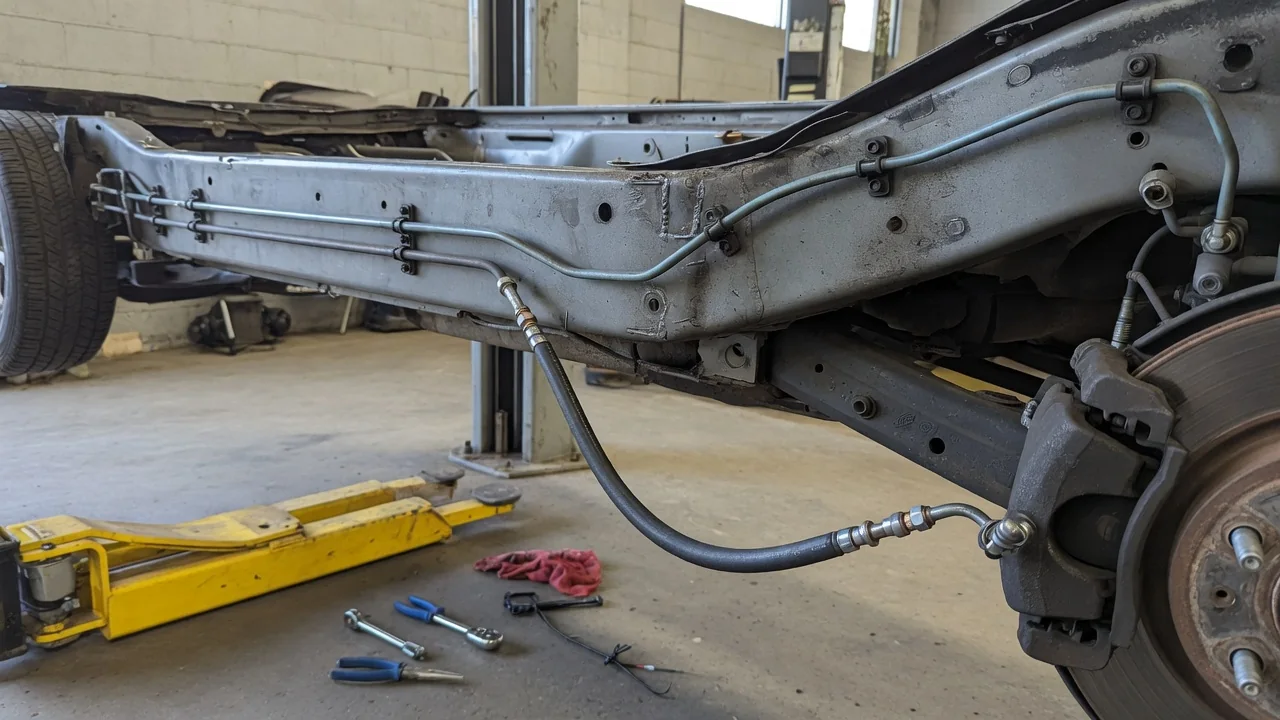
Anyone asking what are brake lines and hoses is really asking how pedal pressure reaches the wheels. Brake lines are rigid metal tubes that carry hydraulic fluid along the body, while brake hoses are flexible reinforced sections that bridge the gap to moving suspension parts. Together they form a sealed path from the master cylinder to each caliper or wheel cylinder.
Where each runs
Rigid brake lines begin at the master cylinder on the firewall, usually pass through an anti-lock brake hydraulic unit, and then travel along the frame rails or underbody toward each wheel. They are bent to follow the vehicle's shape and held by clips so vibration cannot rub them against metal. Because steel tubing barely expands under pressure, it delivers a firm pedal over long distances, which is why manufacturers use it wherever the path stays fixed relative to the body.
Flexible hoses take over where movement begins. At the front wheels, a hose spans from a bracket on the body or strut to the caliper, allowing the wheel to steer and the suspension to travel. At the rear, layouts differ: some vehicles use a hose at each wheel, while others with a solid axle use a single center hose feeding hard lines mounted on the axle itself. Looking behind a wheel with the steering turned usually reveals the hose clearly.
Inspection
A visual check of the rigid lines focuses on corrosion, kinks, and security. Surface rust that looks light brown and dry is common on older vehicles, but flaking, swollen, or scaly sections suggest the tube wall is thinning. Areas where lines pass above the fuel tank, behind plastic shields, or through retaining clips tend to trap moisture and road salt, so damage often hides there. A line that has been flattened by a jack or road debris also deserves professional attention.
Hoses are judged differently because rubber ages rather than rusts. Cracks in the outer cover, bulges or blisters, chafed spots where the hose touches a tire or suspension arm, and dampness near the crimped metal ends are all warning signs. Twisted hoses, sometimes left after other brake work, can be spotted by a spiraling stripe or lettering. Some vehicles use braided stainless covers, which hide the inner hose, so condition is harder to judge by eye alone.
Leak urgency
A hydraulic brake system depends on trapped fluid, so any leak in a line or hose is a safety problem rather than a nuisance. Fluid that escapes cannot transmit pressure, and air that enters compresses instead of pushing. The result can be a pedal that sinks further than usual, feels soft, or in a severe failure travels close to the floor. Modern vehicles split the system into two circuits, which preserves some braking, but stopping distances grow considerably.
Brake fluid is typically clear to amber when fresh and darker with age, with a thin, slightly oily feel that differs from engine oil or coolant. Wet spots on the inside of a wheel, drips along the underbody, or a falling reservoir level all point toward a loss somewhere. A red brake warning light may also appear. In these situations the sensible choice is to stop driving and arrange a tow, because a weakened line can fail completely under a hard stop.
Everyday Use and Observations
In normal driving, healthy lines and hoses are invisible to the driver, and that consistency is the best sign. The pedal should engage at a similar height each time, feel firm, and release cleanly. Changes worth noting include a spongy feel, a pedal that slowly sinks at a stoplight, or a vehicle that pulls to one side under braking. A pull can come from many causes, but a restricted hose is one possibility a technician will consider.
A hose can also deteriorate internally without leaking. When the inner lining breaks down, it may slow fluid returning from the caliper, leaving that brake lightly applied. Drivers sometimes notice one wheel running hotter than the others, a burning smell after a trip, or uneven pad wear. Climate matters too: vehicles in regions that salt winter roads generally see rigid line corrosion sooner, while hot, dry environments tend to be harder on rubber components.
Limits and Next Steps
What an owner can see has limits. Much of the rigid tubing runs above shields, crossmembers, and fuel tanks, and a hose that looks sound outside may be failing inside. Symptoms such as a soft pedal can also come from a master cylinder, caliper, or old fluid rather than the lines themselves. A shop with a lift can examine the full routing and test the system under pressure, which turns a suspicion into a confirmed diagnosis.
Repairs to these parts are best left to trained technicians, since the work involves precise fittings, correct flare types, and removing all air from the system afterward. Replacement materials and routing vary by vehicle, and inspection or fluid service schedules are set by each manufacturer, so the owner's manual is the right reference. Asking for the lines and hoses to be checked during routine brake or tire service is a simple way to catch deterioration before it affects stopping.