What Are Adjustable Control Arms and What Do They Do?
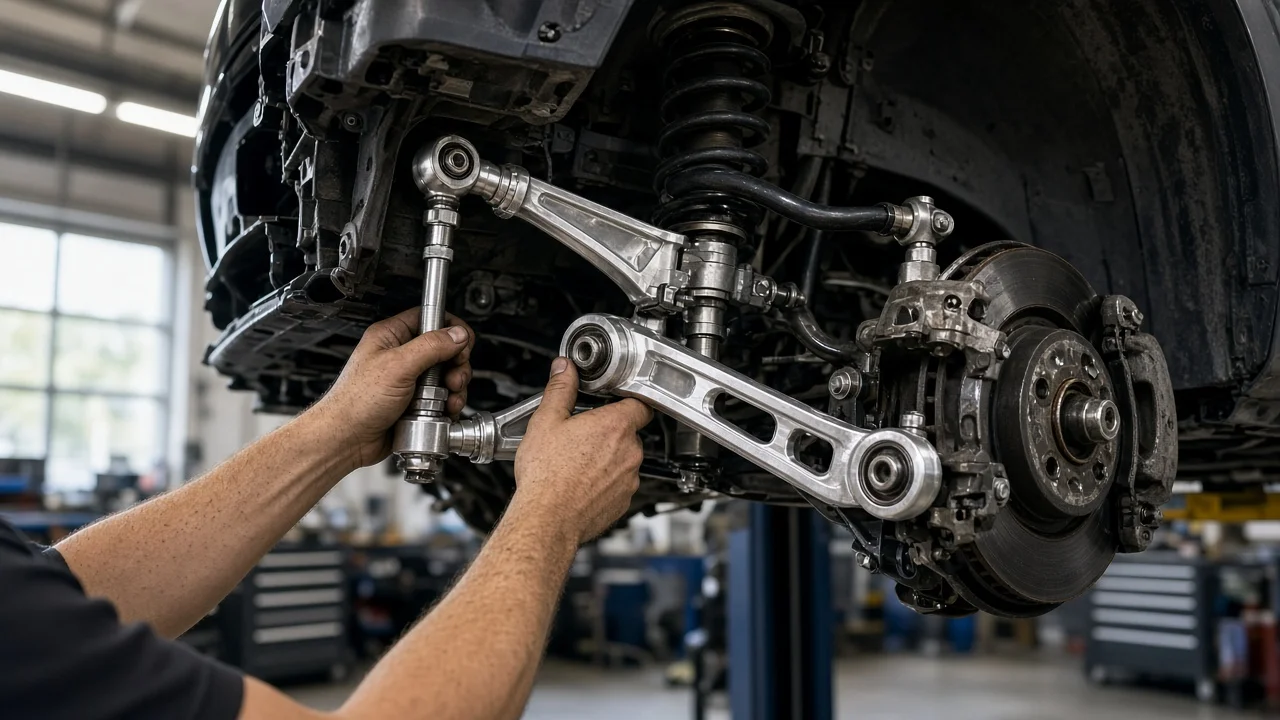
Control arms connect the wheel hub or axle to the frame or subframe and decide where the wheel sits as the suspension moves. Adjustable control arms do the same job, but their effective length or mounting position can be changed. That matters most when ride height has been altered, when the factory adjustment range runs out, or when a solid axle needs repositioning. Here is what they actually change, how they work, and where their usefulness ends.
The Short Answer
Adjustable control arms are replacement suspension arms whose geometry can be set, usually through a threaded section, an eccentric bushing or an offset ball joint mount. Their job is to bring wheel alignment angles back into the manufacturer's specified range, or to a deliberately chosen setting, when the factory parts can no longer get there. Depending on the vehicle and the arm's location, they can correct camber, caster, rear toe on some multi-link designs, or axle position and pinion angle on solid-axle vehicles.
It is just as important to know what they do not do. They do not raise or lower the vehicle, they do not make the ride firmer by themselves, and they do not compensate for worn ball joints, tired bushings or bent parts elsewhere in the suspension. On a stock vehicle with healthy components that already aligns within specification, an adjustable arm usually solves no real problem. They earn their place on lowered or lifted vehicles, on rear suspensions with little or no factory adjustment, and on cars set up for specific handling goals.
How Adjustable Control Arms Work
Every control arm fixes one point of the wheel's knuckle or axle relative to the body. Change where that point sits and the wheel's angle changes with it. In a double wishbone front suspension, moving the upper ball joint outward or inward tilts the top of the wheel, which changes camber. Moving that same point forward or rearward tilts the steering axis, which changes caster. On a rear suspension with separate lateral links, lengthening or shortening one link changes camber or toe. On a solid axle located by trailing arms, lengthening the lower arms moves the axle fore or aft, while changing the upper arms relative to the lowers rotates the axle housing and alters pinion angle.
The adjustment hardware takes a few common forms. Many aftermarket arms use a threaded tube or rod end that is turned to change length and then locked with a jam nut. Others keep a fixed arm but use eccentric cam bolts or offset bushings at the mounting points to shift the arm's pivot. Some upper arms use an adjustable or offset ball joint housing. Whatever the method, changing one angle almost always disturbs another, especially toe, so any adjustment is part of a complete wheel alignment rather than a standalone fix.
What Changes Whether You Need Them
Ride height is the biggest factor. Lowering many independent suspensions pushes camber more negative, while lifting a truck with independent front suspension often moves camber toward positive and reduces caster. Lifting or lowering a solid-axle vehicle can change pinion angle and axle position. Small ride height changes may still fall within the factory adjustment range; larger ones often do not. The exact effect depends on the suspension design, so there is no universal threshold at which adjustable arms become necessary.
Suspension design and use matter too. Some vehicles already provide cam bolts or slotted mounts with generous range, while some rear suspensions offer no camber adjustment at all, making an adjustable arm or an approved adjuster kit the only practical route. The joint type also changes the ownership experience. Rubber bushings isolate noise and vibration, polyurethane is firmer, and spherical rod ends transmit more road noise and typically need more frequent inspection. A daily driver and a track car can reasonably end up with different choices on the same chassis.
What the Owner Can Check and Decide
Start with an alignment printout showing before and after readings. If the technician reports that one or more angles are out of range and the existing adjustment is already at its limit, that is a legitimate reason to consider adjustable arms. Symptoms such as uneven tire wear, a pull or an off-center steering wheel can have many causes, so they point toward an alignment check rather than straight to new parts.
Before buying anything, confirm the existing parts are sound. With the vehicle on proper vehicle support, meaning jack stands at the manufacturer's lift points and never a jack alone, inspect for joint play at the ball joints, cracked or torn bushings, and bent arms or damaged mounting points. Worn components should be replaced first, because adjusting around them hides a problem that will keep changing the alignment.
If you install adjustable arms, follow the model-specific procedure and the fastener specification from the vehicle's service information or the arm maker's instructions rather than guessing. Many bushing bolts must be final-tightened with the suspension loaded at normal ride height so the bushings are not preloaded in a twisted position. Set any adjustable arm to the starting length the manufacturer recommends, have a full alignment performed afterward, and recheck jam nuts and fasteners at whatever interval the arm's instructions call for.
Limitations and Next Step
Correct alignment settings, torque values and arm lengths are specific to each vehicle and setup, so they cannot be generalized. Aftermarket arms can also introduce issues that factory parts avoid: tight clearance to brake lines or wheel speed sensor wiring, ball joint angles that bind at full droop, or rod ends that loosen if not locked properly. Fitment claims should be confirmed for your exact model, drivetrain and ride height.
Seek professional help if you do not have access to alignment equipment, if the vehicle wanders, clunks or pulls after installation, or if any steering or suspension component looks damaged. The practical next step is simple: get current alignment readings, compare them with the factory specification for your vehicle, and decide on adjustable control arms only if the measurements show that the existing adjustment cannot bring the wheels into range.