Westinghouse WGen9500DF Oil Capacity: What to Know Before You Fill
The Short Answer
The Westinghouse WGen9500DF is a dual-fuel portable generator that runs on gasoline or propane. It is powered by a single-cylinder, four-stroke, air-cooled engine. Engines in this size class usually hold roughly a quart of oil in the crankcase. The exact figure for your unit is printed in the owner's manual and often on a label near the oil fill. Treat that published number as a guide only. The dipstick reading is what tells you when the crankcase is correctly filled.
Two qualifications change how you should use the capacity figure. First, the published capacity describes a dry or fully drained engine. A routine oil change leaves some old oil inside, so the refill usually takes a little less than the listed amount. Second, the fuel you burn has no effect on oil capacity. The same engine and crankcase serve both gasoline and propane operation.
Why the Dipstick Matters More Than the Number
Oil capacity means the volume needed to bring the level to the full mark. Several things affect how much you actually pour in:
How completely the old oil drained, and for how long the engine sat with the drain open. Whether the generator was on level ground while draining and refilling. Whether the engine was warm, which lets oil flow out more fully. Residual oil clinging to internal parts after draining.
For these reasons, add oil gradually and check the level as you go. Do not empty a full measured quantity into the fill opening in one go.
How to Check and Fill the Oil
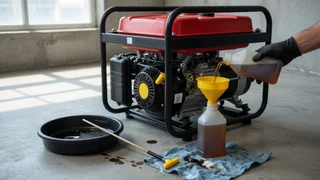
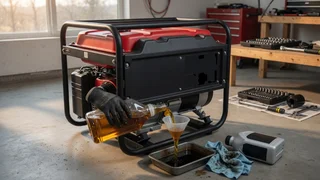
Park the generator on a firm, level surface with the engine off and cool enough to touch safely. Clean around the oil fill cap so dirt cannot fall into the crankcase. Remove the dipstick or fill cap and wipe it clean. Add oil slowly, ideally with a funnel. Reinsert the dipstick and read the level, following the manual's instruction on whether the cap should be threaded in or simply rested in the opening for the reading. Repeat until the level reaches the full mark, then secure the cap.
New generators are commonly shipped without oil in the crankcase, even when a bottle of oil comes in the box. Before the first start, assume the crankcase needs filling and confirm the level on the dipstick.
Overfilling and Underfilling
Running low on oil starves bearings and the cylinder wall of lubrication. In an air-cooled engine it also removes part of the cooling effect. Generators in this category typically include a low-oil shutdown sensor, which stops the engine or prevents starting when the level drops too far. That feature limits damage. It does not replace regular level checks, and a unit that keeps shutting down unexpectedly should be checked for low oil first.
Overfilling causes its own problems. Excess oil can be churned into foam by the crankshaft, which reduces its ability to lubricate. Overfilling can also push oil into the breather and intake system, leading to smoke, a fouled spark plug or an oily air filter. If you overshoot the full mark, drain a small amount and recheck.
Choosing an Oil Grade
Small air-cooled generator engines are generally specified for a multigrade four-stroke oil. SAE 10W-30 is the common choice for typical ambient temperatures. A thinner cold-start grade such as 5W-30 is often recommended where temperatures are low. The owner's manual includes a temperature chart for the WGen9500DF, and that chart is the authority for your climate. Use a detergent oil meeting a current API service category for gasoline engines. Synthetic and conventional oils of the specified viscosity are both generally acceptable unless the manual says otherwise.
Break-In and Change Intervals
New engines shed fine metal particles as internal parts wear in. For that reason, manufacturers of portable generators typically call for an early first oil change after a short break-in period, followed by regular changes at set run-hour intervals. The exact hours for the WGen9500DF are listed in its maintenance schedule. Heavy loads, dusty conditions and hot weather justify changing the oil sooner. A generator that sits unused for long periods should also get periodic oil changes, because oil ages even when the engine is idle.
Does Running on Propane Change Anything?
The amount of oil and the grade stay the same regardless of fuel. Propane burns cleaner than gasoline and tends to leave fewer combustion deposits in the oil. Some owners notice the oil stays visibly cleaner on propane. That does not automatically justify stretching the change interval beyond the manufacturer's schedule, because oil also degrades from heat and run time.
Quick Reference
Topic | Practical guidance; Oil capacity | Roughly a quart class engine; confirm the exact figure in the owner's manual or on the unit label; Filling method | Add gradually on level ground and stop at the full mark on the dipstick; Refill after an oil change | Usually slightly less than the dry capacity; Typical grade | SAE 10W-30 for general use; follow the manual's temperature chart for cold weather; Fuel type effect | None on capacity or grade; gasoline and propane share the same crankcase; First oil change | Early, after the break-in period specified in the manual; Low-oil protection | A shutdown sensor guards against running dry but does not replace routine checks
Bottom Line
For the WGen9500DF, plan on having about a quart of suitable four-stroke oil on hand, and take the exact capacity from the owner's manual. Fill slowly on level ground and let the dipstick decide when to stop. Use the viscosity the manual recommends for your temperatures, and change the oil early after break-in and regularly afterward. These steps matter more to engine life than the precise capacity figure itself.