Water pump leak: signs and the weep hole
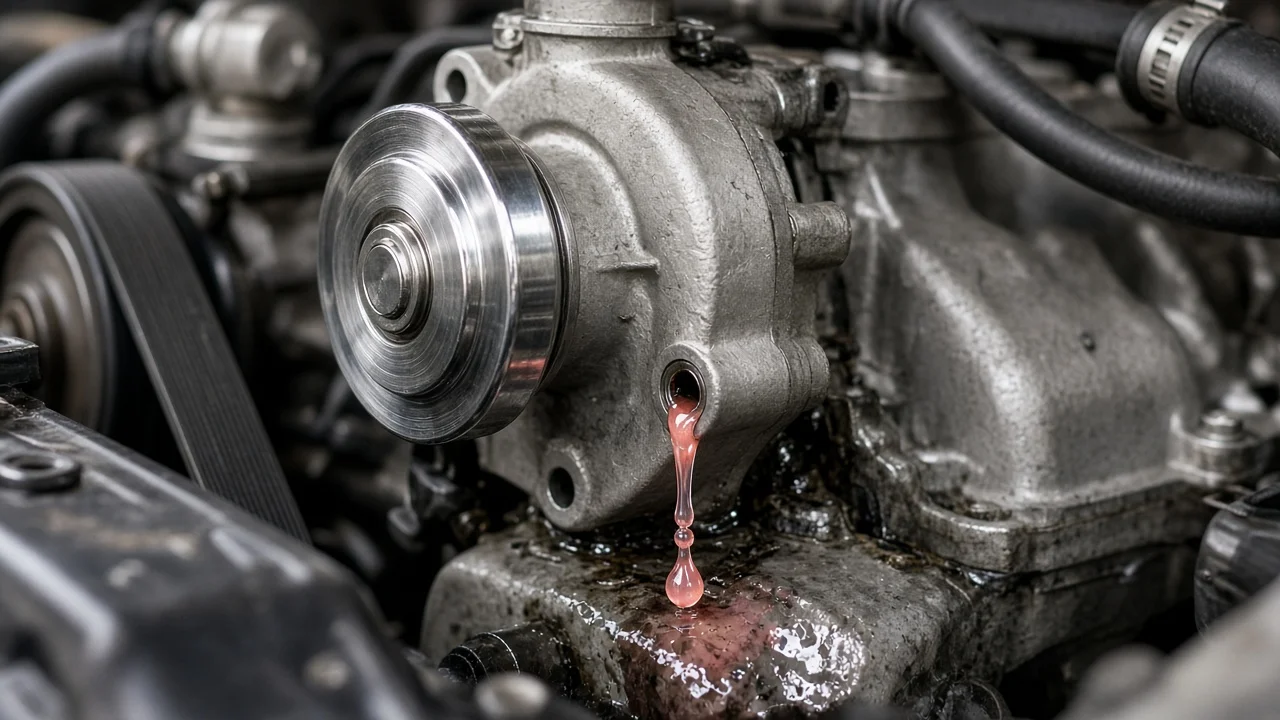
A car water pump leak usually starts small: a faint sweet smell, a crusty trail on the front of the engine, or a coolant level that drops between top-ups. Several parts of the cooling circuit sit close to the pump, so visible wetness does not always mean the pump is at fault. This guide explains how the weep hole works, which observations separate a leaking water pump from nearby faults, which checks are safe for an owner, and when the car should stay parked.
Establish the symptoms
Most engine-driven water pumps have a small weep hole, or drain passage, in the pump body between the shaft seal and the bearing. It lets coolant that gets past a worn seal escape to the outside instead of washing into the bearing. Pump makers' instructions describe how much initial seepage, if any, is acceptable for their design. A steady drip, a wet streak running down the engine, or dried residue that keeps returning means the seal is no longer holding. Residue may be white, green, orange, pink or blue depending on the coolant, and the dried crust is often easier to spot than liquid.
Write down when the leak appears. Coolant that escapes only while the engine runs points toward a seal or gasket weakening under pressure and flow. If the water pump leaks when the car is off, for example after it sits overnight, a gasket or hose joint may be seeping as metal contracts and pressure settles. Note where drops form under the car, how quickly the reservoir level falls, whether the temperature gauge rises, and whether there is steam or a sweet smell from the vents. Record recent work such as a belt change, coolant service or a new pump. Also listen for grinding or whining from the front of the engine that changes with engine speed; a failing bearing often follows a seal leak.
Distinguish plausible causes
Within the pump itself, the two common sources are a worn shaft seal, which shows up at the weep hole, and a failed gasket or O-ring between the pump and the engine, which leaves wetness at the mounting edge instead. What causes a car water pump to leak in the first place is often ordinary wear, but contamination, mixed or degraded coolant, running the system low, overheating and incorrect belt tension can shorten seal life. A corroded or cracked pump body can also weep from the casting.
Nearby parts can leave a very similar trail. A loose or cracked hose at the pump inlet or outlet, a thermostat housing gasket, a radiator or its hose ends, a heater hose, or coolant pushed out past a weak pressure cap can all drip onto the pump area and down to the same spot under the car. Coolant runs downhill and is blown back by the fan and airflow, so the lowest wet point is rarely the source. Observations that support the pump: residue starting at the weep hole or pump flange, dry hoses and clamps above it, and bearing noise or shaft play. Observations that weaken it: a wet connection higher up, a crust beginning at the thermostat housing, or a clean, dry weep hole. Where the pump sits behind a timing cover, the only sign may be residue at the bottom of that cover.
If the level drops with no external trace at all, look beyond the pump. Internal losses, such as a head gasket problem or a heater core leak, produce different signs like white exhaust vapor, misting windows or a damp footwell, and need a technician's diagnosis.
Checks in a useful order
Start with the engine off and fully cooled, on level ground. Never open the radiator or reservoir cap on a hot pressurized cooling system; hot coolant can spray out and cause serious burns. With the engine cold, compare the reservoir level with its marks, then use a flashlight to inspect the pump body, weep hole, mounting edge, hoses, clamps, thermostat housing and radiator. Squeeze the hoses gently for softness, swelling or cracks, and check whether the drive belt is wet, which can cause slipping and noise. Place clean cardboard under the engine overnight to see where drops land and what color they are.
Some tests need tools, specifications or a qualified technician: a cooling system pressure test with the correct adapter to make a leak appear while cold, a pressure cap test, UV dye with a lamp, a check of pump shaft play with the belt removed, and a combustion gas test for suspected internal leaks. Belt removal, especially on engines where the timing belt drives the pump, must follow the manufacturer's procedure. If you top up in the meantime, use coolant that meets the coolant specification in the owner's manual at the correct coolant concentration. Color alone does not establish compatibility, so match the label to the stated requirement rather than matching a shade.
Interpret the findings
Fresh coolant or a growing crust at the weep hole, with dry connections above it, points to a failed shaft seal. That seal is not normally serviced on its own, so the usual repair is a new pump. Wetness only at the pump flange suggests the gasket or O-ring, which still generally means removing the pump; a technician may recommend replacing the pump at the same time depending on its age and condition. Shaft play or bearing noise shows the pump is worn regardless of how much it leaks.
A pressure test that reproduces the leak at a hose, the thermostat housing or the radiator moves the diagnosis away from the pump, even if residue has collected on the pump body. A pressure cap that fails its test can explain coolant lost through the overflow without any component leak. If nothing leaks externally under pressure but the level keeps falling, an internal leak remains unconfirmed until it is tested. Before replacing parts, clean off old residue and confirm the source with the system pressurized. After any repair, the system needs correct filling and bleeding to remove air pockets, since trapped air can cause overheating and misleading gauge readings.
Urgency and next action
Stop driving and arrange a tow if the temperature gauge climbs toward hot, a warning light comes on, steam appears, coolant runs out in a stream rather than drips, the reservoir empties quickly, or grinding comes from the pump area. Overheating can damage the engine, and a pump with a failing bearing can harm the drive belt; where the timing belt drives the pump, a seizing pump can damage that belt. A slow seep with a stable level and normal temperature is less urgent, but there is no reliable way to predict how long it will stay slow, so plan the repair instead of relying on repeated top-ups.
For the repair visit, bring your notes: when the leak appears, how much coolant you added and how often, where the drops land and their color, temperature behavior, noises and recent service work. Have the make, model, year, engine and VIN ready so the shop can identify the correct pump, gasket and coolant specification. Ask whether your engine uses an accessory-belt, timing-belt or electric pump, because that changes the labor involved and which related parts, such as the thermostat or timing components, are sensible to replace at the same time.