Oil Pressure Control Valve Activation: Line Disconnection and Static Diagnosis (VW)
What the oil pressure control valve does
On many Volkswagen engines, the oil pressure control valve is an electrically operated solenoid that changes the target oil pressure. In normal operation, it allows the engine control module to switch between a lower pressure map under light load and a higher pressure map under heavy load or high oil temperature. The valve does not create pressure itself; it regulates a hydraulic pilot circuit that moves a mechanical pressure regulator or pump displacement mechanism.
Direct answer and scope
The essential answer is that a recorded fault such as "Oil pressure control valve activation: line disconnection" or "static" points to a plausibility problem between the engine control unit, the valve solenoid circuit, and the actual oil pressure behavior. It is usually a circuit or wiring fault, a failed solenoid, or a mechanical oil pressure regulation issue, rather than a simple software flag. The exact meaning depends on the generation and engine family. On later EA888 and some diesel engines, the fault can be evaluated only by combining scan tool data, wiring checks, and mechanical oil pressure measurements.
Line disconnection vs. static activation
A "line disconnection" diagnostic typically describes an electrical open circuit at the control valve, interruption of the wiring, or a valve that draws no measurable current when activated. A "static" activation fault generally means the control unit attempted a valve state change but saw no plausible response from oil pressure or the feedback circuit. Separating the two is important: a disconnection code suggests checking continuity and coil resistance first, while a static code requires confirming mechanical oil pressure behavior after the electrical circuit has been verified.
Common affected VW applications
These faults are most often associated with engines that use a switchable or demand-controlled oil pump, including later 1.8 TSI and 2.0 TSI EA888 variants with adjustable oil pressure, some 1.4 TSI engines, and certain TDI installations. The valve location and connector style vary by engine code and market. For example, on a 2.0 TSI engine the valve may be mounted near the oil filter housing or oil pump, while on a 1.4 TSI it can be integrated near the sump or pump assembly. Model year, engine code, and market-specific emissions calibration affect both the part and the diagnostic label.
Diagnostic sequence
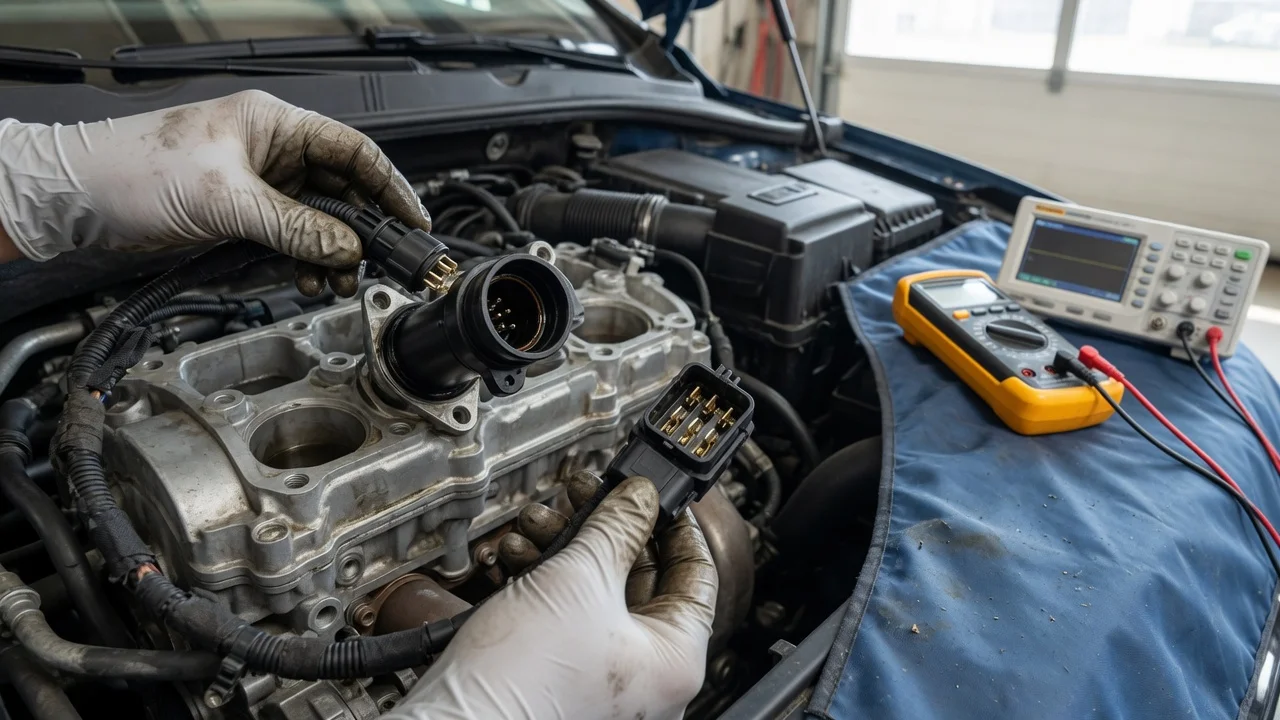
Read all stored engine and oil pressure faults with a compatible scan tool, noting freeze-frame data for engine speed, oil temperature, and load. Check the control valve electrical connector for terminal corrosion, spread pins, or damaged wiring. Pay attention to any wiring routed near heat shields or the oil filter housing. Measure coil resistance across the valve terminals. Compare the reading to the specified range for the engine variant; an open or shorted solenoid must be replaced. Use the scan tool output test for the oil pressure control valve, listening or feeling for a distinct click. No click does not prove a mechanical failure if circuit power or ground is missing. If the electrical side is intact, measure actual oil pressure with a mechanical gauge at the specified engine speeds and temperatures. Compare the readings to the workshop specification for both the low-pressure and high-pressure maps. Inspect the oil pressure regulation mechanism for sticking or debris if measured pressure does not follow the requested state.
How to interpret the static condition
A static fault does not automatically mean the valve is defective. The term "static" in Volkswagen diagnostic text often means the condition is present under non-dynamic or fixed test conditions, or that the control unit sees a constant implausible state. For example, the valve may be commanded to a high-pressure position, but oil pressure remains at the low-pressure target. In that case the fault is static in effect because the pressure response is absent, but the root cause can be electrical, hydraulic, or mechanical.
Practical ownership guidance
A vehicle with an active oil pressure control valve fault should not be driven hard until the cause is known. If the system defaults to low oil pressure when high pressure is needed, accelerated bearing wear can occur under load. If it defaults to high pressure, fuel consumption may increase, but the short-term risk to the engine is usually lower. The next action is to scan for the exact fault number and freeze-frame data, then check the connector and coil resistance before replacing the valve. A careful diagnosis avoids replacing a functioning valve while leaving a damaged harness or a sticking pressure regulator in place.
Documented limits and evidence gaps
Specific resistance values, oil pressure targets, and valve part numbers are engine-code and model-year dependent. This guide does not provide a universal specification because no single value applies across all affected VW engines. Where a workshop manual or technical bulletin exists for the exact engine code, it should be used for the required measurements. Without those references, coil resistance should be treated as a continuity and short-circuit check rather than a precise tolerance test.
Typical scan tool behavior
Oil pressure control valve activation: line disconnection; Status: static; Engine speed: 840 rpm; Oil temperature: 87 °C; Oil pressure switch: not plausible; Diagnostic note: The control module detected no valve circuit current draw; while deactivation was requested.
The example above is a simplified representation of how such a fault may appear. The exact text, status, and available measuring values vary depending on the diagnostic interface and engine control unit software version.