VW GTI PCV Valve: MK5, MK6 and MK7 Symptoms and Replacement
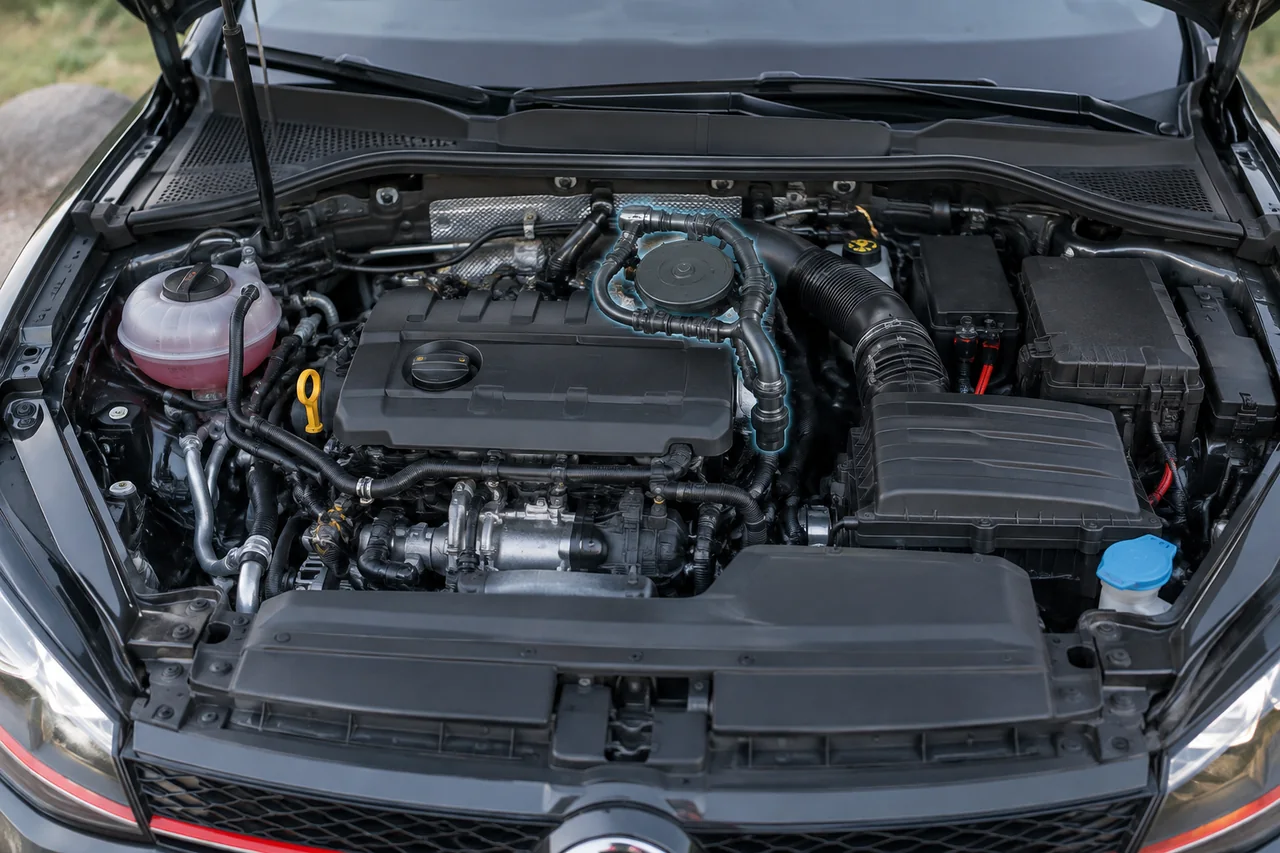
A turbocharged Volkswagen GTI relies on positive crankcase ventilation to manage blow-by, regulate crankcase pressure, and separate oil mist before gases return to the intake. The GTI MK6 PCV valve draws attention because MK5, MK6, and MK7 turbo engines share related failure patterns, yet assemblies, hose routing, and revisions differ. Symptoms, safe checks, and replacement planning treat any one noise or leak as evidence to interpret, not as proof the PCV valve itself has failed.
What the PCV System Does in a Turbocharged GTI
In a turbocharged GTI, positive crankcase ventilation collects blow-by gases that leak past the piston rings and routes them back into the intake so they can be burned. An oil separator, often built into the PCV assembly, knocks liquid oil out of that stream so less mist reaches the intake. A diaphragm or similar regulator tries to keep crankcase pressure in a controlled range. Not every GTI uses the same assembly, so the housing, separator, and hose layout must be identified from vehicle-specific information rather than assumed from generation alone.
Intake vacuum and boost both matter because the same ventilation path sees strong suction at idle and positive pressure when the turbo is working. A torn diaphragm or leaking PCV assembly can pull extra air into the intake under vacuum, or allow crankcase gases and oil to escape under boost. Rough idle, whistling, or oil leaks may follow, but those signs also appear with other intake, ignition, and sealing problems. A GTI PCV valve concern is a reason to inspect the ventilation system, not a conclusion that the assembly has already failed.
MK5 GTI: Confirm the Engine Before Identifying the PCV Assembly
MKV and MK5 describe the same GTI generation, so an MKV GTI PCV valve and a PCV valve on an MK5 GTI belong to the same family of cars. That still does not identify the installed engine. Before naming a PCV assembly or a procedure, confirm the VIN, the engine code, and market-specific vehicle information, because similar-looking GTIs can carry different turbo engines and different ventilation hardware. Service information tied to those details is what identifies which housing, separator, and hose set belong on that car.
An engine-specific diagram helps locate the PCV assembly and the ventilation hoses that connect it to the valve cover, intake, and related fittings. With the engine off and cool, look for cracked, collapsed, or disconnected hoses and for oil residue around joints, but those observations have limits. Residue may be old, a hose may look intact while a diaphragm has torn internally, and oil on the exterior does not prove the assembly is the source. Visible damage is useful evidence to record, not a substitute for confirming the correct part and the whole ventilation path.
MK6 GTI: Symptoms That Warrant a PCV Inspection
On an MK6 GTI, inspecting the PCV valve and related ventilation hardware is warranted when rough idle, an unusual whistling noise, oil leaks, or a rise in oil consumption appear. Extra unmetered air through a failed PCV assembly can unsettle idle, while a torn diaphragm may whistle under vacuum. Excess crankcase pressure can push oil past seals, and a weak oil separator can send more mist into the intake. Those complaints are common reasons to look at the MK6 GTI PCV valve, yet they remain clues rather than a completed diagnosis.
Record when the behavior appears, including cold starts, fully warm idle, and ordinary driving, because a PCV-related idle problem may show most clearly at light load while oil push-out or consumption may show after boosted running. Intake leaks, ignition faults, and other engine problems can produce overlapping symptoms, so a whistling noise or rough idle is not unique to the PCV valve on a GTI MK6. Before attributing the issue to a particular component, verify the assembly and hose routing for that engine. MK6 GTI PCV valve replacement should follow that confirmation rather than the first matching complaint.
MK7 GTI: Safe Checks and Professional Diagnosis
An MK7 GTI PCV valve concern starts with identifying the installed assembly from the VIN, engine code, and matching service information, because later turbo GTI layouts still vary by engine and revision. With the engine off and cool, inspect only what is safely accessible: disconnected ventilation hoses, damaged connectors, and fresh oil residue around the PCV assembly and nearby joints. Do not pull running-engine hoses or improvise a pressure test. Inspection of the PCV valve on an MK7 GTI is useful when those visual findings are recorded alongside the conditions that produced the original complaint.
Oil-cap suction, ventilation noises, and stored fault codes are clues that need interpretation, not independent proof that the PCV valve has failed. Manufacturer-dependent codes can point at mixture, misfire, or pressure-related conditions that several parts can cause, so they require vehicle-specific confirmation. When those clues remain after a visual check, professional crankcase-pressure measurement and controlled leak testing are the next step. Stop driving safely if an oil-pressure warning appears, a severe misfire develops, or substantial oil is actively leaking, then have the car assessed rather than continuing to hunt for a PCV cause on the roadside.
Planning PCV Replacement on an MK6 or MK7 GTI
PCV replacement on an MK6 or MK7 GTI should follow a supported diagnosis and an inspection of associated hoses, seals, and connections, not a swap based only on idle or oil complaints. Confirm the replacement assembly and any applicable revision through VIN and engine-specific fitment information, because a PCV valve for an MK6 GTI is not automatically the same as hardware used for MK7 GTI PCV valve replacement. The wrong assembly can leave ventilation hoses misaligned or a regulator that does not match that engine's ventilation design. Match the part to the car before ordering.
The service scope is to replace the confirmed faulty assembly, renew the seals specified for that job, and repair damaged ventilation hoses and connectors found during inspection. Fastener requirements, tightening specifications, and installation sequence must come from the applicable service information for that engine; guessing torque or hose routing can create new leaks. Cost is driven by diagnostic labor, which assembly is required, whether related hoses and seals are renewed, and any oil-related damage already present. Those factors vary by shop and vehicle, so plan around the confirmed parts list rather than a single advertised valve price.
Confirming the Repair and Handling Persistent Symptoms
After service, check idle quality and unusual ventilation noises under the same conditions that previously produced symptoms, including a cold start and a fully warm idle. Improvement supports the diagnosis, but a quieter idle alone does not prove every related hose and seal is sound. Inspect for fresh leakage around the PCV assembly and connections once the engine has been run and then cooled, and monitor oil level using the procedure in the owner's manual. Rising consumption or new wetness at joints means the repair is incomplete or another leak path is still open.
When testing is warranted, a shop can confirm that crankcase pressure is within the specification that applies to that engine, using the relevant service information rather than an improvised check. Continuing oil consumption, returning oil leaks, or the same fault codes after a PCV valve GTI replacement mean further diagnosis is required. Turbo seals, other intake leaks, ignition problems, and remaining hose damage can mimic a failed PCV assembly. Repeating the same replacement without new evidence wastes the prior work and can miss the condition still driving crankcase pressure or oil control out of range.